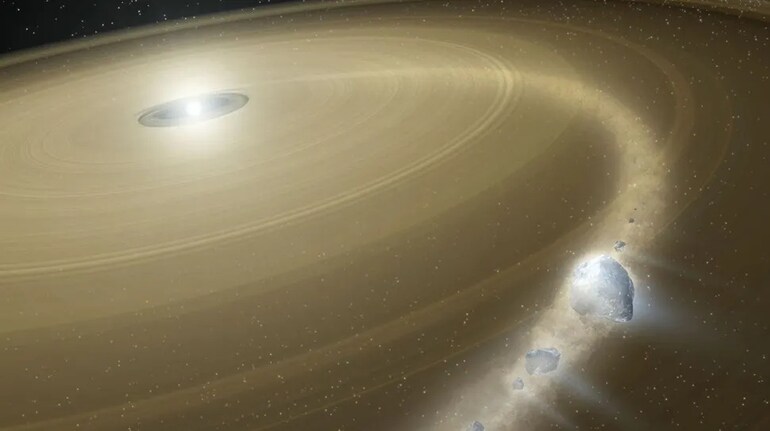
Imagine an old star, once much like our Sun, reaching the end of its life. White dwarf star has become a cosmic remnant with gravity so strong it can rip apart anything that drifts too close. Recently, astronomers using the Hubble Space Telescope caught this star in the act of “feeding” on the remains of a frozen, Pluto-like world about 260 light-years away.
Hubble’s Stunning Discovery
The Hubble Telescope watched this dramatic event unfold. The target was a world 260 light-years away. Scientists used Hubble to study ultraviolet light there. In the light, chemical signatures came into view. These revealed what the shattered world once contained.
Water and Icy Elements
Much of the world was made of ice. Nearly two-thirds of it was just water. Other substances included nitrogen, oxygen and sulphur. These are also found in comets and distant bodies. In many ways, this scene is a window into our own future. Billions of years from now, the Sun will follow the same path.
When it becomes a white dwarf, it may consume the icy objects at the edges of our Solar System, perhaps even Pluto itself. Watching this event unfold in another star system is like watching a glimpse of tomorrow for us.
Next Step for Science
Scientists are not finished with this story yet. They want to use the James Webb Telescope soon. Webb looks in infrared and will show even more. The goal is to study the star and debris. By piecing together these cosmic clues, scientists hope to better understand how planetary systems evolve and what becomes of their precious stores of water.
Discover the latest Business News, Sensex, and Nifty updates. Obtain Personal Finance insights, tax queries, and expert opinions on Moneycontrol or download the Moneycontrol App to stay updated!
Find the best of Al News in one place, specially curated for you every weekend.
Stay on top of the latest tech trends and biggest startup news.