






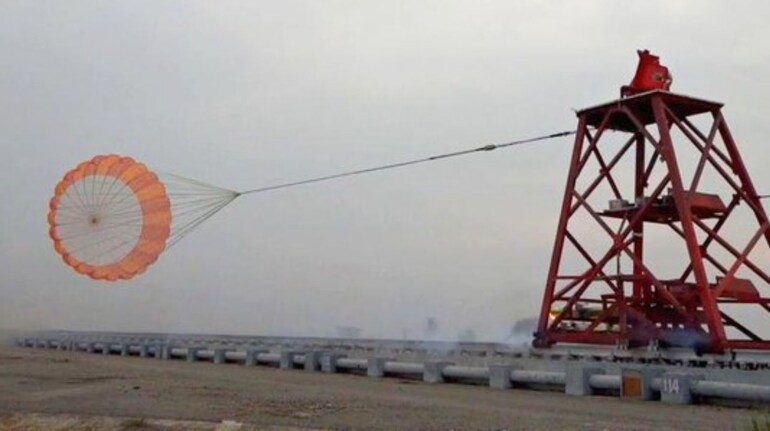

India has successfully completed the Qualification Level Load Test of the drogue parachute designed for the Gaganyaan programme. The high-intensity test was conducted at the Rail Track Rocket Sled (RTRS) facility of the Terminal Ballistic Research Laboratory (TBRL) under the Defence Research and Development Organisation (DRDO).
This is not just another routine test. It is a vital step in ensuring that Indian astronauts return safely to Earth. This test was conducted on 18th february 2026.
What Is a Drogue Parachute?
A drogue parachute is a small stabilising parachute that deploys first when a spacecraft re-enters Earth’s atmosphere. Its role is to stabilise and slow down the crew module.
This will also be prepared for deployment of the larger main parachutes.
The main role of this parachute is to ensure a safe and controlled descent. It is a critical safety component for astronaut recovery.
Where was this Test Conducted?
The qualification level load test of the drogue parachute for the Gaganyaan programme took place at the Rail Track Rocket Sled (RTRS) facility. The facility is located in Chandigarh, India. This high-speed RTRS track is specially designed to simulate extreme conditions, helping scientists test critical systems of the parachute.
Qualification Level Load test of Drogue Parachute for #Gaganyaan programme was successfully conducted at Rail Track Rocket Sled (RTRS) facility of Terminal Ballistic Range Laboratory, DRDOThe test was jointly conducted by teams from Vikram Sarabhai Space Centre (VSSC), ISRO,… pic.twitter.com/Hb0gtOao5c — DRDO (@DRDO_India) February 19, 2026
What Was Tested?
The “Qualification Level Load Test” checks whether the parachute can withstand the extreme forces and loads it would experience during real re-entry conditions.
This test was carried out at the Rail Track Rocket Sled (RTRS) facility of the Terminal Ballistic Research Laboratory, which operates under the Defence Research and Development Organisation (DRDO).
A rocket sled is used to simulate high-speed conditions similar to what the parachute would face during descent.
How Was the Test Conducted?
The Rail Track Rocket Sled facility simulates high-velocity conditions similar to those experienced during re-entry. Using a rocket-powered sled running along tracks, engineers subjected the parachute system to intense aerodynamic loads.
The qualification test verifies that the parachute can withstand peak forces without structural failure. This stage of testing ensures the system meets stringent safety standards required for human spaceflight.
Team of ISRO and DRDO made this test happen
The test was carried out by teams from:
1. Vikram Sarabhai Space Centre (VSSC)
2. Indian Space Research Organisation (ISRO)
3. Aerial Delivery Research and Development Establishment (ADRDE)
4. Terminal Ballistic Research Laboratory (TBRL)
The collaboration highlights how India’s space and defence research bodies are working together to ensure mission safety.
Why This Matters for India’s First Human Spaceflight
The Gaganyaan mission aims to send Indian astronauts into low Earth orbit and return them safely. Human spaceflight demands near-perfect reliability. Every bolt, every system, every parachute must perform flawlessly. With this successful qualification test, India moves one step closer to launching its first crewed mission.
Discover the latest Business News, Sensex, and Nifty updates. Obtain Personal Finance insights, tax queries, and expert opinions on Moneycontrol or download the Moneycontrol App to stay updated!
Find the best of Al News in one place, specially curated for you every weekend.
Stay on top of the latest tech trends and biggest startup news.





