






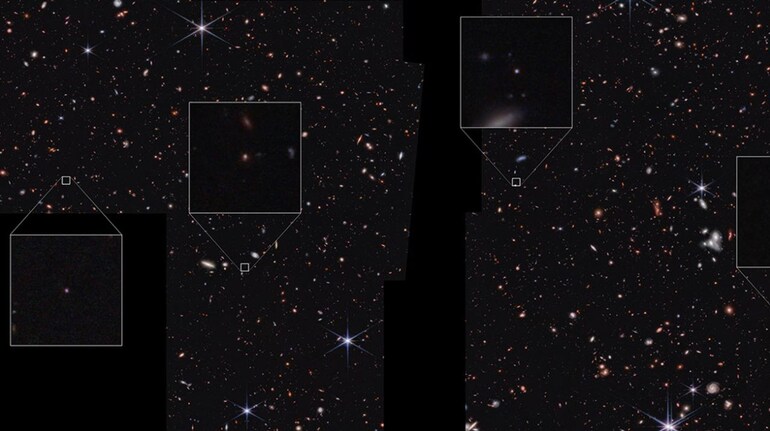

NASA’s James Webb Space Telescope has spotted something strange. Astronomers found a set of galaxies that defy normal classification. The team calls them “astronomy’s platypus” because, like the animal, they combine unusual traits. These galaxies are compact, faint, and unlike anything seen before. The discovery could reshape how we understand the early universe.
Odd Galaxies That Do Not Fit
Webb identified nine unusual sources from 12 to 12.6 billion years ago. They are very small, almost point-like, even for Webb’s sharp vision. These galaxies lack the bright quasar cores expected in similar distant objects. Yet their light spectra resemble some star-forming galaxies.
The combination of features is what makes them so puzzling. They are neither classic quasars nor normal compact galaxies. Scientists say their spectra show narrow emission lines, indicating slower gas motion. This contradicts expectations for galaxies from that era.
Why They Are Called Platypus Galaxies?
The nickname comes from their unusual mix of traits. Just like a platypus, they look like a hybrid of unrelated types. Compact yet not quasar-like, faint yet structured where nothing fits. Researchers hope the term helps highlight how odd these galaxies truly are.
A Mystery of the Early Universe
Astronomers do not yet know what these objects really are. They may be building blocks of the first galaxies, or they could represent a completely new class of early galaxies. Webb’s powerful instruments will allow follow-up studies for clues.
Why This Discovery Matters?
These galaxies give a glimpse of the universe’s first billion years. Webb lets scientists observe how galaxies evolved in the cosmic dawn. The discovery may rewrite theories of galaxy formation and growth. It shows how unexpected objects can challenge existing cosmic models.
Next Steps in the Hunt
Astronomers plan higher-resolution spectroscopy to study these objects in detail. They will examine chemical composition, gas movement, and star formation. The goal is to understand how these galaxies fit into cosmic history. Webb may uncover even more unusual, early universe surprises.
Discover the latest Business News, Sensex, and Nifty updates. Obtain Personal Finance insights, tax queries, and expert opinions on Moneycontrol or download the Moneycontrol App to stay updated!
Find the best of Al News in one place, specially curated for you every weekend.
Stay on top of the latest tech trends and biggest startup news.





