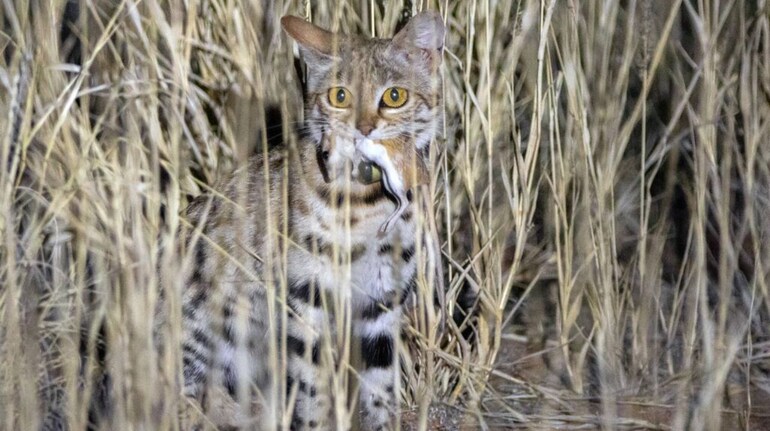

New research in southern Namibia reveals how the elusive black-footed cat depends on abandoned springhare burrows to raise its young and survive in a harsh semiarid landscape, Mongabay reported.
Black-Footed Cat and Nocturnal Survival
Under darkness, the black-footed cat hunts silently. Its speckled coat blends with grasses. The cat weighs between one and two kilograms. Despite size, it hunts with fierce efficiency. Researchers say it outperforms lions and leopards. By daylight, it vanishes below ground. This behaviour remains rare among felines. Females patrol vast territories for prey. Ranges vary with food availability. Males roam even wider areas. Alexander Sliwa leads the Black-footed Cat Working Group. He described the species as active and unique. Mongabay reported his remarks on behaviour.
Springhare Burrows and Raising Kittens
A recent study examined daytime shelter use. Harold Brindley led research from Cape Town. He works at the University of Cape Town. His team tracked five females using collars. They monitored more than fifty burrows. Laser lidar technology scanned underground spaces. The cats used twelve shelters on average. The study lasted one hundred thirty eight days. Females stayed two days in each den. Mothers with kittens behaved somewhat differently.
They remained longer before kittens matured. After six weeks, movement increased sharply. Mothers then changed dens almost daily. This likely reduces predation risk significantly. Jackals and caracals threaten young kittens. Springhares dig and abandon many burrows. These tunnels buffer extreme desert temperatures. Springhares resemble rabbits mixed with kangaroos. They are not prey for these cats. Male cats sometimes use larger burrows. Aardvarks and ground squirrels dig those holes. Brindley noted dependence on rodent engineers. He said vulnerability would increase without them.
Conservation, Farmers and Fragile Populations
The species numbers around ten thousand individuals. It reproduces slowly with few kittens yearly. Kidney disease weakens many individuals further. AA amyloidosis increases mortality risk considerably. The population cannot recover from losses quickly. Much habitat lies on livestock farms. Cooperation with farmers remains critically important. Poisoning predators can kill these small cats.
Overgrazing reduces burrow availability drastically. Hunting springhares removes vital shelter options. Fragmented habitats isolate already small populations. Variable rainfall complicates survival prospects further. Sliwa stressed understanding struggling farmers’ realities. The cat does not threaten livestock income. Awareness remains low due to elusiveness. Martina Küsters coordinates research in Namibia. She urges landowners to value biodiversity. She calls them miniature leopards. Protecting burrow builders protects the cats.
Discover the latest Business News, Sensex, and Nifty updates. Obtain Personal Finance insights, tax queries, and expert opinions on Moneycontrol or download the Moneycontrol App to stay updated!
Find the best of Al News in one place, specially curated for you every weekend.
Stay on top of the latest tech trends and biggest startup news.