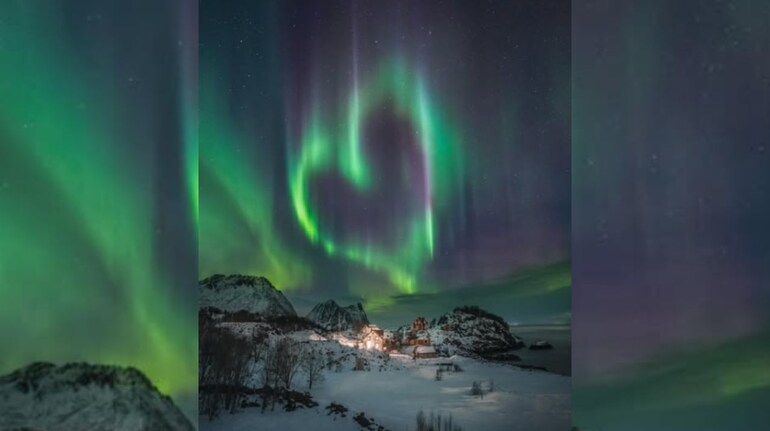

A Norwegian photographer shared an image that quickly travelled far beyond the Arctic skies. The photograph, posted on Instagram by Kristoffer Vangen, appeared to show the northern lights forming a glowing heart above a dark winter landscape. Within days, the image was being described online as the most romantic aurora seen in recent years, arriving just before Valentine’s Day and capturing widespread attention.
Northern Lights Form Rare Heart Shape
The picture was taken on a cold night in Norway, where auroras frequently ripple across the horizon during winter months. Yet even in a region accustomed to dramatic skies, this formation stood apart. The luminous green arc curved inward on both sides, meeting at a soft point to create a clear heart outline suspended above the landscape. Viewers online said the shape looked almost staged, as though the sky had briefly written a love note.
Vangen explained in his caption that the moment had been years in the making. He wrote that he had long hoped to capture the aurora forming recognisable shapes. Over time, he imagined birds, spirals and even skull-like figures appearing in the shifting lights. Several times, he felt he had come close, yet the patterns always seemed too blurred or uneven to feel convincing.
Then, last Friday, conditions aligned. The lights gathered and curved in a way that felt unmistakable. Vangen acknowledged that a heart might sound predictable, but he said he was delighted with the result. Online audiences agreed, flooding the post with comments praising its dreamlike quality.
Was the Aurora Image Real?
As the photograph spread, some viewers questioned whether the scene had been artificially generated. In response, Vangen shared additional Instagram Stories showing behind-the-scenes footage and explaining his editing steps. He insisted the image was genuine and clarified that adjustments were limited to standard photographic processing.
His explanation appeared to satisfy most sceptics, allowing the focus to return to the sky itself. The episode highlighted how easily extraordinary natural events can be mistaken for digital creations in an era shaped by artificial imagery.
The Science Behind the Romantic Glow
Auroras occur when charged particles from the Sun collide with gases in Earth’s upper atmosphere. These collisions release energy as light, producing shifting curtains of green, purple and sometimes red. The final appearance depends on altitude, atmospheric composition and magnetic activity. While the shapes constantly change, clear symbolic forms remain rare.
For many observers, the heart-shaped aurora offered more than spectacle. It served as a reminder that even in predictable scientific processes, nature can deliver moments of surprise. In this case, the Arctic sky briefly resembled affection, glowing softly above Norway before dissolving back into darkness.
Discover the latest Business News, Sensex, and Nifty updates. Obtain Personal Finance insights, tax queries, and expert opinions on Moneycontrol or download the Moneycontrol App to stay updated!
Find the best of Al News in one place, specially curated for you every weekend.
Stay on top of the latest tech trends and biggest startup news.