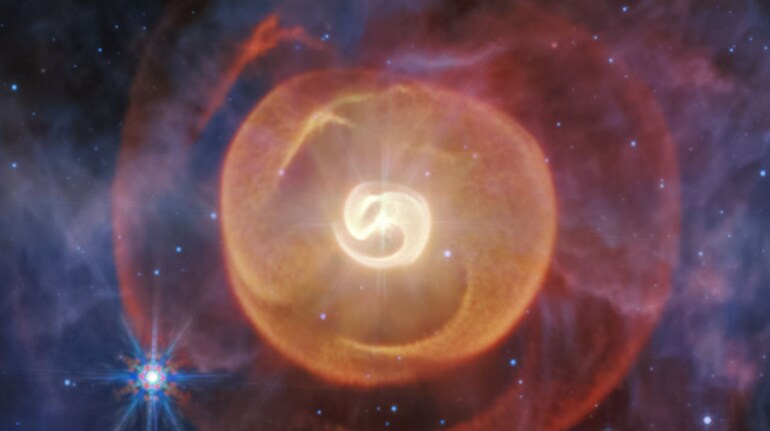
A new cosmic scene has emerged with quiet drama. Astronomers say the view feels almost otherworldly. JWST has shown a system shaped by chaos. Its spirals appear like threads around a cosmic cradle. Each layer holds clues about rare stellar lives.
Apep’s Rare Wolf-Rayet Stars Shape Expanding SpiralsA nested set of dusty spirals surrounds Apep today. The triple system sits nearly 8,000 light years away. Astronomers say it contains two rare Wolf-Rayet stars. Only about 1,000 such stars exist in our galaxy. Their fierce winds pull heavy material from their surfaces.
These winds form dense nebulae shaped by orbital motion. Apep is unusual because both stars orbit for 190 years. Their closest passes create carbon-rich spirals every 25 years. Each dusty arm then slowly expands outward in space.
“This is a one-of-a-kind system,” said Ryan White. He is a PhD student at Macquarie University. He noted the next longest similar orbit is 30 years.
 Webb’s mid-infrared image shows four coiled shells of dust around a pair of Wolf-Rayet stars known as Apep for the first time. Previous observations by other telescopes showed only one. Webb’s data also confirmed that there are three stars gravitationally bound to one another. (Image: NASA, ESA, CSA, STScI; Science: Yinuo Han (Caltech), Ryan White (Macquarie University/ Alyssa Pagan (STScI))JWST Shows Spirals Long Hidden From Earlier Telescopes
Apep was first spotted in optical light in 2018. Only the innermost spiral was visible through early images. JWST’s MIRI instrument has now revealed several faint spirals. These structures show four close passes across 700 years.
“Looking at Webb’s new observations felt like switching lights,” said Yinuo Han of Caltech. Han is lead author of one of two related papers. “There is dust everywhere in Webb’s image,” Han said. The telescope shows repeating and organised structures clearly.
White’s team refined Apep’s orbits using JWST data. They also used eight years of Very Large Telescope measurements. These tracked how the inner dusty shell expanded.
Third Star Found Creating Cavity Inside Dusty ShellsThe images reveal a surprising third star within Apep. This companion is more massive than the Wolf-Rayet pair. It appears as a single point because of the system’s distance.
The star may weigh 40 to 50 solar masses. Its presence shapes a cavity inside the dusty spirals. JWST shows this gap between the 10 and 2 o’clock positions. “The cavity looks like a funnel in each shell,” White said.
All three stars are expected to end violently. The Wolf-Rayet stars may collapse as gamma-ray bursts. They could leave black holes orbiting a neutron star later.
Both papers were published on 19 November in The Astrophysical Journal. Han led one paper, while White led the other.
Discover the latest Business News, Sensex, and Nifty updates. Obtain Personal Finance insights, tax queries, and expert opinions on Moneycontrol or download the Moneycontrol App to stay updated!
Find the best of Al News in one place, specially curated for you every weekend.
Stay on top of the latest tech trends and biggest startup news.