






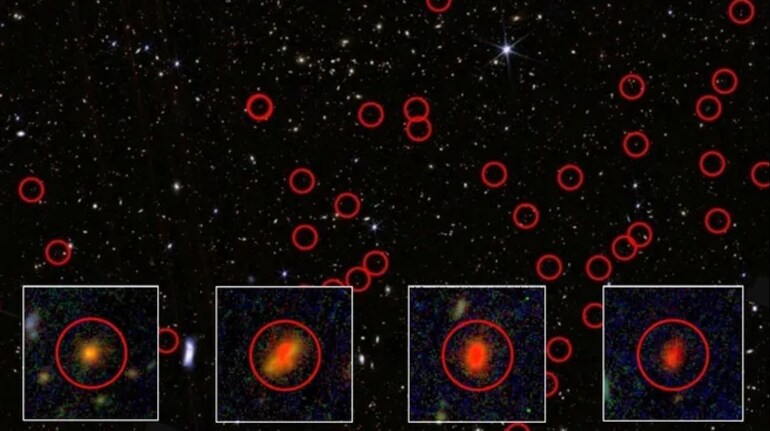

Astronomers are rethinking mysterious cosmic objects spotted by the powerful James Webb Space Telescope, after new research suggested they might be giant early stars rather than feeding black holes. The study, published 5 Feb in The Astrophysical Journal, explores whether these puzzling “little red dots” could represent an earlier stage in the life cycle of the universe’s first massive objects.
Little Red Dots puzzle astronomers studying early universe
The compact objects appeared during the universe’s first two billion years. Scientists first identified them through observations from the James Webb Space Telescope. Their bright yet extremely small appearance quickly puzzled astronomers. Many initially suspected the objects were active galactic nuclei. Such systems contain massive galaxies powered by feeding black holes. Yet several clues did not fully support that explanation.
These objects appear unusually small compared with known galaxies. Observations also revealed no strong X ray emission signals. Feeding black holes normally release clear X ray radiation. Their spectra also lack strong metal emission lines. Instead they mostly show hydrogen and helium signatures. Such features suggest surrounding gas remains chemically primitive.
These unusual clues pushed scientists toward another possible explanation. Researchers asked whether the objects could actually be stars. More specifically they might be enormous stars nearing collapse. The idea was investigated by Devesh Nandal and Avi Loeb at the Harvard & Smithsonian Center for Astrophysics. Nandal told Live Science that their model reproduces several observed features. The research suggests scientists may be seeing living stars.
Supermassive stars could explain strange cosmic signals
Scientists describe these objects as extremely large early stars. They formed mostly from hydrogen and helium gas. Astronomers call them Population III stars in theory. Some models suggest masses reaching nearly one million suns.
To test the idea researchers created a simplified stellar model. The simulation reproduced brightness seen in several little red dots. Two objects known as MoM BH star one and The Cliff were analysed. They formed roughly 650 million and 1.8 billion years later.
The model also explains a distinctive V shaped dip. Scientists previously thought dust caused the spectral shape. The new research suggests the star atmosphere creates it. Material expelled from the star may surround it closely. That shell could cool and redden escaping light.
Debate continues over black holes or ancient stars
Not every astronomer accepts the stellar explanation completely. Daniel Whalen from the University of Portsmouth Institute of Cosmology and Gravitation reviewed the work. He said the model reproduces several spectral features. However it may not clearly outperform black hole explanations.
Another challenge involves the short lifetime of huge stars. Extremely massive stars shine brightly for about 10,000 years. Less massive examples could survive nearly one million years. Researchers say that narrow window complicates detection chances.
Scientists discovered roughly 400 to 500 little red dots. That number seems high for such brief lifetimes. Astronomers now seek clearer evidence from future observations. X ray signals could confirm feeding black holes. Steady light without flickering might favour giant stars.
Future radio observations could also reveal the truth. Facilities such as the Square Kilometre Array and Next Generation Very Large Array may detect hidden black holes. Radio waves can escape dense gas clouds surrounding these objects. Scientists hope upcoming data will finally solve the mystery.
Discover the latest Business News, Sensex, and Nifty updates. Obtain Personal Finance insights, tax queries, and expert opinions on Moneycontrol or download the Moneycontrol App to stay updated!
Find the best of Al News in one place, specially curated for you every weekend.
Stay on top of the latest tech trends and biggest startup news.





