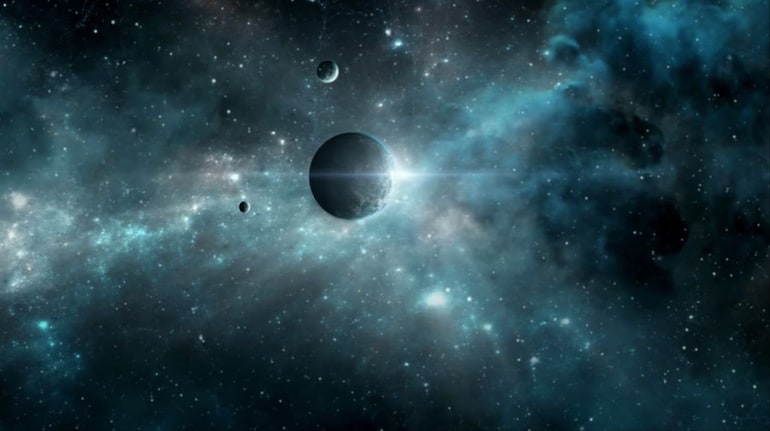
A team of astronomers has uncovered fresh insights into free-floating planetary-mass objects (PMOs), strange celestial bodies wandering through space without a host star. Using advanced simulations, researchers have proposed a new theory explaining how these cosmic drifters may form.
A New Theory on PMO Formation
PMOs, often found in young star clusters like Orion’s Trapezium, have puzzled scientists for years. These objects, with masses below 13 times that of Jupiter, were previously thought to be failed stars or ejected planets. However, these theories could not explain the high number of PMOs, their frequent binary pairings, or their coordinated movement with stars.
Led by Dr Deng Hongping of the Shanghai Astronomical Observatory, an international team used high-resolution simulations to model interactions between circumstellar disks—rings of gas and dust around young stars. Their study, published in Science Advances, suggests that PMOs can form when these disks collide in dense star clusters.
How Disks Collide to Create PMOs
The simulations showed that when two circumstellar disks pass within 300–400 astronomical units (AU) of each other, gravitational forces create elongated "tidal bridges" of gas. These bridges collapse into dense filaments, which then fragment into compact cores. When these filaments gain enough mass, they form PMOs roughly ten times the mass of Jupiter.
The research also found that up to 14% of PMOs form in binary or triplet systems, explaining why these objects often appear in pairs. In crowded star clusters, frequent disk encounters could generate hundreds of PMOs, solving the mystery of their abundance.
Why PMOs Stand Apart
PMOs differ from ejected planets in several ways. They move in sync with nearby stars and retain material from their parent disks. Their composition reflects the metal-poor outskirts of these disks, where heavier elements are scarce. Some PMOs even have gas disks up to 200 AU wide, raising the possibility of moons or planets forming around them.
“This discovery changes how we classify cosmic objects,” said Prof. Lucio Mayer from the University of Zurich. “PMOs may represent a third category—formed not by star birth or planet-building, but through chaotic gravitational interactions.”
The study involved researchers from the University of Hong Kong, the University of California Santa Cruz, and the Shanghai Astronomical Observatory. Future research will focus on studying PMOs in different star clusters to confirm their formation process and chemical makeup.
Discover the latest Business News, Sensex, and Nifty updates. Obtain Personal Finance insights, tax queries, and expert opinions on Moneycontrol or download the Moneycontrol App to stay updated!
Find the best of Al News in one place, specially curated for you every weekend.
Stay on top of the latest tech trends and biggest startup news.