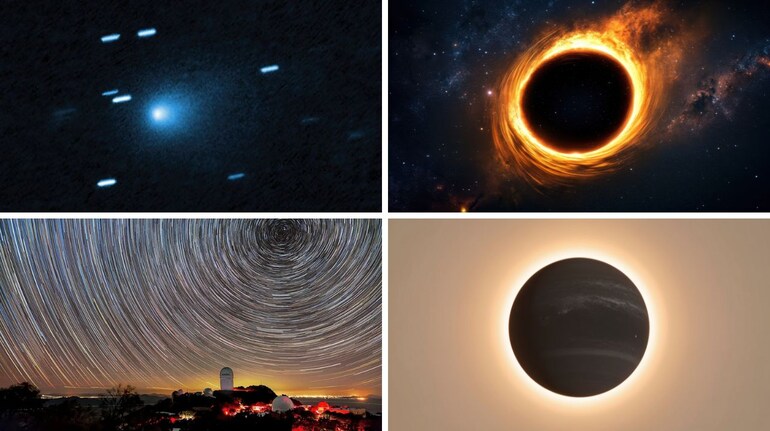
The past year delivered unprecedented discoveries in space. Astronomers uncovered clues about Mars, interstellar comets, exoplanets, and dark energy, captivating scientists and enthusiasts worldwide.
3I/ATLAS: An Interstellar Visitor
The highlight of late 2025 was comet 3I/ATLAS. The Chilean Asteroid Terrestrial-impact Last Alert System spotted it first. Observations began on July 1 near Sagittarius. Its trajectory was hyperbolic, confirming it came from interstellar space. The comet moved faster than any previously recorded, at 36 miles per second. NASA and ESA spacecraft monitored it during solar conjunction. Scientists found its chemistry largely resembled solar system comets. Slightly more nickel than iron revealed its star system origin. The comet also displayed a rare "anti-tail" pointing toward the Sun. Tracking continues into 2026 to understand its full composition.
Signs of Early Supermassive Black Holes
JWST deep images revealed unusual luminous red dots. These objects did not resemble stars or dwarf galaxies. Astronomers now identify them as forming black holes. The black holes emerged in dense gas clouds early in the universe. Their formation challenges previous assumptions about supermassive black hole growth.
Dark Energy Shows Unexpected Behaviour
DESI released data from over 13 million galaxies and quasars. Researchers observed dark energy weakening over the past 4.5 billion years. Previously, dark energy was thought constant across cosmic history. Findings suggest exotic "phantom dark energy" existed earlier, then weakened unexpectedly. The discovery could reshape cosmology and models of universal expansion.
Potential Signs of Life on Mars and Exoplanets
NASA's Perseverance rover found "leopard spots" in Jezero Crater. Organic molecules were detected in surrounding clay sediments. Evidence strongly hints microbial life existed 3.5 billion years ago. JWST strengthened signs of dimethyl sulfide on K2-18b. This may indicate a hycean world with oceans and atmosphere. Many astronomers remain cautious, citing possible abiotic origins of molecules.
New Exoplanets Around Nearby Stars
Barnard’s Star hosts a confirmed quartet of small planets. Alpha Centauri A may have a massive, elliptical gas giant. These discoveries expand knowledge of nearby planetary systems. Habitable zones remain unexplored in these systems.
Galactic Collisions and Black Holes
The Milky Way and Andromeda may miss colliding entirely. Simulations suggest a critical distance of 650,000 light-years. The most massive known black hole, 36 billion solar masses, resides in Cosmic Horseshoe galaxy. Its mass was measured directly using stellar motion tracking.
Vera C. Rubin Observatory Sees First Light
After over 10 years of construction, the telescope achieved first light in summer. It captured stunning images of Virgo Cluster, Trifid and Lagoon Nebulae. Equipped with a 3.2-gigapixel camera, it produces 20TB of data nightly. The 10-year Legacy Survey of Space and Time will amass 60 petabytes of data. This unprecedented survey promises discoveries ranging from supernovas to asteroids.
From interstellar comets to signs of life beyond Earth, 2025 was extraordinary. Each discovery revealed new cosmic mysteries and expanded humanity’s understanding of the universe.
Discover the latest Business News, Sensex, and Nifty updates. Obtain Personal Finance insights, tax queries, and expert opinions on Moneycontrol or download the Moneycontrol App to stay updated!
Find the best of Al News in one place, specially curated for you every weekend.
Stay on top of the latest tech trends and biggest startup news.