






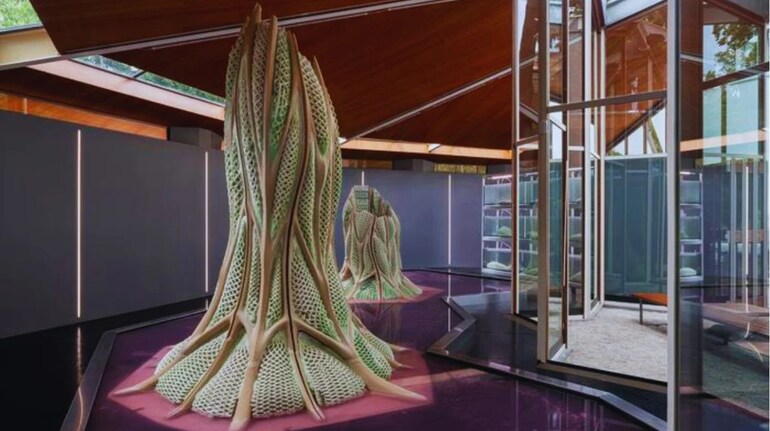

People who visit the Canada Pavilion at the Venice Architecture Biennale are experiencing an interesting experiment that combines art, science, and sustainability. The Picoplanktonics installation consists of 3D-printed objects that contain living cyanobacteria, which require specific conditions of light, humidity, and temperature to thrive. The goal of the research is to investigate the use of living materials for architectural and environmental purposes.
How Cyanobacteria Capture Carbon
Laboratory experiments have demonstrated that these microorganisms have the ability to capture carbon dioxide using two different methods. The first method is based on biomass production, where the Synechococcus sp. strain PCC 7002 captures CO₂ via photosynthesis.
The second method is based on microbially induced carbonate precipitation, where the microorganisms precipitate calcium and magnesium ions to form insoluble carbonates. The data published in Nature Communications indicates that hydrogels containing cyanobacteria captured 2.2 ± 0.9 milligrams of CO₂ per gram in the first 30 days. Over 400 days, cumulative capture reached 26 ± 7 milligrams per gram. Control samples without organisms showed no carbon sequestration.
Architectural Demonstration of Living Materials
The Picoplanktonics installation represents the largest architectural structure made from living materials, according to the Canada Council for the Arts. Developed by the Living Room Collective in collaboration with ETH Zürich, the installation demonstrates how large-scale structures might incorporate living systems.
The caretakers are present at the site during the duration of the exhibition, which ends on 23 November, ensuring the environmental conditions are optimal for the cyanobacteria. According to architect Andrea Shin Ling, the project investigates co-construction with living systems, shifting from extractive design practices.
Challenges and Future Potential
Although the laboratory results indicate promising carbon sequestration, the team indicates that scaling up the material to a level that could significantly reduce atmospheric CO₂ concentrations would necessitate much larger quantities. Biomass growth has plateaued after the 25th day, suggesting a point of diminishing returns for further sequestration.
Nevertheless, calcium carbonate precipitates in the hydrogels seem to increase the material strength over time. The passive photosynthetic MICP process has clear environmental benefits over ureolytic processes, which generate toxic byproducts. Long-term durability and reliable reinforcement properties are currently untested and would require further research over the course of decades.
The Picoplanktonics exhibition showcases the potential of integrating sustainability, design, and biology. Although it does not currently have a direct positive effect on the environment, the exhibition illustrates how architecture could work in tandem with living systems to create self-reinforcing and carbon-sequestering materials.
Discover the latest Business News, Sensex, and Nifty updates. Obtain Personal Finance insights, tax queries, and expert opinions on Moneycontrol or download the Moneycontrol App to stay updated!
Find the best of Al News in one place, specially curated for you every weekend.
Stay on top of the latest tech trends and biggest startup news.





