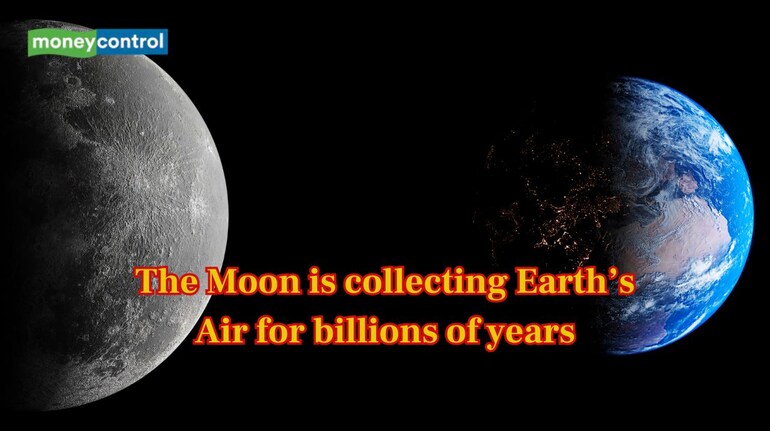

For decades, scientists believed Earth’s magnetic field acted as a protective shield. New research now suggests it has also been a silent transport system. Earth may have been sharing its atmosphere with the Moon for billions of years.
A new study reveals that particles from Earth’s upper atmosphere travel into space. Some of them do not vanish into the void. Instead, they end up embedded in the Moon’s surface.
Scientists uncovered the secret of Moon and Earth
Scientists have discovered that Earth’s atmosphere slowly leaks into space. These particles are swept up by the solar wind from the Sun. Earth’s magnetic field then guides them outward like invisible rails.
Over time, these charged particles reach the Moon’s orbit. They eventually settle into lunar soil. This process has likely continued for billions of years. The Moon is not entirely separate from Earth. It has been collecting pieces of our planet’s atmospheric past.
Earth is Losing Its Air to Moon
Earth’s upper atmosphere constantly loses charged particles. The Sun’s solar wind pulls these particles away. Most drift into deep space. But some are captured by Earth’s magnetic field.
They travel along invisible magnetic lines. These lines stretch far beyond the planet. Eventually, they intersect the Moon’s orbit. The particles do not bounce away. They settle into the lunar surface.
How Scientists Realised this study?
Researchers analysed simulations of Earth’s magnetic field behaviour. They tracked how ions escape Earth’s upper atmosphere. The results showed clear pathways towards the Moon. This explains puzzling gases found in Apollo mission samples. Scientists previously struggled to identify their origin. Earth itself now appears to be the source.
Yes, Moon Holds Earth’s Ancient Secrets
Over billions of years, this transfer slowly built up. Layer after layer formed inside lunar soil. Each particle carries Earth’s chemical signature. Scientists believe the Moon preserves ancient atmospheric clues.
Some may date back before oxygen filled Earth’s skies. Others could reflect dramatic climate shifts. In effect, the Moon stores Earth’s atmospheric history. It is a frozen archive in space. One we are only beginning to read.
What This Means for Future Moon Missions?
Lunar soil may contain valuable resources. Some particles could support human exploration. Others may reveal Earth’s earliest conditions. Future missions can target these deposits directly.
Scientists want deeper samples from untouched regions. Each scoop could rewrite planetary history. The Moon is no longer just a destination. It is a record keeper, and it has been watching Earth evolve.
Discover the latest Business News, Sensex, and Nifty updates. Obtain Personal Finance insights, tax queries, and expert opinions on Moneycontrol or download the Moneycontrol App to stay updated!
Find the best of Al News in one place, specially curated for you every weekend.
Stay on top of the latest tech trends and biggest startup news.