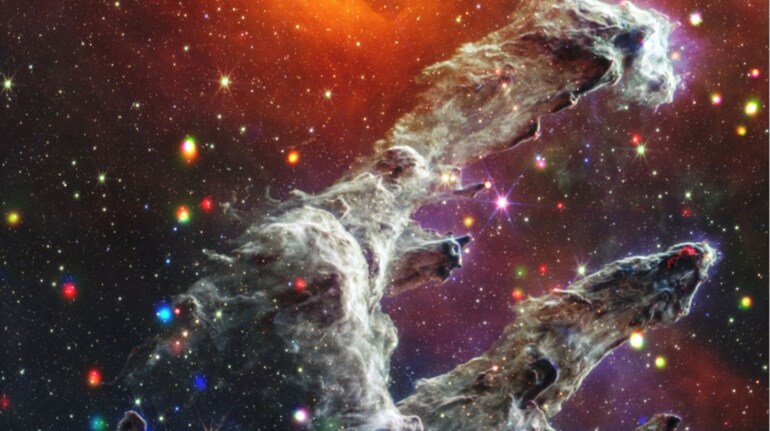

NASA has transformed starlight into music for the first time. Scientists and artists collaborated to make data audible. Two orchestral pieces were composed using measurements from distant stars.
The project bridges science, technology and human creativity. NASA captured these subtle signals and converted them into sound. It turns out that these are orchestral compositions inspired directly by the cosmos.
How Do Stars Become Music?
NASA shared a striking image alongside the announcement. It shows a colourful map of a star’s activity. Bright spots and oscillations represent changes in light and energy. These variations are what scientists converted into musical notes.
Stars emit light, energy, and electromagnetic waves continuously. Sensitive instruments record variations in brightness and motion. Each spike or dip becomes a unique note or rhythm. The resulting sound is shaped into orchestral compositions.
What is this technique called?
The technique is known as asteroseismology. It works like studying earthquakes on Earth. Asteroseismology uses star vibrations to reveal stellar structures. Sound waves uncover temperature, density, and magnetic patterns inside stars. This adds a new layer of scientific insight beyond visual data.
Where Can You Hear the Stars?
NASA scientists provided the star data sets. Professional musicians and composers turned the numbers into melodies. The collaboration blends precision science with creative artistry.
This composition was made by the stars - literally! 🎼Two new orchestral works have been made by using real data from the @chandraxray and @NASAWebb telescopes - transforming the life cycle of stars into music. Play these pieces yourself by visiting https://t.co/WuEcBcZ2HZpic.twitter.com/22xk3ALaGC — NASA Marshall (@NASA_Marshall) December 27, 2025
It is a reminder that science and art can work together. NASA has made recordings available online. Listeners worldwide can experience the sound of distant stars. The project is part of NASA’s mission to inspire exploration.
What Can Science Learn from Stellar Music?
Converting star data into sound reveals patterns invisible to the eye. Astronomers study stellar oscillations to understand star interiors. Sound waves highlight temperature, density, and magnetic activity inside stars. These vibrations help measure star size, age and evolution.
How this study matter in science?
This approach makes complex science accessible and engaging. People can “hear” star formation, explosions, and evolution in real time. NASA transformed real data from the Chandra X-ray and James Webb telescopes into music. Two new orchestral works represent the life cycle of stars. From birth to death, stellar processes become audible compositions. It sparks curiosity, wonder and a deeper understanding of the universe.
Discover the latest Business News, Sensex, and Nifty updates. Obtain Personal Finance insights, tax queries, and expert opinions on Moneycontrol or download the Moneycontrol App to stay updated!
Find the best of Al News in one place, specially curated for you every weekend.
Stay on top of the latest tech trends and biggest startup news.