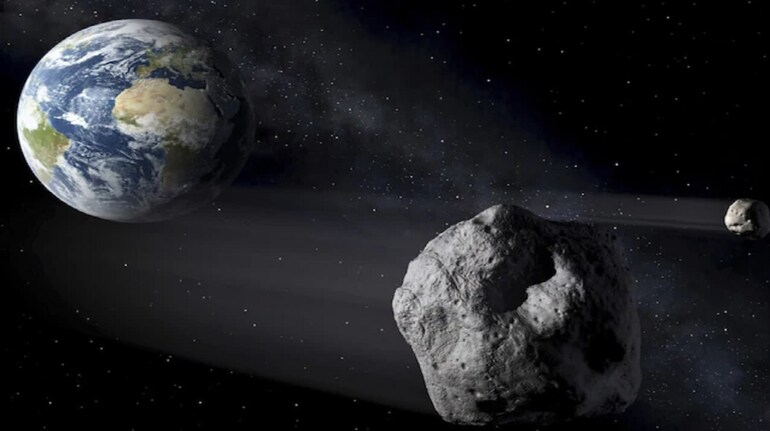

Astronomers worldwide are closely tracking asteroid 2024 YR4, a small space rock that holds a slim but notable chance of striking the Moon in December 2032, potentially triggering scientific observation on an unprecedented scale.
What scientists see approaching the Moon
Asteroid 2024 YR4 measures roughly sixty metres across. Current calculations suggest around a 4 percent impact probability. That figure remains low, yet high enough to draw attention. If the asteroid collides with the Moon on December 22, 2032, scientists say the energy release would be immense.
Models indicate a crater approaching one kilometre wide could form. Pools of molten lunar rock may spread hundreds of metres. Researchers estimate a moonquake near magnitude 5.0 could ripple across the lunar surface. Telescopes worldwide would monitor debris plumes, shockwaves, and seismic vibrations in real time. Infrared observatories, including the James Webb Space Telescope, could track cooling melt zones for several days.
What the impact could mean for Earth
Although the Moon would absorb the direct collision, Earth would not remain untouched. Simulations suggest lunar ejecta could reach Earth’s atmosphere days later. Millions of microscopic particles might burn up as meteors. Scientists estimate hundreds of visible fireballs per hour could appear.
Regions across South America, North Africa, and parts of Arabia could witness bright skies. A small amount of debris, possibly several hundred kilograms, might survive re-entry. Experts stress serious harm remains unlikely, though minor damage cannot be ruled out. Satellite operators are more concerned. Orbital debris could briefly increase collision risks for spacecraft. Some researchers warn cascading impacts might threaten satellite networks if conditions align unfavourably.
What decisions space agencies may face
Space agencies are studying potential deflection options years in advance. A slight push could redirect the asteroid safely away. Such action would protect satellites and avoid unexpected debris risks. However, scientists acknowledge a scientific dilemma exists. Allowing impact would provide rare direct data on lunar geology. Observing crater formation live could answer long-standing questions about the Moon’s interior.
Seismic responses, molten rock movement, and dust dynamics remain poorly understood. Many researchers describe the event as scientifically priceless. Officials emphasise no decision has been made. Further tracking will refine probabilities over coming years.
Whether deflected or allowed to strike, asteroid 2024 YR4 highlights how closely Earth now watches its celestial neighbourhood, balancing safety, curiosity, and the promise of discovery.
Discover the latest Business News, Sensex, and Nifty updates. Obtain Personal Finance insights, tax queries, and expert opinions on Moneycontrol or download the Moneycontrol App to stay updated!
Find the best of Al News in one place, specially curated for you every weekend.
Stay on top of the latest tech trends and biggest startup news.