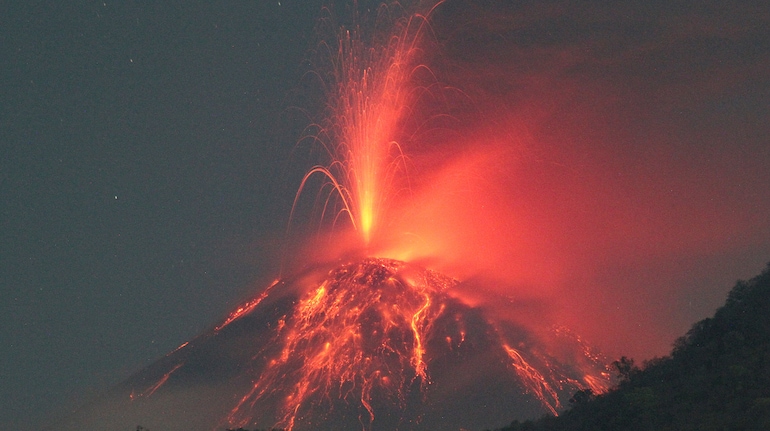
About 300 miles off Oregon’s coast, something is stirring. Hidden a mile beneath the ocean, Axial Seamount might soon awaken again. Scientists tracking it for decades now believe an eruption could be close.
Signals suggest eruption is on the way
Volcanologist Bill Chadwick from Oregon State University said recent signs are strong. Over 1,000 daily quakes were recorded earlier this spring. The volcano is swelling too, suggesting molten rock is rising inside. “It’s like a balloon filling up,” said Chadwick.
The researchers have a network of sensors across the seafloor. They’ve seen similar patterns before Axial’s past eruptions. It last erupted in 2015, creating lava flows nearly 450 feet thick. “That’s about two-thirds the Space Needle’s height,” Chadwick explained.
Axial is part of a hotspot, where magma rises from deep Earth. But unlike most hotspots, it also sits between two tectonic plates. These are the Pacific and Juan de Fuca plates, slowly pulling apart. Their movement increases pressure below the crust and fuels volcanic activity.
No danger to people, but still valuable science
Despite its activity, Axial poses no real risk to humans. It’s too far from land and too deep underwater. Even a strong eruption wouldn’t be noticed by ships above it. “You could be right over it and not realise,” said Chadwick.
Still, scientists see it as a rare research chance. Since Axial’s eruptions don’t threaten lives, forecasts can be tested safely. “We can practise predicting eruptions without big consequences,” said Scott Nooner, a geophysics professor at the University of North Carolina Wilmington.
Forecasting eruptions remains a difficult task
Volcano forecasting is still far from perfect. Magma behaves in complex and changing ways beneath the crust. Nooner said, “It’s harder than weather forecasting, which is already hard.”
Short-term warnings — just hours before eruptions — are improving. But longer-term predictions are often inaccurate. That’s why Axial Seamount is useful. Its repeated eruptions give scientists patterns to learn from, without risking public safety or wasting resources.
Chadwick has studied Axial for 30 years. It erupted in 1998, 2011 and 2015. Now, he and his team believe the next one could happen any time before the year ends. Until then, they continue to watch, measure and listen to the ocean floor — waiting for the volcano’s next move.
Discover the latest Business News, Sensex, and Nifty updates. Obtain Personal Finance insights, tax queries, and expert opinions on Moneycontrol or download the Moneycontrol App to stay updated!
Find the best of Al News in one place, specially curated for you every weekend.
Stay on top of the latest tech trends and biggest startup news.