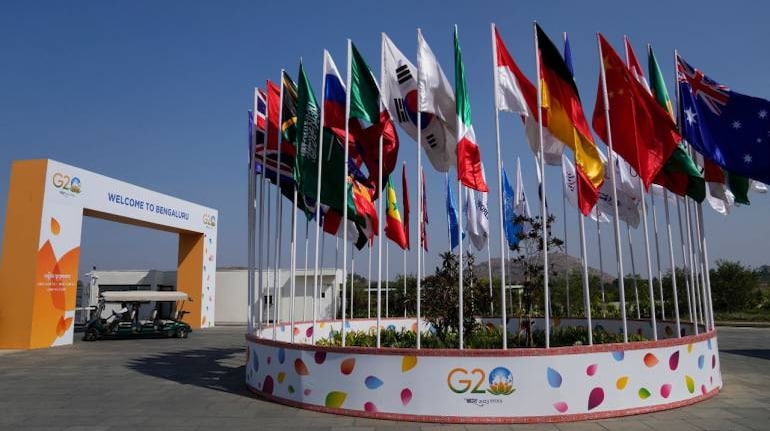
The G20 foreign ministers’ meeting in Delhi ended on Thursday along expected lines – in acrimony, and without a joint communique.
In its wake the meeting has left behind a serious question: whether the fate of the G20 summit in September, held under India’s presidency, will also end similarly if the current division within the group continues.
At the meeting, the war in Ukraine stoked sharply polarised views. With the western group wanting a clear condemnation of Russia’s aggression, and another lot emphatically disagreeing, the foreign ministers were unable to arrive at an agreed text for a joint statement.
Nonetheless, most countries expressed concern over the disastrous impact of the war on the supply of food, energy, and fertilisers, especially in developing countries.
The western nations are keen to enlist the support of the developing countries, or the Global South, to isolate Russia. But so far most developing nations have decided to remain neutral.
The sharp division within the G20 on Russia has increased since the Bali summit in November last year, where a joint statement was finally issued.
Indian External Affairs Minister S Jaishankar said that no joint statement was possible with member states having further hardened their positions since the Bali declaration.
“If we had a perfect meeting of minds on all issues and captured all issues fully – there would have been a collective statement,” he said. But, “There were divergences,” said Jaishankar.
Jaishankar added that a “Chair’s Summary and Outcome Document” was released, which reflected the deliberations at the two-day meeting.
However, the highlight of the foreign ministers’ meeting was an interaction on the sidelines between US Secretary of State Anthony Blinken and Russian Foreign Minister Sergey Lavrov.
This was the first face-to-face meeting between the two leaders since the war in Ukraine began in February last year.
Russian Foreign Ministry Spokesperson Maria Zakharova stressed that the meeting took place at the behest of the US. “Blinken asked for contact with Lavrov,” she told Tass.
Blinken admitted to meeting Lavrov and conveying the US’s steadfast support for Ukraine, even though he called for an end to the war through diplomatic means based on Ukraine’s peace proposal.
During their brief interaction, Blinken also told Lavrov that Russia should reverse its decision to withdraw from the New START nuclear agreement.
Moscow recently announced its decision to suspend the START as it feared that US inspection teams were likely to share information about Russian nuclear sites with Ukraine.
India is among the countries that has refused to condemn Russia, even though it was one of the first G20 members to call for an immediate cessation of violence and a return to negotiations to resolve outstanding issues on Ukraine.
However, India has maintained relations with both the pro and anti Russia dispensations and asserted its own strategic independence. It has also taken the opportunity to host a meeting of the Quad —US, Australia, Japan, and India — foreign ministers.
Among the issues that are likely to be discussed at the Quad meeting are the ongoing war in Ukraine and its impact on developing countries.
What happened at the foreign ministers’ meeting was perhaps expected as the G20 finance ministers’ meeting in Bengaluru was similarly divided and did not result in a joint statement.
The September G20 summit that will be attended by the heads of government of the member nations will pose an even bigger challenge for India, as Delhi will be hard-pressed to ensure that it does not end up in acrimony, despite differences members may have on the Ukraine issue.
Public sentiment in America and Europe may help India walk this tightrope.
Surveys conducted in the past few weeks indicate that support for Ukraine in the west has softened from 60 to 48 percent.
In addition, the number of people in the US who felt the government was doing too much for Ukraine has gone up from 32 to 40 percent.
There have also been a number of protest rallies in the past weeks in countries like Germany, France, and Brussels, where people have called for peace and criticised their government’s decision to go on arming Ukraine to continue the war with Russia.
Indications suggest that in the coming days the war is likely to intensify as both sides are trying to gain territory that they could show it as theirs before hostilities end and they resume negotiations.

Discover the latest Business News, Sensex, and Nifty updates. Obtain Personal Finance insights, tax queries, and expert opinions on Moneycontrol or download the Moneycontrol App to stay updated!
Find the best of Al News in one place, specially curated for you every weekend.
Stay on top of the latest tech trends and biggest startup news.