





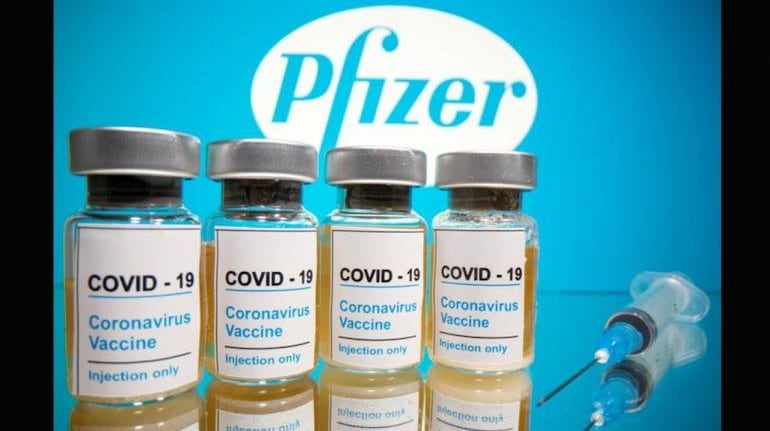
The co-founder of BioNTech said Tuesday it was "highly likely" that its vaccine against the coronavirus works against the mutated strain detected in Britain, but it could also adapt the vaccine if necessary in six weeks.

"Scientifically, it is highly likely that the immune response by this vaccine also can deal with the new virus variant," said Ugur Sahin. But if needed, "in principle the beauty of the messenger technology is that we can directly start to engineer a vaccine which completely mimics this new mutation -- we could be able to provide a new vaccine technically within six weeks." Sahin said the variant detected in Britain has nine mutations, rather than just one as is usually common. Nevertheless, he voiced confidence that the vaccine developed with Pfizer would be efficient because it "contains more than 1,000 amino acids, and only nine of them have changed, so that means 99 percent of the protein is still the same". He said tests are being run on the variant, with results expected in two weeks. "We have scientific confidence that the vaccine might protect but we will only know it if the experiment is done... we will publish the data as soon as possible," he added. Countries across the globe shut their borders to Britain on Monday due to fears about a highly infectious new coronavirus strain, causing travel chaos and raising the prospect of food shortages in the United Kingdom.

The note of calm from the CEO about the UK mutation echoed the World Health Organization, which cautioned against major alarm, saying this was a normal part of a pandemic’s evolution.

Sahin said he hadn’t yet been immunized but would like to be. He said it was more important that his employees get the vaccine so they can continue to do their jobs.

(With AFP inputs)


COVID-19 Vaccine

Frequently Asked Questions

View more
How does a vaccine work?

A vaccine works by mimicking a natural infection. A vaccine not only induces immune response to protect people from any future COVID-19 infection, but also helps quickly build herd immunity to put an end to the pandemic. Herd immunity occurs when a sufficient percentage of a population becomes immune to a disease, making the spread of disease from person to person unlikely. The good news is that SARS-CoV-2 virus has been fairly stable, which increases the viability of a vaccine.

How many types of vaccines are there?

There are broadly four types of vaccine — one, a vaccine based on the whole virus (this could be either inactivated, or an attenuated [weakened] virus vaccine); two, a non-replicating viral vector vaccine that uses a benign virus as vector that carries the antigen of SARS-CoV; three, nucleic-acid vaccines that have genetic material like DNA and RNA of antigens like spike protein given to a person, helping human cells decode genetic material and produce the vaccine; and four, protein subunit vaccine wherein the recombinant proteins of SARS-COV-2 along with an adjuvant (booster) is given as a vaccine.

What does it take to develop a vaccine of this kind?

Vaccine development is a long, complex process. Unlike drugs that are given to people with a diseased, vaccines are given to healthy people and also vulnerable sections such as children, pregnant women and the elderly. So rigorous tests are compulsory. History says that the fastest time it took to develop a vaccine is five years, but it usually takes double or sometimes triple that time.

View more
Show