




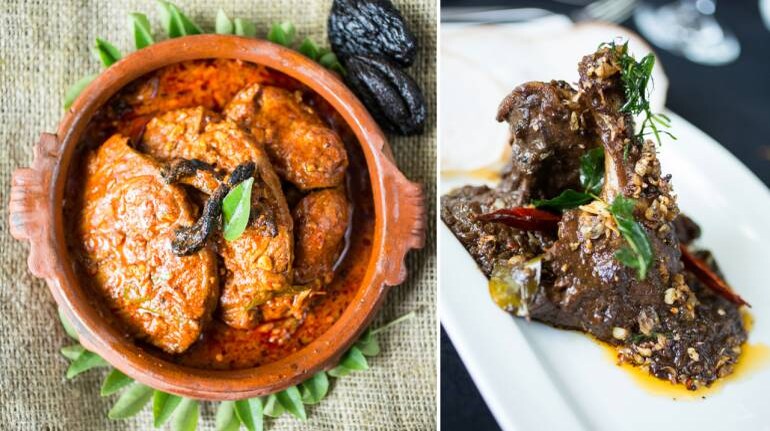
Story goes that the First Class Railway Mutton Curry was concocted on a moving train, when a hungry English army officer found the mutton curry simmering in the lunch car too spicy and a kindly cook mixed in a bit of coconut milk, to take the edge off.
"The dish became a staple on all first-class train compartments,” says Poonam Singh, general manager, CGH Earth Experience Hotels.
The dish is a fine example of culinary and cultural legacies of various foreign traders and empires that became incorporated in Kerala cuisine to make it what it is today.

Melting pot of food
Rasmi Poduval, Founder, Cranganor History Cafe & Riverside Chateau, says, “Kerala cuisine is primarily based around local produce and some unique foreign influences that came about as Kerala was a premium emporium or the first port of trade in the country."
"Meat preparations involve a masala base of chilli, coriander, pepper, nutmeg, cloves, and cardamom. Vegetarian dishes have coconut, cumin, and green chilli as their base. Coconut either in grated form or slivers or as coconut milk is present in everything,” adds Poduval.
While the Arabs brought fenugreek, cumin and mustard to Kerala, the Portuguese introduced chillies and coriander from the Caribbean.
Interestingly, the state has a fairly equal distribution of different religions and each of them has their own take on the cuisine of the state. Kerala cooking can be generally classified as the Ammachis special which is mainly home food, tea shop delicacies and the toddy shop food culture which revolves around the various foods served along with toddy. Tribal cooking with native ingredients is another category.
There are distinct cuisine styles namely Syrian Christian Cuisine which uses pork, duck, beef and freshwater fish like Karimeen apart from chicken and lamb, which you will find in the Malabar Muslim or Moplah Cuisine also. Fish curry with Kerala Kokum, Karimeen (backwater fish). Mappas, Pork Piralan, Pidi Kozhi, Chicken Stew with Appam Kozhukatta (elaichi-flavoured grated coconut and jaggery filled in ball shaped rice dough and steamed), are some of the Syrian Christian dishes. Arappu, a coconut and red or yellow masala with jeera, is a common mixture used for many of the dishes.
Joseph Garcia, COO, The Malabar Escapes, explains, “The Namboothiri Hindus use pure vegetarian ingredients for their cuisine. The Namboothiri Sadhya has steamed rice; kalan - raw plantain, curd and raw coconut dish; olan - white gourd or ash gourd cooked with black eyed peas in coconut milk; thoran - grated or finely chopped vegetables sautéed and steamed with coconut, turmeric green chillies; avial - a mixed vegetable preparation with grated coconut, curd, curry leaves, turmeric powder; parippu (dal), pappadums, inchipuli (sweet and sour chutney like dish made of ginger, tamarind and jaggery); palada payasam - thin rice pudding with sugar as sweetener; and parippu (moong dal) payasam which is dark brown uses jaggery as sweetening.”
The food of Kerala, though, heavy on seafood, is also about fresh and seasonal ingredients. The tubers of Kerala like tapioca and yam are an integral part of average Kerala food.
Radhakrishna Shenoi, General Manager, Operations, CGH Earth says, “This evergreen tropical land with plenty of sun, rain and fertile soil has a centuries old tradition of healthy living in a very natural way. The food has always been from its rich vegetation with innumerable varieties of vegetables, tubers, herbs, the 14 varieties of bananas and the seafood. Mopila Cuisine of North Kerala is influenced by the Arab traders and has non-vegetarian - fish, poultry, and lamb - with a judicious mélange of spices. The Central Travancore Cuisine of the Christians of Kerala is localised with plenty of coconut-based flavours and has dishes like Pollichathu, Pattichathu, Mappas, Piralan, Appam and Stew.”
Syrian Christian cuisine has accepted the various cooking techniques from around the world and adopted the same with locally available ingredients.
Chef Regi Mathew, Culinary Director and Co-owner Kappa Chakka Kandhari (Bengaluru and Chennai), explains, “Baking, stewing, and roasting are common in Syrian Christian cooking. Predominantly non-vegetarian, beef, chicken and fish are very common in their menu. Kodampuli (Malabar Tamarind) is a unique ingredient used as a souring agent while making seafood in this cuisine. Tapioca is one of the staples from this region. Kudampuliyitta fish curry with Tapioca is one of the specialties. Toddy (fermented sap of coconut or palm tree) is consumed as alcohol or used for fermentation. Vinegar is also a part of Syrian Christian cooking, especially for making pickles.”
The flavours of Kerala cuisines are best enjoyed when you eat with your hands, it is said to be the best way to activate all your senses. Whether it is the local non-vegetarian preparations or the traditional sadhya with its rainbow-coloured food, Kerala food has a connection with inner wellbeing, something that is best experienced when you taste it.
Discover the latest Business News, Sensex, and Nifty updates. Obtain Personal Finance insights, tax queries, and expert opinions on Moneycontrol or download the Moneycontrol App to stay updated!
Find the best of Al News in one place, specially curated for you every weekend.
Stay on top of the latest tech trends and biggest startup news.




