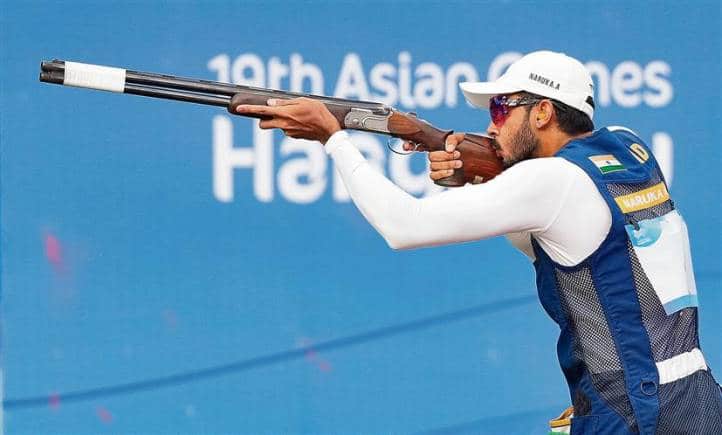
Forty-three perfect shots during the men’s skeet final at the Asian Games this week, then, an aberration. In the next instant, Anant Jeet Singh Naruka’s mind wandered from the shooting range at Fuyang Yinhu Sports Centre in Hangzhou, China, to his days as a junior.
On five occasions at the Nationals back then, he had been in the lead. A miss, followed by loss of composure, compounded his misery. He ended all those junior competitions with silver.
After years, he was now looking at the same situation once again.
“I was quite shocked at how I missed since I had found my rhythm by then,” Naruka recalls.
Until that miss, he had been level with Kuwait’s Abdullah Alrashidi — a legend in this world of shooting. The contrast was stark. At 25 years, Naruka was competing in his first final at the senior level. Alrashidi is 60 years old, a three-time world champion with two Olympic bronze medals to his name.
Even as he assessed the situation, a hit and a miss followed on the 45th and 46th shot, respectively. It set Naruka’s heartbeat racing.
“I told myself — you cannot miss another one because if you do, you’re going to have to settle for bronze this time around. So I decided to stop sulking about the two misses and move on to the next target,” Naruka says.
Here on, Naruka didn’t miss; unfortunately for him, neither did Alrashidi. The latter picked up his second Asian Games gold; Naruka on the other hand, created history to land India’s first silver in the skeet event.
“Anything can happen in this sport. So you have to always keep your focus until the last target,” Naruka says.
It’s been a long wait for Naruka to land his moment in the limelight. Eleven years ago, he first accompanied his father, Dalpat Singh, to the Oases Shooting Range in Jaipur. Hailing from Rajput royalty in Uniara in the Tonk district of Rajasthan, guns were all around him while growing up. There was an instant connection with the sport.
“I realised I really like guns. It’s a great feeling when you shoot — the kick that you get, a rush of adrenaline. It’s a very different sport, different from everything else that I’ve played,” he says.
“Of course, as a professional, there is pressure that comes with shooting. And I really enjoy it,” he adds.
 The fixation on shooting as a sport ran in Naruka's family. (Photo: Twitter)
The fixation ran in the family. Naruka and his father’s relationship blossomed at the shooting range, where the latter doubled up as coach during the early days. At his first junior nationals, Naruka returned with a bronze. The following year, he made the junior Indian shooting team. The books from school were soon set aside, table tennis reduced to a hobby. The Narukas were invested in shooting.
“My father travelled with me to all competitions. He absolutely loves the sport and when you are as involved as he is, you end up talking about shooting all the time. Even today when I ask him to join me at the range, he’s the first one to get ready,” Naruka says, laughing.
At the international stage as a junior, Naruka met success in a silver at the Asian Championships in 2014, followed by a bronze at the World Cup the next year. However, transitioning to the senior level after 2019 was a gradual process. It wasn’t until the COVID-19 pandemic had waned that Naruka was able to focus on the sport again.
“There wasn’t much shooting right through the pandemic. But once I restarted it was all very different, real excitement. I enjoyed it immensely. The moment I woke up, all I wanted to do was go train. And when I saw improvement, it was added motivation,” he says.
“It was quite a busy year before the Asian Games. I shot at three World Cups, the World Championships where I got a good score but didn’t make the final, and multiple trials where I put in encouraging performances,” he adds.
In between competitions and camps this year, he made frequent trips to Italy where he fine-tuned his skills under Olympians, Pietro Genga and Ennio Falco — the latter a gold medallist at Atlanta 1996.
“I’ve been putting in the work, leading a disciplined life and gaining confidence with every competition. And telling myself that I could be up there among the best. We had a day of practice after reaching Hangzhou where I shot well, so I was quite confident going into the Asian Games,” he says.
Alongside Gurjoat Khangura and Angad Vir Singh Bajwa, Naruka first picked up bronze as a team. As he lined up for the individual event, his initial aim was to simply make the final. And once he did, the pressure was off.
“It was my first final as a senior. And a big one too. Everyone back home was watching it on television, including my father. It didn’t matter who was lining up alongside. This was anyone’s game and I knew the podium could happen,” he says.
It was more relief than joy once he clinched silver, the job finally done. A quick call to his father followed as they soaked in the reward of the dedicated effort over the last few years.
“This is my fourth year as a senior. It took me time to finally be on the podium, but the wait has been worth it,” Naruka says.
For the next few days, he wants to sit back and soak it all in with family and friends back home in Jaipur. Then it’s down to business again. Next up is the Asian Championships in Changwon, South Korea in October. This time around, there are quota places at stake for the Paris Olympics next year.
“It’s another big competition where the same shooters are going to be around. Pressure is only going to bring you down. I know just what I need to do this time as well,” he says.
Discover the latest Business News, Sensex, and Nifty updates. Obtain Personal Finance insights, tax queries, and expert opinions on Moneycontrol or download the Moneycontrol App to stay updated!

Find the best of Al News in one place, specially curated for you every weekend.
Stay on top of the latest tech trends and biggest startup news.