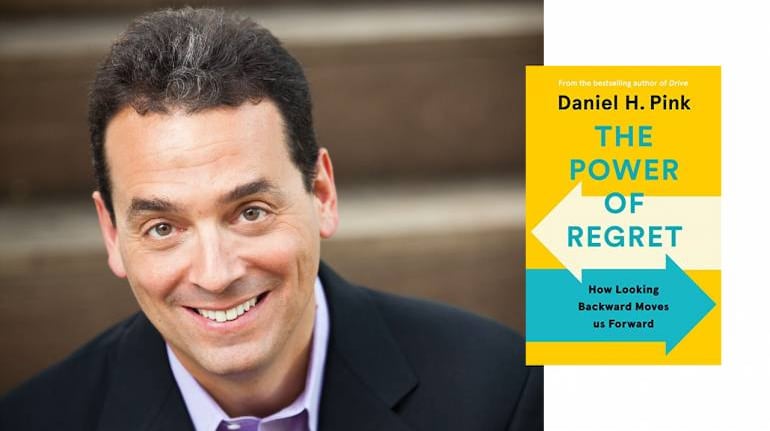
Daniel H. Pink, who has written bestsellers like A Whole New Mind (2005), Drive (2009), To Sell is Human (2012), and When (2018), is back with a new book titled The Power of Regret (Riverhead Books, 2022). It is based on the principle of “how looking backward moves us forward”.
We bring you nine important takeaways from this book, written by a man who has been a columnist, television host, author, and chief speechwriter to Vice President Al Gore.
1. You cannot escape negative emotions by suppressing them.Pink writes, “Stashing negativity in your emotional basement merely delays the moment when you must open the door and face the mess you’ve stored inside.” Using insights from psychology, he argues that suppression can cause headaches, insomnia, heart disease, intestinal problems and autoimmune disorders. He states, “Burying negative emotions doesn’t dissipate them. It intensifies them, and the contaminants leach into the ground soil of our lives.” Pink recommends confronting them, and using them as catalysts for future behaviour.
2. Reframe regret as an opportunity rather than a threat.If you believe that regret is a waste of time and energy, Pink’s book will urge you to reconsider. According to him, the power of regret needs to be reclaimed because it is “an indispensable emotion.” He shows that “the negative emotion of regret” can be turned into “a positive instrument for improving your life.” Regret can sharpen our decision-making skills, improve our performance at work, and strengthen our sense of meaning and connectedness.
3. Allow yourself to feel bad so that you can do better.Pink is an advocate of “regret’s ameliorative properties”. When we pause to contemplate our past choices, we are more mindful about the choices that we are about to make. Regret has an impact on our “decision hygiene.” What is usually seen as “negativity” is helpful because it keeps us from being hasty. We seek more information, and we take longer to weigh the pros and cons. Pink writes, “We take more time to reach a conclusion. Because we step more carefully, we’re less likely to fall through cognitive trapdoors like confirmation bias.”
4. Practise self-disclosure to experience relief.Revealing information about our past behaviour brings up feelings of shame, so we avoid sharing what bothers us. According to Pink, “reckoning with all regrets” must begin with self-disclosure. If we are hesitant to tell, we can write. Research indicates that self-disclosure leads to benefits such as “reduced blood pressure, higher grades, better coping skills.”
5. Make self-compassion a part of your life.Sometimes, it seems easy to have compassion for others but not ourselves. We belittle ourselves for having acted in ways that are not aligned with our expectations. Pink suggests that “we’re better off extending ourselves the same warmth and understanding we’d offer another person.” This is not about overlooking shortcomings. It simply means acknowledging that we are imperfect, and having more realistic expectations of ourselves. Self-compassion can be learnt. “By normalizing negative experiences, we neutralize them,” adds Pink.
6. Self-distancing can help you with insight and closure.Revisiting the past can be debilitating if we identify strongly with our pain. Self-distancing, on the other hand, can help us “analyze and strategize.” Pink points out that regret can be examined dispassionately in order to “extract” lessons that can shape our choices in the future. “Recounting” compels us to swim in the “murky depths of regret” whereas “reconstruing” allows us to pilot “above the water to examine its shape and shoreline.” The latter helps us take control of our response to the challenges that life throws at us.
Distancing through space involves reviewing past behaviour “from the perspective of a neutral observer.” When we witness from a distance, we are less enmeshed in the drama. This is why people like to take time off, and go to a new place, so that they can see things afresh. About distancing through time, Pink explains, “When we simulate looking at the problem retrospectively, from the binoculars of tomorrow rather than the magnifying glass of today, we’re more likely to replace self-justification with self-improvement.” Self-distancing through language involves abandoning first person pronouns and using the third person. This can help remove the stigma or shame attached to a previous action that is being regretted.
8. Don’t overdo regret; too much of it can harm you.This book distinguishes between feeling emotions and wallowing in them. Excessive regret can be “dangerous, sometimes devastating.” Based on research, Pink concludes, “It can lead to rumination, which severely degrades well-being, and to the regurgitation of past mistakes, which can inhibit forward progress. Excessive regret is linked to an array of mental health problems—most prominently depression and anxiety, but also post-traumatic stress disorder.” Replaying thoughts of regret can build “a chamber from which it’s difficult to escape.”
9. Focus on particularities of behaviour.Pink claims that regret is unhelpful if it turns into self-flagellation. There is a risk of this when regret is framed as a judgement of “who we are” or “our underlying character”. When you forget a loved one’s birthday, do you regret not making a note of the date in your calendar or do you beat yourself for being an uncaring person? Pink writes, “Framing it as an evaluation of a particular behaviour in a particular situation —what we did—can be instructive.” Acceptance, rather than a judgemental attitude, can bring about a genuine shift.
Discover the latest Business News, Sensex, and Nifty updates. Obtain Personal Finance insights, tax queries, and expert opinions on Moneycontrol or download the Moneycontrol App to stay updated!
Find the best of Al News in one place, specially curated for you every weekend.
Stay on top of the latest tech trends and biggest startup news.