Last year, Prime Minister Narendra Modi had set an ambitious target of doubling farmers’ income by 2022 with the spotlight on the food sector.
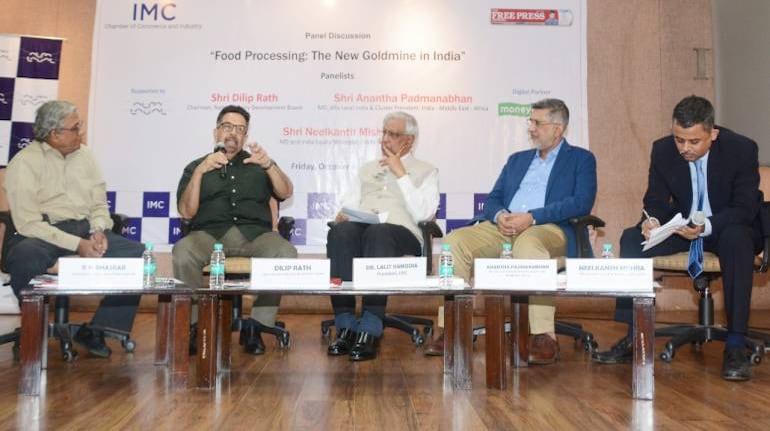
The food processing sector is more than just output as it adds value, creates jobs, and sustains prosperity. In order to realise the potential of the food processing industry, The Free Press Journal organised a panel discussion on-‘Food Processing: The new goldmine in India’- along with the Indian Merchants Chamber and Moneycontrol.com. The panellists including Dilip Rath, Chairman of the National Dairy Development Board; Anantha Padmanabhan, MD, Alfa Laval and Cluster President, India, Middle East & Africa; and Neelkanth Mishra, MD, India Equity Strategist at Credit Suisse, discussed how food processing sector has the potential to create jobs and double income.
Lalit Kanodia, IMC President, in his welcome address said, agriculture constitutes around 15 per cent of the GDP but provides employment to about 60 per cent of the working population, which means the per capita income is very low.
“In this view, food processing is extremely crucial to India. Food processing is a bridge that links agriculture and industry. An estimate says it can create nine million jobs, which is massive if you compare it with IT sector which is about 3.5 million jobs,” said Kanodia.
His thoughts were resonated by Dilip Rath, who said dairy is a vital tool for doubling farmer’s income as it contributes about 25 per cent of the total income of the rural households. “Today, we all know that a significant part of the milk produced is retained in the villages. We also know that a significant part of production is handled by the unorganised milk vendors. Between these two, the situation is that only 17 per cent comes to the organised processing sector and the untapped potential today is still huge. Even today we are present only in 50 per cent of India’s six lakh villages,” he said.
When discussed about food processing, technology and innovation plays an important role. With right technology and infrastructure, the food processing in India can grow from strength to strength with more chilling units, etc.
Anantha Padmanabhan said, “Alfa Laval has developed technologies worldwide and brought them to India. India, today, is a competence hub for Alfa Laval worldwide. It is a disappointment that India has not yet fully absorbed the technology to develop the quality of production and product variety, compared to our neighbours like Sri Lanka and South East Asian countries. The food processing sectors there produce very high quality of food and are quite export-oriented, which means that the domestic markets there also access high-quality products.”
For India to create an efficient system and strengthen the food processing sector, private investments will have to be roped in so that a world-class infrastructure can be created.
“I was told by the Canadian consulate that McCain has a very large potato processing plant in Gujarat, a single location which supplies potatoes for all of McDonald's and Burger King, very high-end quality material. So there is investment now starting to happen given that evaluation is available, electricity is available, farmers are more informed and APMC has been repealed. It is very hard to quantify whether it will be Rs 10,000 crore or 20,000 crore, but the ecosystem is now ready and it is a matter of time,” said Mishra.
Rath said, “We think that this represents an investment requirement of Rs 16,000 crore including creation of drying and value added product capacities. Our estimates are that the dairy industry needs to create additional capacities of about 500 lakh litres of milk per day, which will definitely need that kind of money,” he said.
For co-operatives, the government has announced a new scheme, ‘Dairy Processing & Infrastructure Development Fund’, with a total outlay of Rs 10,800 crore to invest in expansion and refurbishment of processing capacities over the next three years. It will be channelised through NABARD and NDDB. The rate of interest would be 6.5 per cent, with a subsidy component too. Since cooperatives pass on about 75 per cent to 80 per cent of the consumer rupee to the milk producer, this investment is likely to see tremendous benefits flow to producers. It will help create huge employment and income opportunities in rural areas.
So, how does one take an initiative?
“The key is not setting up one large unit, but tens of thousands of small units. The forces beyond public markets are needed, specifically for procurement, at least in fruits and vegetables, repealing of APMC powers has eased the process, however you still have to create a parallel system or market,” said Mishra.
Discover the latest Business News, Sensex, and Nifty updates. Obtain Personal Finance insights, tax queries, and expert opinions on Moneycontrol or download the Moneycontrol App to stay updated!
Find the best of Al News in one place, specially curated for you every weekend.
Stay on top of the latest tech trends and biggest startup news.