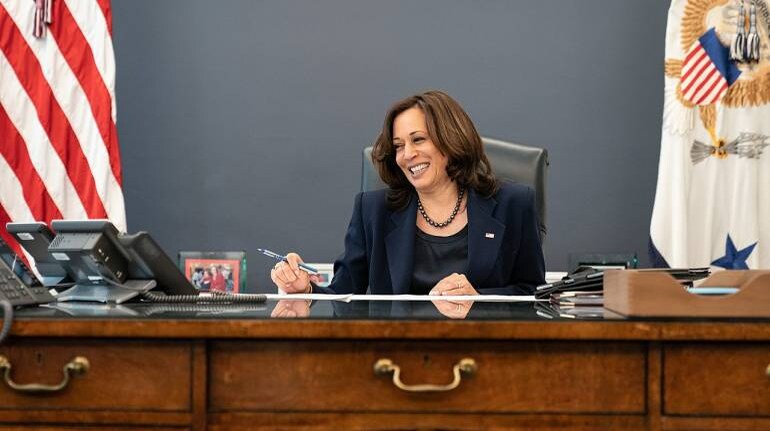
Journalist Chidanand Rajghatta, who wrote The Horse That Flew: How India’s Silicon Gurus Spread Their Wings (2001) and Illiberal India: Gauri Lankesh and the Age of Unreason (2018) has a new book out. Titled Kamala Harris: Phenomenal Woman (HarperCollins, 2021), it is an impressive volume about a woman of colour’s rise to the top in white-supremacist America. We bring you five major takeaways from Harris' eventful life.
1. Embrace your heritage.Rajghatta writes, Harris is “unapologetically Black.” She takes pride in the art, culture and history that she inherited from her Jamaican father and other Black elders. This book documents her love of music and dancing, of stars like Nina Simone and Aretha Franklin.
Do you remember the time when Harris tweeted, “When you attend an HBCU, there’s nothing you can’t do”? She was celebrating her education at Howard University in Washington DC. It falls under the umbrella of Historically Black Colleges and Universities (HBCU). Rajghatta calls Howard “the seat of Black academic pride”. It includes Thurgood Marshall, Toni Morrison, Zora Neale Hurston, and Walter Washington among its alumni.
Clarifying that Indians rarely go to HBCUs and prefer elite, white-majority institutions, Rajghatta writes, “Already brought up as a young Black girl in Berkeley whose Blackness hadn’t been dimmed by the multi-cultural school in Montreal and the strong ties with India, she wanted to go to a HBCU for higher education. And there was none better than Howard – a Black school in a city of white monuments.”
Harris joined Howard at the age of 18. She had inspiring teachers like Alain Locke, Ralph Bunche, Rayford Logan, and E. Franklin. She cut her teeth on student politics there. She found mentors, and a sisterhood that nourished her spirit. “Students came not just from all over America, but from across the pan-African world – from fledgling African countries to Caribbean Island nations.”
2. Change the system from within.After Howard, Harris studied law at the University of California, Hastings College of the Law. Her legal career began with the Alameda County District Attorney’s Office.
Born to an Indian mother and a Jamaican father, why did she become a prosecutor for the US government, knowing that minorities are treated unjustly by the system? This is a question that she has faced repeatedly because her parents Shyamala and Donald were known as “radicals” at the University of Berkeley. They marched for civil rights. Harris knew of “brave prosecutors who went after white extremists, corporate polluters and corrupt politicians” from studying and working in Washington DC. She saw possibilities for change in a broken system, and her role in it. Rajghatta quotes Harris, who once wrote, “When activists came marching and banging on the doors, I wanted to be on the other side to let them in.” Has she stuck to her word? Some would say yes, others would say no.
3. Ambition is courage.The misogyny in American politics is hardly recent. How did Harris emerge as a formidable leader in such an environment? Rajghatta notes that “self-assurance and self-belief came easily and early – qualities instilled in her by her mother”.
Harris, he says, drew inspiration from other Black women, particularly writers and activists like Alice Walker and Maya Angelou, “who led hard lives and emerged scathed but on top”.
According to Rajghatta, Harris was able to thrive in the male-dominated corridors of power because ambition was “not a taboo word in her vocabulary”.
At the Black Girls Lead 2020 Conference, Harris said, “There will be a resistance to your ambition, there will be people who say to you, ‘You are out of your lane’…They are burdened by only having the capacity to see what has always been instead of what can be – but don’t let that burden you.”
Rajghatta points out that the VP’s niece Meena has said that ambition is respected in the Harris household, for it is seen as synonymous with courage and living one’s purpose.
4. Stay above the slush.Harris got her first name ‘Kamala’ from her mother Shyamala. It refers to the lotus flower and goddess Lakshmi, who symbolizes abundance and 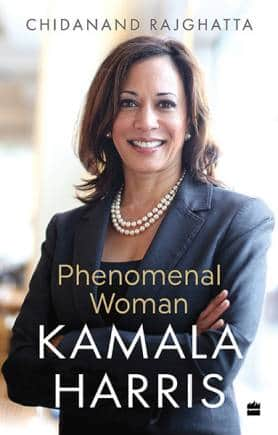 prosperity. Rajghatta highlights how, just like the lotus, she “stayed above the slush and the pig fight that Trump Republicans wanted to drag her into.” She chose not to get rattled when they made fun of her name.
Rajghatta shows how this fed into a culture of “racism and bigotry” directed also at other women of colour in American politics – Ilhan Omar, Rashida Tlaib, and Alexandra Ocasio-Cortez. In the book, he recalls, “She called the deliberate mispronouncing of her name ‘childish games’, while explaining in an interview on The Daily Show that as far as she was concerned, a person’s name is ‘precious and sacred’ and is ‘informed by tradition and love’.”
5. Own your job, redefine it.This book emphasizes that Harris has been part of key decisions made by US President Joe Biden. She often spoke first at public events in the run-up to the inauguration. White House communications include her name and comments in every dispatch. Rajghatta writes, “At Biden’s first big foreign policy speech, Kamala went first, and followed that up with remarks at the Pentagon, the country’s military headquarters that has long been a male preserve.”
This is a big deal because in the US, VPs are typically associated with ceremonial roles assigned to them by Presidents. They do not have much of a say in decision-making.
In politics, where women and men are often judged by different standards, Harris has tried to champion women’s leadership across party lines. Rajghatta recalls that she hosted a dinner for all 24 female US senators “in a nod to bipartisan quarterly potlucks first hosted by Barbara Mikulski in the 1990s”. Harris has tried to revive the female senatorial caucus that “had petered out with the rise of Trumpism” to illustrate the “clout of women in America”.
Discover the latest Business News, Sensex, and Nifty updates. Obtain Personal Finance insights, tax queries, and expert opinions on Moneycontrol or download the Moneycontrol App to stay updated!
Find the best of Al News in one place, specially curated for you every weekend.
Stay on top of the latest tech trends and biggest startup news.