If you’ve been following celebrity and pop-culture in the last few weeks, you’ve come across some or all of the off-screen drama surrounding Olivia Wilde’s Don’t Worry Darling. You’re either Team Flo (yes!) or Team Wilde. You have probably analysed the Spitgate footage from multiple angles and have an opinion on whether Harry Styles actually spit on Chris Pine (this reviewer believes he did)! But now that the movie has finally been released, we can judge it on its own merits. And, unfortunately, Don’t Worry Darling doesn’t impress despite a bravura performance by Florence Pugh.
Actor-turned-director Olivia Wilde’s second feature, Don’t Worry Darling, tells the story of Alice and Jack Chambers (played by Pugh and pop star Harry Styles), a happy young couple who lives in what seems like a perfect company town of Victory, California in the 1950s. When Alice begins to notice cracks in her idyllic life, she becomes curious about the nature of her husband’s work on the secret Victory project, and her quest to uncover the truth raises tensions in the community.
The movie looks great, with stunning production design to evoke the 1950s from the cars to the houses. The period-perfect costumes are gorgeous, and the styling is impeccable. Cinematographer Matthew Libatique allows the colours to pop just a little more than they naturally would, which aids the feeling that everything we’re seeing is too good to be true.
The script by Katie Silberman, who also wrote Wilde’s first movie Booksmart (2019), starts off strong. The first act introduces the viewer to Alice’s perfect life, while alluding to the fact that everything is not what it seems. Wilde expertly stages some of these sequences, from an overhead shot of all the cars leaving the cul-de-sac in a perfectly synchronised manner, to an on-the-nose but effective sequence where the walls of the house close in on Alice.
Without getting into spoilers, it’s in the interminable second act that the movie loses its footing. When Alice sees her neighbour Margaret kill herself, she realises that something is seriously wrong with Victory and their lives there. But the script continues to pile on the eerie occurrences without advancing the characters or the plot. The film plays its cards too close to its chest for too long. This deliberate withholding of information results in an extremely rushed third act as the movie scrambles to lift the curtain on its convoluted script. Everything is revealed but nothing is really answered, leaving the viewer with even more questions.
On the plot level, there are a number of setups that simply don’t pay off. What was the plane crash that Alice saw? What happened to Margaret’s son? Why does the ground rumble frequently? As Alice unravels the mystery behind Victory, the answer only serves to undermine everything we’ve seen before. The film tries to be Get Out (2017) for women, addressing weighty issues, such as toxic masculinity, but it doesn’t really have a clear and compelling point of view. Even when it’s trying to say something about the role of women in society, its ideas are rooted in second-wave feminism, stuck in the ’50s and ’60s, much like its characters.
Pugh and Styles are ably supported by a solid cast, including Kate Berlant, Timothy Simons, Nick Kroll, Gemma Chan, Kiki Layne, and Wilde herself. Chris Pine deploys his considerable charm to make something more out of his one-note role as Frank, the enigmatic leader of Victory who resembles a New Age spiritual guru. Styles’ fans will be relieved to hear that he is serviceable in his first major movie role, matching the (admittedly low) demands of the script. But it’s really Pugh’s stellar performance as Alice Chambers that holds the film together. She is in nearly every scene of the movie, and a number of those scenes are just her character all alone. Her performance is a finely calibrated mix of vulnerability and steely determination. This is a proper movie star role and performance from Pugh, who has previously headlined smaller indie movies, and been a part of ensemble casts.
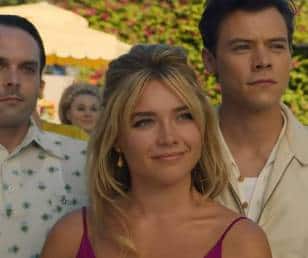 A still from the film
Wilde is a competent director, adept at setting the mood and creating an unsettling vibe. She also gets to show off her action chops with an exciting car chase that ends in the desert. Unfortunately, some of her ideas are in opposition with the themes of the movie. For example, she has spoken in interviews about the lack of female pleasure in movies and wanting to foreground female pleasure in Don’t Worry Darling. There’s a powerful scene early on in the movie that really sells that idea, but later revelations force the viewer to dramatically recontextualise what they’ve seen, to the extent that the viewer lands on an almost opposite reading of the scene.
In spite of the movie’s flaws, it’s still refreshing to see a non-IP, female-led and fronted mid-budget movie from a major studio. Now, if only someone would make a movie chronicling all the off-screen drama, that would surely be a lot more satisfying.
Discover the latest Business News, Sensex, and Nifty updates. Obtain Personal Finance insights, tax queries, and expert opinions on Moneycontrol or download the Moneycontrol App to stay updated!
Find the best of Al News in one place, specially curated for you every weekend.
Stay on top of the latest tech trends and biggest startup news.