






A Bengaluru-based professional has triggered debate online after revealing that he has spent six years tracking his friendships and calculating what he describes as their “return on investment”, concluding that forming new close relationships is statistically inefficient.
Referring to the fictional character Sheldon Cooper from the television series "The Big Bang Theory", he noted how audiences once laughed at a character who maintained detailed social rules and even ranked friends. He argued that while the character was treated as eccentric, he himself applies a similarly structured approach in real life.
Posting on X (formerly Twitter), Pankaj wrote that he has created a system called “Ziya”, which he described as a personal customer relationship management tool for the people in his life. According to him, the system records contextual information, behavioural patterns, frequency of interaction and his emotional response after conversations.
“I literally quantify friendships,” he wrote. “If someone’s ROI stays negative long enough, I stop engaging.”
He acknowledged criticism from other users. “Most people called it cold, dystopian, treating humans like transactions,” he said. “But I think pretending time is infinite is worse.” He added that he was not attempting to persuade anyone, stating: “Not trying to convince anyone. I’m just showing what my numbers say about making new friends.”
The data behind the system:
According to figures drawn from what he described as his “new_relationship_events”database, establishing what he considers a meaningful friendship requires substantial time investment.
For the initial phase, he estimates that moving from first contact to a substantive conversation requires approximately eight to twelve hours, involving introductory exchanges and identifying shared ground.
To build what he terms a “trust baseline”, he calculates a further 45 to 60 hours over a period of three to six months. “Most don’t make it past this phase,” he wrote.
Reaching a deeper level of personal openness, he estimates, requires between 80 and 120 hours across 12 to 18 months.
He therefore places the total “boot-up cost” of a new meaningful friendship at roughly 128 to 192 hours.
Beyond that, he outlined ongoing annual commitments:
30 to 40 hours for regular communication, including messages, calls and meetings
12 to 15 hours for significant occasions such as birthdays, celebrations or providing support during difficult periods
Around seven hours for updating one another on changes in life circumstances, projects or personal developments
He concluded that maintaining a friendship demands between 45 and 65 hours each year, adding that these figures have remained broadly consistent across attempts.
Six attempts over six years:
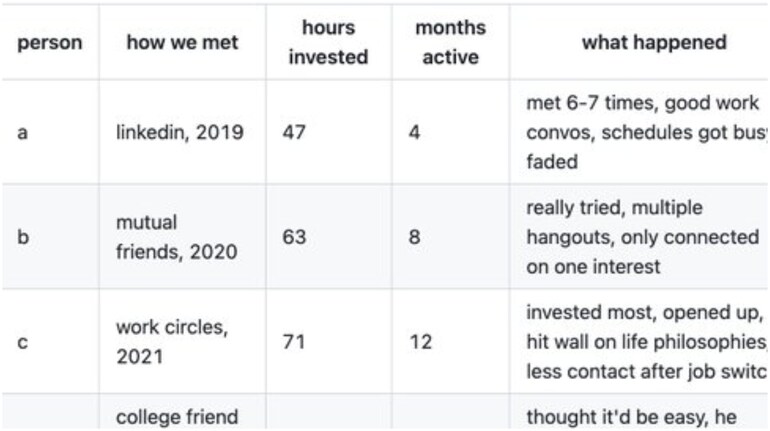
Between 2019 and 2025, he tracked what he described as his last six attempts to form new close friendships. Over that period, he spent a total of 354 hours.
Reflecting on the outcome, he wrote that those hours might have been invested differently. Instead, he said, he now has “six people who are now just names in my contacts”. He added: “Like most people, I overestimated my emotional bandwidth.”
https://t.co/cV8xxvnR2z— Pankaj (@the2ndfloorguy) February 16, 2026
This led him to what he described as an “uncomfortable realisation”. “After tracking this for six years, I’ve realised something I once hated hearing – constantly removing people from your life is mandatory,” he wrote.
He clarified that this was not about resentment or wrongdoing. “Not because you hate them or they did something wrong or anything,” he stated, but because “relationship capacity is fixed”.
He estimates that he can sustain between five and eight deep relationships and up to 10 to 12 meaningful ones. “Every new person you add either pushes someone else out or dilutes everyone,” he wrote.
Existing friendships versus new ones:
He said he currently has four close friends, each known for between eight and 12 years, and that he spends approximately 400 hours annually across those relationships.
In his assessment, the same 400 hours could support six to eight new friendships, but he believes they would remain superficial, characterised by repeated introductory discussions and limited emotional depth.
He further modelled what he considers the likely outcome of meeting someone new at the age of 25:
A minimum of 128 hours to establish a basic foundation
Around 50 hours per year for upkeep
Three to five years to reach a comparable level of depth to existing friendships
A 72 to 73 per cent probability that the relationship would end within two years
Based on this, he calculated an “expected cost” of 228 hours over two years, with what he described as a roughly 70 per cent failure rate. By contrast, he argued that investing the same time in established close friends offers “3x better odds” and “zero wasted setup time”.
Addressing common objections, including questions about chance encounters or unexpected compatibility, he wrote that he examined the probabilities. He estimated:
A four per cent chance that a new individual is genuinely distinct from his current circle
A 31 per cent chance of forming a deep bond
A 27 per cent chance that the relationship lasts more than two years
He concluded that the combined probability of long-term success under those assumptions is approximately 0.35 per cent, noting that this calculation is based on a personal dataset with a small sample size.
A selective approach:
“After 23, my friend roster is almost closed for new additions. My default is no,” he wrote. “Someone has to be statistically exceptional to enter. Not because I’m antisocial but because the math doesn’t support it.”
Instead, he said he prefers to invest time in existing close relationships, personal development, professional skills, health and pursuits that “compound” over time.
He distinguished between friendships and broader networks, arguing that professional or interest-based connections can continue to expand, but should not be conflated with close friendships. “Friendship is the expensive, high-touch tier. Connections are the scalable tier,” he wrote.
He acknowledged that many readers consider his framework unusual. “Lot of people find this weird. That’s fair,” he stated, adding that his calculations are approximate and based on limited personal data. “Take it as perspective, not proof.”
Online response:
The post prompted mixed reactions. One user commented: “A very weird way to look at life if you calculate time taken to talk with anyone on an ROI basis - only talk to people if it's mutually fun for both, and if it's that, you shouldn't expect any more "ROI" from that. Conversations are not a means to an end in my opinion.”
Another asked: “Don't try too hard mate. It's okay. Insurance also has negative ROI till you're healthy. (Or may be you mean acquaintance, not friends?)."
A third described the analysis as thought-provoking: “The math was brutal, but it is what it is. Thanks for writing this. It’s understandable that it felt disturbing to read. The takeaway for those who have good friends is to double down, and for those who don’t, to be wiser.”
Discover the latest Business News, Sensex, and Nifty updates. Obtain Personal Finance insights, tax queries, and expert opinions on Moneycontrol or download the Moneycontrol App to stay updated!
Find the best of Al News in one place, specially curated for you every weekend.
Stay on top of the latest tech trends and biggest startup news.




