




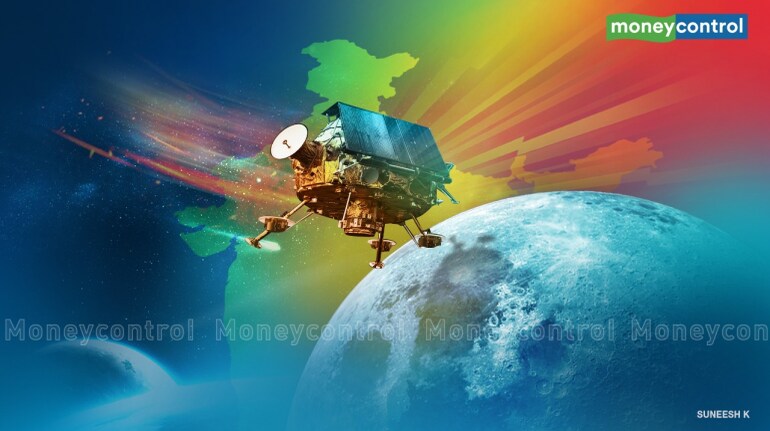
India's success in reaching the lunar south pole has attracted the attention of other space agencies interested in the water-ice and minerals on the moon. Artificial intelligence (AI) powered sensors were crucial to the Chandrayaan-3 landing safely on the moon's surface. The technology allowed the lander to accurately predict the lunar surface, locate any obstacles, and descend safely.
AI is rapidly becoming vital in many fields, including space exploration. The technology expedites data analysis, offers predictive insights, enables autonomous navigation, enhances mission operations, and detects anomalies, among other uses. Like past space missions, AI played a crucial role in India's Chandrayaan-3 mission.
Significance of sensors
The array of sensors, which includes velocimeters and altimeters, was announced by ISRO Chairman S. Somanath as a significant technological advance. Cameras (including a hazard avoidance camera and inertia-based cameras) and other sensors provide essential visual data, while the instruments measure the speed and altitude of the lander. These data streams are combined using complex computational techniques to form a complete picture of the lander's location.
Also read: Chandrayaan-3: India to celebrate August 23 as National Space Day, says PM Modi
Rover and AI
AI will also play a part during the rover's time on the moon. The rover will conduct tests, collect samples, and plot the most compelling exploration route using AI and navigation cameras. AI will be crucial in the analysis after the spacecraft collects this valuable data. AI also will assist in uncovering previously hidden information.
Chandrayaan-3 Mission:All planned Rover movements have been verified. The Rover has successfully traversed a distance of about 8 meters. Rover payloads LIBS and APXS are turned ON. All payloads on the propulsion module, lander module, and rover are performing nominally.… — ISRO (@isro) August 25, 2023
India became the fourth nation to safely land on the lunar surface, joining the US, Russia, and China. ISRO has specified three main objectives for the mission:
- Showing a safe and soft lunar surface landing
- Demonstrating the Rover's mobility throughout the Moon's landscape
- Carrying out on-site scientific research
Adaptive Intelligence
The actual power of AI was on display as it learned and reacted on the fly, during Chandrayaan-3's soft-landing. Accuracy was maintained throughout the descent, thanks to exhaustive simulations, rethought guidance schemes, and laborious algorithms. Despite the storm, the ship continued on its course. ISRO's Somanath said that the craft's backup propulsion mechanism allowed it to continue operating despite sensor failures.
Most notably, the Lander Hazard Detection and Avoidance Camera (LHDAC) stole the show. It used AI to map the lunar surface for potential hazards that could derail the landing. In addition, the lander's safe passage was secured by an orchestra of AI-controlled sensors and cameras.
Rover Pragyan
The AI assistance in this expedition doesn't stop at the lander. The lunar rover Pragyan was guided by AI as it collected samples and conducted tests on a daylong adventure. Pragyan's success on the moon depended on a suite of cameras and antennas assisted by AI. A critical decision lies at the apex of the AI-driven decision-making during this mission. The lander's AI has to choose between a vertical landing and a lateral motion of up to 150 meters to avoid obstructions. The future of Chandrayaan-3 is in the hands of AI while the world watches.
ISRO's historic lunar landing was made possible by the power of AI. The successful landing of Chandrayaan-3 in the vastness of space is a monument to the power of AI and the inventiveness of humans.


Discover the latest Business News, Sensex, and Nifty updates. Obtain Personal Finance insights, tax queries, and expert opinions on Moneycontrol or download the Moneycontrol App to stay updated!
Find the best of Al News in one place, specially curated for you every weekend.
Stay on top of the latest tech trends and biggest startup news.