-
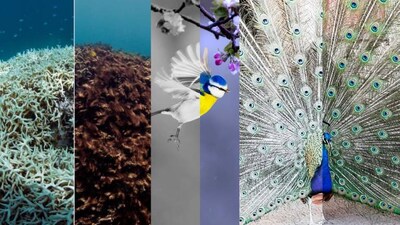
Nature is losing its colours: From animals to birds, the World is becoming colourless, why are scientists worried?
From bleaching coral reefs to fading forests and duller birds, scientists warn Earth is losing its colours under climate stress, but could these subtle shifts reveal deeper environmental truths?
-

Forget concrete: Scientists develop living building material that grows and self-heals over time
Architecture meets biology at the Venice Biennale as 3D-printed walls host living cyanobacteria, capturing carbon while strengthening themselves. Could buildings of the future become self-sustaining environmental systems?
-
China’s tree-planting drive turns the harsh Taklamakan desert from a biological void into a carbon sink
China’s vast tree-planting drive around the Taklamakan Desert may be turning shifting sands into a carbon sink. But can forests truly tame one of Earth’s harshest landscapes?
-
Standard Chartered remains a market leader in sustainable investing strategies: Ben Daly, Global Head of Transition Finance
The global bank released the ‘India and the Energy Transition’ report on February 10, which showed that 83% of the corporates were confident that India will meet its net-zero goals
-
Lifestyle, sustainability set to redefine housing market this year, says experts
Sustainability is becoming a core driver of residential demand. According to a report by Carbon Guardians, India’s green building market is projected to grow to nearly $85 billion by 203.
-
Coal gasification may get Budget boost as govt eyes lower syngas costs, wider use
PMO-led review looks at slashing syngas costs, widening industrial use and unlocking stranded gas-based power capacity. NTPC to set up a Rs 10,000-crore coal-to-gas project.
-
Centre plans separate rules for solar waste; centralised storage from 2029
Government to delink solar PV waste from e-waste rules, push panel reuse and centralised storage from 2029.
-
What went right for Earth: Seven under-the-radar climate and nature wins in 2025
Amid worsening climate pressures, 2025 delivered quiet wins from surging renewables to returning wildlife, landmark legal shifts and indigenous gains, showing unexpected progress that often escaped headlines worldwide this year.
-
Plants failed to absorb carbon 56 million years ago — Are we near a repeat?
Plants pull carbon from air during photosynthesis. They store carbon in leaves, wood and roots. This process supports the global carbon cycle.
-
Govt working to boost investment in India, boost FDI and FII: Piyush Goyal
Goyal says “good news” on an India–US trade deal will come once the agreement is fair and balanced, saying ties remain strong and strategic despite differing paces across issues.
-
Massive hidden heat ‘burp’ building in Southern ocean could reignite global warming
Under current warming, the ocean stores heat as deep waters mix with warmer layers above. At the same time, the loss of reflective sea ice allows more solar radiation to penetrate and be absorbed.
-
India prepares to reveal its first red list of endangered species at IUCN World Congress
India prepares to spotlight its conservation efforts on a global stage as the world gathers to decide the future of biodiversity.
-
World Animal Day 2025: Date, theme, history and global significance
The first World Animal Day was held in 1925 by Heinrich Zimmermann, a German writer and activist. Zimmermann wanted to promote animal rights and inspire global action.
-
British Indian entrepreneur bats for bamboo to make cricket more affordable, accessible
A University of Cambridge scientist who examines and designs sustainable materials, hit upon the concept of bamboo bats a few years ago in the course of his work on the use of bamboo as a structural material for building homes and schools.
-
World Bamboo Day 2025: Date, theme, history and significance
Bamboo is more than a plant, it is culture, livelihood and innovation. This World Bamboo Day 2025 reveals why its role in our future is bigger than ever.
-
India’s supply chains resilient, not at the mercy of anyone, says Piyush Goyal
Commerce Minister Piyush Goyal reiterated that India is holding talks with the US on a bilateral trade agreement (BTA).
-
We’re killing animals smarter than Dogs’: Scientists warn of ‘octopus farming horror’
Octopuses have around 500 million neurones in their bodies. Many of these neurones are spread through their arms. This allows them to act and sense independently.
-
Decor tips: Why modern bathrooms are focusing on innovation and sustainability?
In 2025, the Indian bathroom is no longer just a functional space, it has evolved into a reflection of how we live, what we value, and how we want to feel in our most private spaces.
-
No Sun, crop collapse and cold hunger: How nuclear war threatens our oceans and Earth’s survival as new report warns of real danger
Corn yields could fall by 80 percent. With extra damage from UV radiation, losses could reach 87 percent. Many parts of the Northern Hemisphere would freeze for years.
-
International Tiger Day 2025: Date, history, conservation and most legendary tigers and tigresses
Global Tiger Day, or International Tiger Day, was first observed in 2010. It was established during the Tiger Summit held in Saint Petersburg, Russia.
-
Developers adopt new-age tech, sustainable practices to drive India’s green building boom
According to Savills data, there has been a surge in green building certifications, with over 7,000 IGBC certified projects in India, accounting for a total built-up area of around 1,370 msf
-
Melting glaciers could trigger hundreds of dormant volcanoes and spark a wave of explosions across the globe, says study
Since the 1970s, scientists have suggested that disappearing ice might release pressure in Earth's crust. As gases and magma expand, the chance of eruption rises.
-
Centre looking to cut turnaround time to set up nuclear power plants by five years
The government is also planning to set up one nuclear power plant in every state that does not fall under the Seismic Zone 5 and may consider the 'fleet mode' in order to ramp up capacity addition.
-
May 2025 ranked second-hottest globally, EU data shows
May's average global temperature was 1.4°C higher than the 1850-1900 pre-industrial average. That figure pushes Earth further into the danger zone agreed upon in the Paris climate pact.
-
Earth's oceans are losing light: Scientists warn of widespread, mysterious marine darkening
The photic zone, where sunlight penetrates and sea creatures survive, is considerably shallower in most places now.