-
Is industrial production rising or falling? Depends on what you’re looking at
The picture painted by the month-on-month data is completely different from the year-on-year figures. We badly need seasonally adjusted data
-

US factory activity slows to two-year low as clouds gather over economy
The slowdown in manufacturing followed moderate consumer spending growth in May along with weak housing starts, building permits and factory production
-
China factory activity dips to 2-year low as Beijing battles COVID outbreak
The official Purchasing Managers' Index (PMI), a key gauge of manufacturing activity, clocked 47.4 in April - below the 50-point mark separating growth from contraction - as authorities said that a "decline in production and demand" has deepened
-
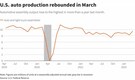
Auto sector rebound fuels US manufacturing output gain in March
Overall industrial production increased 0.9 percent last month, keeping pace with February's upwardly revised pace
-
Chart of the Day | Industrial Output: Slowdown, what slowdown?
Although the year-on-year data indicate a slowdown in industrial growth in October 2021, the month-on-month numbers show a substantial jump
-
Eight core industries growth rises to 7.5% in October
The output has marked a sequential growth, as the core industries grew by 4.4 percent in September.
-
September IIP rises 3% as low base effect wears off
Measured by the Index of Industrial Production (IIP) data, which was released by the Centre on November 12, industrial output maintained growth in the latest month even though the headline figures fell.
-
Eight core industries' output rose 4.4% YoY in September, data show
The cumulative output of the core sector industries in the first nine months of FY22 has risen by 16.6 percent, as compared to a 14.5 percent fall in the same period of the previous financial year.
-
August IIP holds firm at 11.9% as low base effect wears off
Industrial production had almost caught up with pre-pandemic levels by July. In August, this expanded significantly. In August, 2019, production had contracted by 7.3 percent.
-
July IIP sees slower YoY growth at 11.5% as low base effect wears off
Industrial production has almost caught up with pre-pandemic levels. Compared to July, 2019, production was just 0,3 percent lower in the latest month.
-
China economy under pressure as factory output, retail sales growth slow sharply
Industrial production in the world’s second largest economy increased 6.4% year-on-year in July, according to data released by the National Bureau of Statistics (NBS), against expectations for 7.8% growth and after rising 8.3% in June.
-
Eight core industries' output rose 8.9% YoY in June, data show
The cumulative output of the core sector industries in the first three months of FY22 has risen by 25.3 percent, as compared to a 23.8 percent fall in the same period of the previous financial year.
-
Eight core industries' output rose 16% YoY in May, data show
The cumulative output of the core sector industries in the first two months of FY22 has risen by 35 percent, as compared to a 30 percent fall in the same period of the previous financial year.
-
April IIP shoots up 134% YoY due to low base effect
With the early part of 2020 witnessing nationwide shutdown, low base effects have thrown economic calculations haywire and resulted in volatile growth numbers. Economists say this will continue to mar industrial figures till at least June.
-
IIP shrinks 3.6% in February owing to steep decline in manufacturing
India's industrial output has shrunk 11.3 percent in the April-February period of FY21, as compared to the same period of the previous year. It has shrunk 8 out of the first-11 months of the 2020-21 financial year.
-
China's factory output posts first increase for 2020 but consumption still weak
That was faster than the 1.5% increase forecast in a Reuters poll on analysts and followed a 1.1% fall in March.
-
Japan's January factory output beats forecasts but slowdown expected
The world's third-largest economy shrank at the fastest pace in almost six years in the December quarter as a nationwide tax hike hurt business and consumer spending and soft overseas demand hit exports.
-
Japan's factory output posts largest fall in almost 2 years
Factory output fell 4.2% in October from the previous month, trade ministry data showed on Friday, below the median market forecast for a 2.1% fall and swinging from a 1.7% rise the previous month.
-
India's industrial production grew 2% in June
Industrial output, or factory output, is the closest approximation for measuring economic activity in the country's business landscape
-
India's factory output at 2.4% in December
Factory output, measured by the Index of Industrial Production (IIP), is the closest approximation for measuring economic activity in the country's business landscape.
-
Factory output growth plummets to 17-month low of 0.5% in November
Factory output, measured by the Index of Industrial Production (IIP), is the closest approximation for measuring economic activity in the country's business landscape.
-
Factory output grows 8.1% in October
Factory output, measured by the Index of Industrial Production (IIP), is the closest approximation for measuring economic activity in the country's business landscape.
-
India's factory output grows 4.3% in August
Factory output, measured by the index of industrial production (IIP), is the closest approximation for measuring economic activity in the country’s business landscape
-
Inflation cools off, manufacturing output increases. Here's what experts are saying about the data
India’s retail inflation fell to 3.69 percent in August, lowest in ten months, driven by cheaper food items while IIP growth for the April-July period was 5.4 percent compared to 1.7 percent in the year ago period.
-
IIP grows at 6.6% in July vs 7% in June as manufacturing, capital goods shine
IIP growth for the April-July period was 5.4 percent compared to 1.7 percent in the year ago period