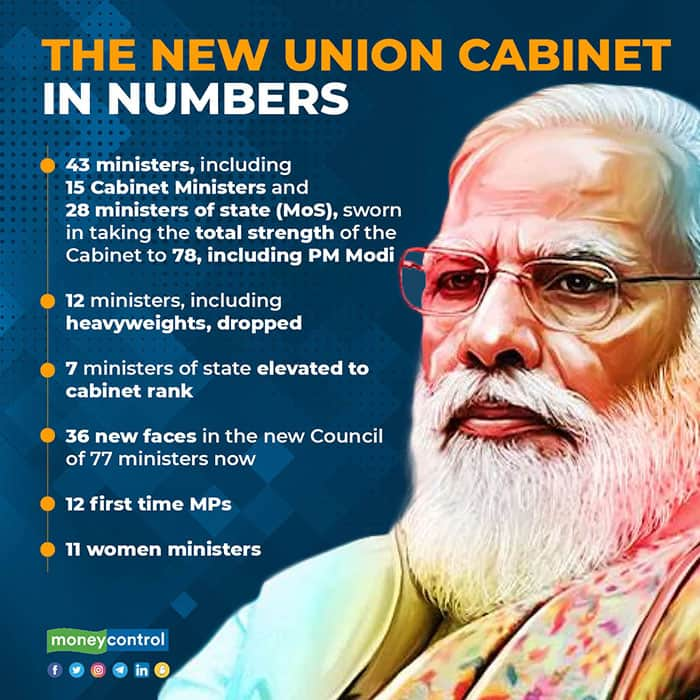
Almost half of the 77 ministers in Prime Minister Narendra Modi’s cabinet, after the much-awaited reshuffle, are new faces, including 12 first-time parliamentarians.
With a dozen ministers, including heavyweights at the helm of pandemic-hit sectors, shown the door and with the promotion of seven ministers of state, PM Modi has undertaken in what is a mid-term overhaul of the cabinet rather than a reshuffle, since he came to power for the second term in 2019.
Read: Portfolios assigned, Amit Shah gets Cooperation Ministry, Jyotiraditya Scindia is new Civil Aviation Minister; check full listThe carefully calibrated exercise keeps the assembly elections scheduled next year, the alliance arithmetic and the caste and regional factors in mind.
Observers say it is an attempt to strike a balance between politics and governance. There is more representation to socially and economically backward communities and preference has been given to ministers with upgraded skill sets with the addition of better qualified young professionals.
This comes at a time when the government’s image has been hit by a crisis of capacity and credibility.
I congratulate all the colleagues who have taken oath today and wish them the very best for their ministerial tenure. We will continue working to fulfil aspirations of the people and build a strong and prosperous India. #Govt4Growthpic.twitter.com/AVz9vL77bOExcluded matter as much as included— Narendra Modi (@narendramodi) July 7, 2021
While the entry of new faces, including Jyotiraditya Scindia, Narayan Rane and Sarbananda Sonowal is significant, equally important is the resignation of 12 ministers, including heavy weights such as Union Health Minister Dr Harsh Vardhan, Law and IT Minister Ravi Shankar Prasad, and Education Minister Ramesh Pokhriyal.
For the Opposition, the resignations meant a confession that the Modi government has failed in managing the pandemic.
“There is a lesson for ministers in these resignations. If things go right the credit will go to the PM, if things go wrong the minister will be the fall guy. That is the price a minister pays for implicit obedience and unquestioning subservience,” Congress leader P Chidamdaram said in a tweet.
The resignations of the Union Health Minister and the MoS Health is a candid confession that the Modi government has utterly failed in managing the pandemic — P. Chidambaram (@PChidambaram_IN) July 7, 2021
Vardhan, and his ministry, faced criticism over COVID-19 management while Prasad went amid the row between the Centre and Twitter over India's new social media rules.
Some leaders got promoted too, perhaps, to send a message across.
Kiren Rijiju, Hardeep Puri, Anurag Thakur, Mansukh Mandaviya and G Kishan Reddy were among seven Ministers of State (MoS) elevated to the cabinet rank.
Mandaviya is the new Health Minister, Rijiju got Law and Justice and Thakur becomes Minister of Information and Broadcasting and Minister of Youth Affairs and Sports.
More young faces, technocratsThe new Modi cabinet is younger than its previous form. The youngest member, Cooch Behar MP Nisith Pramanik, the new MoS (Home), is 35. In the cabinet that took oath along with PM Modi in May 2019, Smriti Irani, 43, was the youngest.
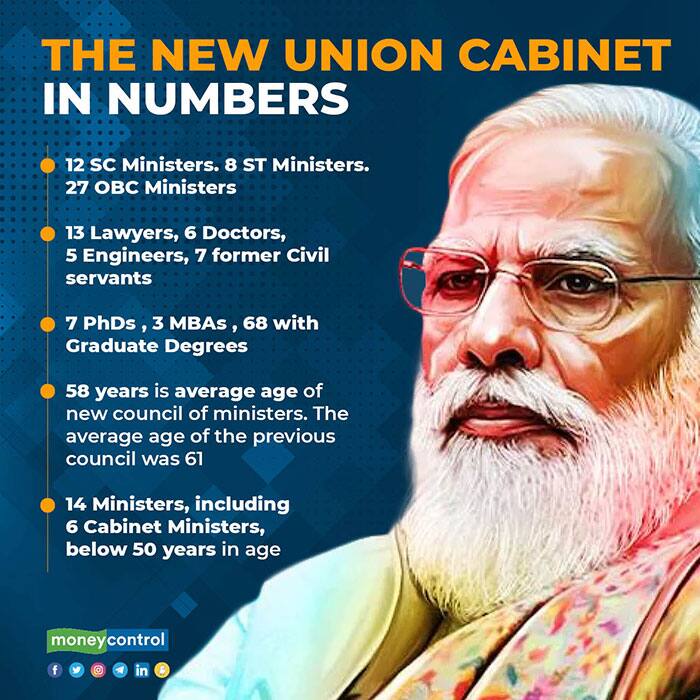
While the average age of the outgoing council was 61 years, the average age of the new council of ministers is 58 years.
“Most of the ministers who were dropped are above 60. The reshuffle got new and young faces. Clearly, young people are preferred over the old,” said a leader.
Among those shown the door, Harsh Vardhan and Ravi Shankar Prasad are 66; Prakash Javadekar is 70, DV Sadananda Gowda 68, Santosh Gangwar 72 and Thawarchand Gehlot, who becomes Governor of Karnataka,73.
The reshuffle factored in professional expertise as well. The new cabinet has 13 lawyers, six doctors, five engineers and five former civil servants. Besides, it includes seven with PhD degrees, three with MBAs and 68 with graduate degrees.
The new railway minister, Ashwani Vaishnav, for example, is 1994-batch IAS officer, an MBA from Wharton School, Pennsylvania University and an MTech from IIT Kanpur.
More allies have been accommodated. Before the rejig, Republican Party of India’s Ramdas Athawale was the only non-BJP minister in the Cabinet.
The new ministers representing allies include RCP Singh of the Janata Dal (United) and Anupriya Patel of Apna Dal (S), among others.
Also, read: Centre creates new 'Ministry of Cooperation'Twenty-five of the 36 new faces came from crucial castes and regions in states such as Uttar Pradesh, Maharashtra, West Bengal, Gujarat, and Karnataka, which together account for 200 Lok Sabha seats.
Uttar Pradesh, which will see assembly elections in 2022, has got seven new ministers, taking the state’s total to 14.
The party’s social engineering strategy reflects well after the reshuffle. There are 12 ministers representing Schedule Caste, eight ministers from Schedule Tribes and 27 ministers representing the Other Backward Castes, among 77 ministers.
“This shows inclusiveness. The time when BJP was perceived to be a Brahmin party has gone now with its roots in economically backward communities as well,” said a political observer.
The new cabinet has 11 women ministers, of which seven were inducted on July 7.
From the portfolios allotted post reshuffle, there was a clear indication that the PM Modi has undertaken an attempt to rationalise the ministries by clubbing many for greater synergy between them.
Health, Education and Labour, the pandemic-hit ministries got new faces.
Mansukh Mandaviya, 49, the leader from Gujarat and former MoS Chemicals and Fertilisers earlier, has been made Union Minister of Health and Family Welfare and Minister of Chemicals and Fertilizers.
Health and Pharma, which comes under the Chemicals Ministry, allocated to the same minister will bring the much-needed synergy between the two at a time when the country is fighting COVID-19 pandemic. The two ministries were with two different ministers in the previous cabinet.
Also, read: 7 immediate challenges for Jyotiraditya Scindia, the new Civil Aviation MinisterAnother aspect that the reshuffle brings with it is the implicit trust in new leaders by PM Modi.
Rajya Sabha member Bhupender Yadav, known for his organizational skills, gets the Ministry of Environment, Forest and Climate Change and Minister of Labour and Employment, the two portfolios held in the previous cabinet by now-dropped Prakash Javadekar and Santosh Gangwar.
“People like Yadav have proven their mettle as election organisers. Now it is time for them to prove themselves in governance. They have close to three years before 2024 general elections,” said a leader who did not want to be named.
Also, read | Cabinet Reshuffle: The rules and the process before the final names are announcedYadav is credited for being a war room strategist behind securing convincing victories for the BJP in the Assembly elections of Rajasthan (2013), Gujarat (2017), Jharkhand (2014) and Uttar Pradesh (2017).
He was the BJP's in-charge for the 2020 Bihar Legislative Assembly elections where JD(U)-BJP alliance returned to power.
केन्द्रीय मंत्रिमंडल में शपथ लेने वाले सभी नवनियुक्त मंत्रियों को हार्दिक बधाई! मुझे विश्वास है कि मा. प्रधानमंत्री श्री @narendramodi जी के नेतृत्व में आप सभी देश के विकास को गति देने में, अपना महत्वपूर्ण योगदान देंगे एवं आत्मनिर्भर भारत के संकल्प को साकार करेंगे।#Govt4Growth— Jagat Prakash Nadda (@JPNadda) July 7, 2021
By choosing 36 new faces in the 78-member council of ministers, including PM Modi, the government clearly wants to create a new generation of leaders.
Only two ministers in the new cabinet -- Rajnath Singh and Mukhtar Abbas Naqvi -- were also members in Atal Bihari Vajpayee’s cabinet.

Discover the latest Business News, Sensex, and Nifty updates. Obtain Personal Finance insights, tax queries, and expert opinions on Moneycontrol or download the Moneycontrol App to stay updated!
Find the best of Al News in one place, specially curated for you every weekend.
Stay on top of the latest tech trends and biggest startup news.