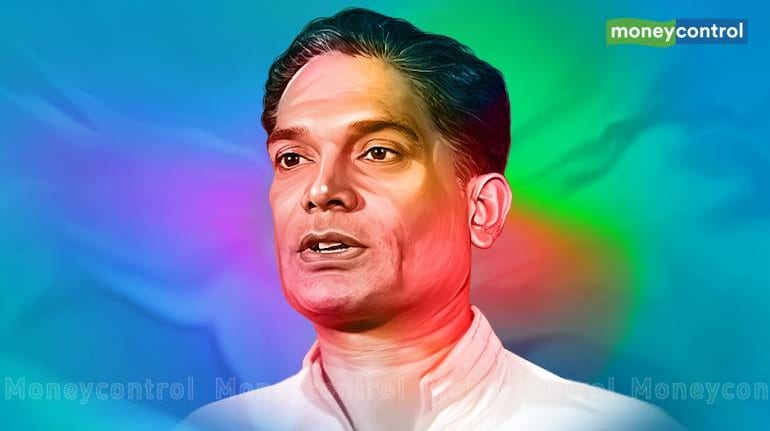
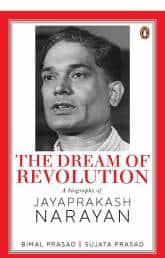
Jayaprakash Narayan, a political force for nearly half a century, was self-effacing, yet so visible that he was known just by his initials, JP. In their book “The Dream of Revolution: A Biography of Jayaprakash Narayan” - published by Penguin Random House India - JP's close associate Dr Bimal Prasad and his daughter Sujata Prasad present an account of JP’s life from his political awakening in the 1920s during his student years in the US to his ‘total revolution’ call to overthrow the Indira Gandhi regime in 1970s.
In an exclusive interview with Moneycontrol, Sujata Prasad, columnist, curator, heritage conservationist and co-author of the biography, talks about how JP adapted to the ideological shock of separating from communism by drawing closer to Mahatma Gandhi and why he thought of becoming Indira Gandhi’s adviser or mentor at one point in time. Edited excerpts:
When did you decide to write a biography of JP?The need to write the biography came after my father's death in November 2015. My father started work on the biography after completing 10 volumes of JP’s selected works. He left behind a very comprehensive blueprint. I began work on it a couple of years later. In a sense, this book is the keeping of a silent promise made to my dying father.
 The book is written by JP's close associate Dr Bimal Prasad and his daughter Sujata Prasad.What impact did seven years in the US have on JP’s political journey that started after he returned to India in 1929?
In 1922, JP set sail for America and would spend the next seven years there, moving across campuses. It was at Madison, a vibrant campus infused with radical politics, that JP was exposed to Marxism. Through the friends he made and the literature he consumed—all of Marx, Engels, Lenin, Trotsky and Plekhanov, among so much more—JP acquired a dynamic perspective of class and class consciousness. The Russian revolution resonated with JP and he began dreaming of a socialist revolution in India.
JP flirted with Marxism, armed revolution and eventually with Gandhism. Wasn’t he critical of Gandhi at a stage of his life?The genesis of JP’s lifelong pursuit of freedom and a just and fair order may well lie in the political and philosophical awakening of his student years in America. But it was upon his return to India in 1929 that he entered the real-life theatre of revolution and the freedom struggle. In 1934, the Congress Socialist Party (CSP) was set up and JP became its first secretary general.
READ: Nitish Kumar govt in Bihar sees red over varsity dropping thoughts of JP, Lohia from syllabus
Around that time, JP remained a fierce critic of Mahatma Gandhi. In his book “Why Socialism?”, published by the CSP in January 1936, JP laid out his uncompromising vision for socialism as it translated into the Indian context, and strongly criticised the alternative, Gandhism, deeming it a ‘dangerous doctrine’ that was deceiving the masses and encouraging the upper classes to continue their domination. But tumult within the Congress and events on the world stage and India would ensure JP’s stance on Gandhism and the Mahatma underwent a turnabout in the next few years.
After years of charting out a political line that was diametrically opposed to Gandhi’s, after debating, arguing and disagreeing with him, it was evident that JP adapted to the ideological shock of separating from communism by drawing closer to Gandhi.
JP wrote sweet, informal letters with birthday wishes to Indira Gandhi. What started the disagreements before Indira Gandhi imposed Emergency?When Indira Gandhi became prime minister for the first time in 1966, JP offered her his full support, looking forward to a new dawn. Having known Indira intimately since her childhood, one can safely speculate that JP thought of dipping his toes into mainstream politics as Indira’s adviser or mentor. He may even have imagined that she would establish with him the same sort of relationship that Nehru had with Gandhi.
Till about 1970, the disagreements between Indira and JP were without rancour. Things really came to a head after Indira’s overwhelming victory in the 1971 parliamentary election. JP expressed outrage at the government’s actions in Kashmir during the elections—which he saw as nothing less than tyranny of the state—and other electoral malpractices like impersonation, booth capturing and the use of money power that had reduced elections to a colossal farce.
Two really testy, flagrant areas of confrontation came up around this time. The first related to the 24th amendment to the Constitution passed in 1971, wherein the citizen’s fundamental rights and freedoms, as laid down in the Constitution, could not only be amended but also abrogated by Parliament. The second was the appointment of the chief justice of the Supreme Court, superseding three justices technically senior to him.
Also, read: Congress now as 'rigid' as Jayaprakash Narayan's Janata Party in 1977: Sitaram Yechury
This was unprecedented. JP was greatly alarmed at both these developments. His differences with Indira were now direct and public. Comparing her to Nehru, he said that while Nehru had been a democrat and a visionary, she was an autocrat who was killing democracy.

Discover the latest Business News, Sensex, and Nifty updates. Obtain Personal Finance insights, tax queries, and expert opinions on Moneycontrol or download the Moneycontrol App to stay updated!
Find the best of Al News in one place, specially curated for you every weekend.
Stay on top of the latest tech trends and biggest startup news.