Amidst the noise and hyperbole around the charismatic power of Generative Artificial Intelligence (GAI), specifically ChatGPT, there is a strong divide. Many stand by the originality and sanctity of their content sans GAI. Others embrace its efficiencies. They are also questions about whether GAI is a substitute for creative abilities or an enabler to supplement its effort in creating better content. We believe it’s beneficial for the media outlets, even though it brings new challenges that need answers.
The media industry, at present, is intensely competitive wherein only the fittest can survive. Given the information overload, attracting the user’s attention is becoming increasingly difficult. Keeping users engaged and loyal is yet another challenge. Only those media outlets which can deliver quality content at a faster speed can hope to survive and thrive. Yet, there is a limiting budget constraint that can’t be wished away.
If effectively used, GAI or its tools such as ChatGPT can help address the content problem of the media industry with respect to cost, quality and speed. It can also help in improving user engagement by curating customised content. At the same time, it can flag offensive content cost-effectively, and at a speed that humans can’t match.
Generating Content
AI can learn from existing content, data sets and information, and create new content based on those learnings and “abstracting the underlying patterns associated with input data” with the help of natural language processing (NLP) and machine learning.
AI can help analyse vast amounts of data, text, audio and video content, and generate new content, articles, stories and audio-video podcasts at a faster pace and far lower costs, a critical factor of success, given the time sensitive nature of the news business.
News story writers often have to deal with completely different topics on different days, for instance, GAI today and a financial scandal tomorrow. They may lack a basic understanding of the issues involved around a given topic they’re not familiar with. ChatGPT can be an efficient helping hand in such cases for gathering basic information by analysing existing works and delivering a gist. That can be like starting material to work on, for a better news story or opinion piece.
Media professionals can input an abstract or part of an academic article into ChatGPT and ask it to simplify it. Moreover, it can assist a journalist in preparing interview questions. One can list questions one has in mind for an interview subject, and ChatGPT will create more questions modelled after them. ChatGPT can also help in editing an article or news story or fact check and translating contents from one language to another. This is quite useful for Indian media companies where people speak dozens of languages.
Hyper-personalised Content
Similarly, given the intense market competition and availability of multiple media channels, the curation of content to give a personalised experience to users becomes crucial for customer engagement. Doing it manually is cumbersome and expensive, and therefore, impractical. But AI can easily and promptly analyse a user’s preference by looking into its background — demography, reading habits and political inclinations.
That is not all. The same news story or a report on an event can be tailored to a younger audience with visual appeal or delivered as an analytical piece for mature audiences. There could be audio-related personalisation too. One use case is cloning journalists' voices. Thus, one can train an AI with the voice of the audience's favourite presenter and have the synthetic voice read text articles and more. An avatar of a correspondent can answer viewers’ questions via chatbots or virtual assistants like Alexa.
Thus, AI can be used to give a hyper-personalised news and views experience to customers. That will improve engagement and help earn customer loyalty. That in turn will bring in more advertising revenues.
Flag Objectionable Content
Allowing users to post comments and share views on news articles, opinion pieces and social media posts, improves user engagement. However, many of those comments could be offensive and may need to be flagged. The challenge here for the media industry including social media platforms is how to moderate or block such objectionable user-generated content at speed and without incurring much costs. Humans can do the job but at a slower speed, and at very high costs. AI can also help in fighting fake news by verifying facts and help deliver quality news content.
However, the use of AI in the media raises ethical concerns. The first and foremost question is about ownership or copyright over content. Using an AI system to generate content that is “identical or substantially similar to existing copyrighted material” may infringe upon the original creator's IPR. Thus, media houses must figure out accreditation and copyright issues. Many argue that the use of AI must be disclosed upfront in generating media content. In times to come, such disclosures could be mandated by law.
There are also concerns about accountability and transparency in AI-generated content. The ability to manipulate content can have a severe impact on the public's perception of the media's integrity. Media outlets must exercise caution when using AI-generated content that may perpetuate biases and discrimination present in the data sets and information it learns from. It's important to ensure that the AI algorithms are fair and unbiased.
And, like every new technology, GAI too is perceived as a threat to jobs. Instead of us deliberating on the issue, we asked the devil itself to defend or assert. Here is what ChatGPT says on the concern of job loss.
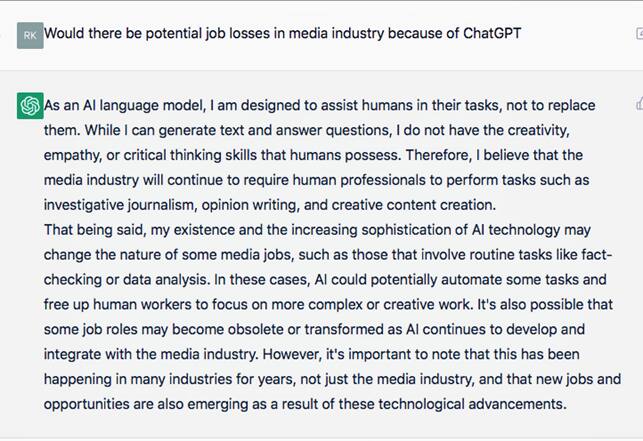
GAI and ChatGPT may threaten routine jobs such as data analysis, fact-checking or copy editing, but they may not kill jobs that require special skills or knowledge, for instance, investigative journalism. Rather, by collaborating with the likes of ChatGPT media persons can be more productive.
Ritesh Kumar Singh is a business economist and CEO, Indonomics Consulting Private Limited. He tweets @RiteshEconomist. Mahesh Narayan works for a leading consulting firm. Views are personal, and do not represent the stand of this publication.


Discover the latest Business News, Sensex, and Nifty updates. Obtain Personal Finance insights, tax queries, and expert opinions on Moneycontrol or download the Moneycontrol App to stay updated!
Find the best of Al News in one place, specially curated for you every weekend.
Stay on top of the latest tech trends and biggest startup news.