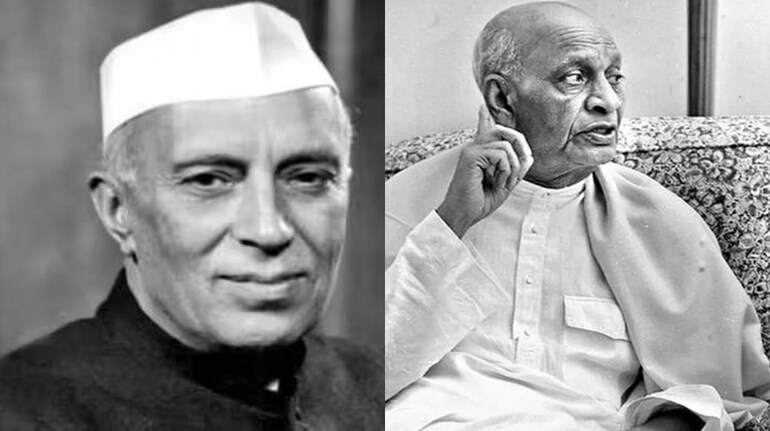
It couldn’t have been more ironic that the Congress Party is claiming itself to be the true heir of Sardar Vallabhbhai Patel’s legacy. The party’s highest decision-making body, the Congress Working Committee (CWC), met in Ahmedabad, Gujarat recently, which happens to be the home state of both Sardar Patel and Prime Minister Narendra Modi, and passed a resolution in this regard.
Let us take a look at how Sardar Patel was treated by his colleague and top Congress leader, Prime Minister Jawaharlal Nehru, both in life and in death, and one can understand why the Congress doesn’t have any right to claim the legacy of Sardar Patel.
M.K.K. Nayar, a well-known civil servant who worked in senior positions during the Nehru era, has recalled some of these incidents in his memoir The Story of an Era Told Without Ill-will.
On 30 April 1948, the Indian army withdrew from Hyderabad, and soon Qasim Rizvi (the founder of the dreaded Razakars, who killed Hindus in Hyderabad) and the Razakars began to behave licentiously all over the state. Mountbatten had returned to Britain, and Rajaji was the Governor-General. Nehru, Rajaji, and Patel were all aware of the unsafe situation in Hyderabad. Patel believed that the army should be sent to put an end to the Nizam’s high-handedness. At that time, the Nizam sent an emissary to Pakistan and transferred a large sum of money from his government account in London to Pakistan.
Nayar says, “At a cabinet meeting, Patel described these events and advised that the army may be sent to end the terror regime in Hyderabad. Nehru, who was usually calm, peaceful, and good-mannered, lost his self-control and said, ‘You are a total communalist, and I shall not accept your advice.’ Patel remained unfazed and left the room with his papers. He stopped attending cabinet meetings and even speaking with Nehru after that.”
Nehru and Patel did not agree on many issues. According to Nayar, Patel used to point out the shortcomings in Nehru’s approaches. “Almost everyone knows that the problem of the North-East began with Nehru’s policy. Patel had vehemently opposed Nehru’s plan to administer the North-Eastern region under the Foreign Ministry and differentiate it from the rest of India. He explained the repercussions of such a step, but there was no one in the cabinet to oppose Nehru. When implemented, it became easy for Christian missionaries to tell local people that they were not Indians and that theirs was another country because India’s Foreign Ministry dealt with it.”
Nehru created a new cadre, the Indian Frontier Administrative Service, to administer the region, but the selection process was similar to that of the Indian Foreign Service. However, except for one or two exceptions, everyone chosen was incompetent and did not have the required administrative calibre, says Nayar. Their clumsy rule and the poor control by the Foreign Ministry led to the flourishing of anti-national activities in Nagaland, Mizoram, Manipur, and the hill areas of Assam.
According to Nayar, “Incessant differences of opinion between Nehru and Patel caused Nehru to treat Patel with personal animosity. If the great Nehru was not above harbouring personal hatred, he would not have done two things he did on the day Patel died. He sent two orders to the Home Ministry, which arrived at V.P. Menon’s desk. The first was that the Cadillac car that Patel used should be returned the very next morning to the Foreign Ministry.”
“Patel died in Bombay. Nehru’s second memo instructed officers who wished to attend his funeral to travel at their own expense. V.P. Menon called officers from his ministry and, without divulging Nehru’s order, asked who was interested in attending the funeral. About a dozen officers expressed their desire. He bought their air tickets at his own expense. When Nehru learnt about it, he was annoyed even more,” recounts Nayar.
Nehru’s vindictiveness was reflected in the way he treated V.P. Menon, a brilliant administrator and true patriot who, alongside Sardar Patel, played a key role in getting Indian princely states to sign the Instrument of Accession.
Nayar, who worked closely with Menon, says, “After Patel’s death, Nehru decided to ignore V.P. Menon entirely. Thus, V.P. Menon, who was amongst the most brilliant administrators in Indian history, was eased out. A little before V.P. left the government, Nehru had appointed him as a stopgap Governor of Orissa when Asif Ali went on a short sabbatical. Even political tenderfoots knew that Nehru did not like hearing V.P. Menon’s name or having his contributions praised. So, they wilfully ignored and obliterated him and his unforgettable contributions to the unity, strength, and security of India.”
RSS and Sardar PatelThe RSS critics often raise the point that it was Sardar Patel who had banned the RSS in 1948. But they forget the fact that it was Prime Minister Jawaharlal Nehru who wanted the RSS banned and had apparently leveraged his position as Prime Minister to pressurise the then Home Minister, Sardar Patel. In fact, on the 29th day after Mahatma Gandhi’s assassination, i.e., 27 February 1948, Sardar Patel wrote to Nehru, where he categorically stated that all allegations against the RSS in connection with Gandhi’s murder had been found to be untrue.
Dwarika Prasad Mishra, a senior Congress leader who was also the Home Minister of the Central Provinces during that era, writes in his autobiography Living in An Era (P. 59), “That Mahatma Gandhi’s assassination gave unscrupulous politicians a handle to defame and, if possible, pull down their rivals is difficult to deny.” However, Nehru failed in his attempt to crush the RSS by falsely implicating it in Mahatma Gandhi’s assassination. His government had to lift the ban on the RSS on the midnight of 11 July 1949, as none of the charges against the RSS were found to be true.
Earlier RSSFACTS columns can be read here.
Discover the latest Business News, Sensex, and Nifty updates. Obtain Personal Finance insights, tax queries, and expert opinions on Moneycontrol or download the Moneycontrol App to stay updated!
Find the best of Al News in one place, specially curated for you every weekend.
Stay on top of the latest tech trends and biggest startup news.