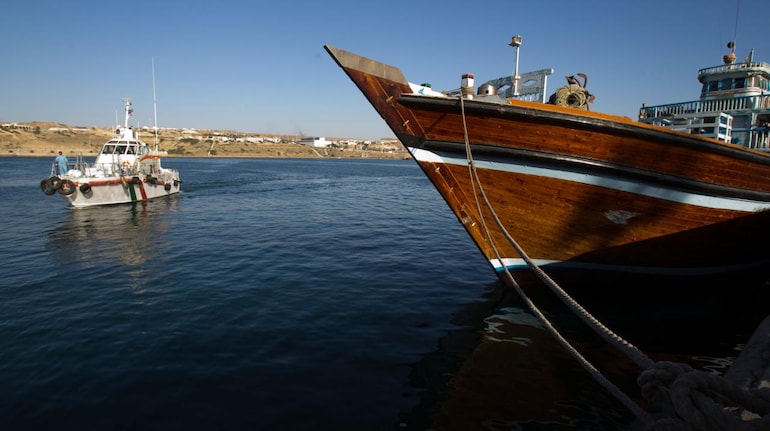

India, on Friday, signalled it will not walk away from Iran’s Chabahar port, highlighting the project’s strategic, economic and geopolitical importance even as a US sanctions waiver covering operations there approaches its April 26 expiry.
The Ministry of External Affairs (MEA) said New Delhi is in talks with Washington to ensure continuity. “On October 28, 2025, the US Department of Treasury issued guidance on a conditional sanctions waiver valid till April 26, 2026. We remain engaged with the US side in working out this arrangement,” MEA spokesperson Randhir Jaiswal said.
The stance comes amid tighter US sanctions on Iran and renewed warnings from US President Donald Trump that countries doing business with Tehran could face additional tariffs. While India was granted a temporary exemption for Chabahar, officials have ruled out any arrangement that assumes an eventual exit.
Chabahar: India’s only western corridor
At the heart of New Delhi’s insistence is geography.
Located on Iran’s south-eastern coast, Chabahar is India’s only viable western maritime corridor, providing direct access to Afghanistan and Central Asia while bypassing Pakistan, whose land routes remain largely closed to Indian trade.
For decades, India has faced bottlenecks in sending goods to Afghanistan due to Pakistan’s control over key crossings. Chabahar removes that constraint, offering a sea-based route that sidesteps regional chokepoints and political barriers.
Gateway to Central Asia and Europe
Chabahar is also central to the International North-South Transport Corridor (INSTC), a multi-modal network linking India with Iran, Russia and Europe through a combination of sea, road and rail links. The corridor is expected to cut transit time and logistics costs compared with traditional routes via the Suez Canal, strengthening India’s integration with Eurasian markets.
Beyond trade, the port holds energy significance. It can act as a conduit for imports from Iran and Central Asia, helping India diversify supply routes and reduce dependence on longer or politically sensitive shipping lanes.
Geopolitically, Chabahar gives India a strategic foothold in a competitive neighbourhood.
It is widely seen as a counterbalance to the China-backed Gwadar port in Pakistan, developed under the China–Pakistan Economic Corridor. Maintaining a presence at Chabahar allows India to retain influence in regional maritime connectivity rather than ceding space to rival infrastructure projects.
Trade, aid and long-term commitment
The port’s utility is not just strategic. By opening a gateway to landlocked regions, Chabahar expands India’s export reach and has already been used as a logistics hub for humanitarian assistance, including wheat shipments to Afghanistan.
India’s commitment is long term.
In 2024, New Delhi signed a 10-year agreement to operate a terminal at Chabahar through Indian Ports Global Limited and committed investments of around $120 million. According to PTI, India is in the process of transferring the committed funds while managing its exposure under the sanctions regime.
India first proposed developing Chabahar in 2003 to secure an alternative route to Afghanistan and Central Asia. Despite repeated disruptions due to sanctions on Iran, New Delhi maintains that the port remains indispensable to its regional connectivity strategy.
As Jaiswal reiterated, India continues to engage with the US to “work out the arrangement”, but the message from New Delhi is clear - Chabahar is not a short-term project, and exiting it is not an option.
Discover the latest Business News, Sensex, and Nifty updates. Obtain Personal Finance insights, tax queries, and expert opinions on Moneycontrol or download the Moneycontrol App to stay updated!
Find the best of Al News in one place, specially curated for you every weekend.
Stay on top of the latest tech trends and biggest startup news.