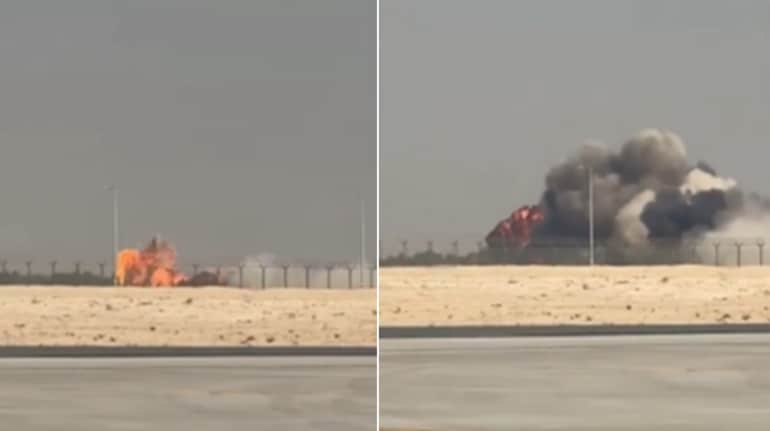
A fighter jet Tejas of the Indian Air Force crashed during an aerial display at the Dubai Air Show on Friday and the pilot died in the accident.
The IAF said a court of inquiry is being constituted, to ascertain the cause of the accident.
The video of the incident, now making the rounds on social media platforms, shows the aircraft soaring almost vertically into the sky, just moments before the crash.
How did the Tejas crash?Experts told India Today that the aircraft was executing barrel roll before it crashed. A barrel roll is an aerial maneuver where a plane simultaneously rolls and climbs in a helical path, completing a full 360-degree rotation while maintaining its general direction.
On Friday, the Tejas had aimed to execute a precise loop. It was initially pulling up, then going inverted, and then descending again. It was supposed to climb again.
According to exports, the jet was likely too close to the ground to again pull up and complete the manoeuvre. Khaleej Times reported that the fighter jet crashed into the ground soon after take-off. Photos and videos shared online show plumes of black smoke billowing into the air from the aircraft on the ground.
Experts told NDTV that the Tejas was executing a negative G turn before it slammed the ground.
Negative G-Force in aviation refers to forces acting on an aircraft and its contents in the opposite direction of normal gravity. These forces are typically experienced during aerobatic manoeuvres, sudden descent, or severe turbulence.
It is the force experienced by an object in a direction opposite to that of gravity. In aviation, negative G-force occurs when an aircraft accelerates downward or experiences a downward change in velocity, causing occupants to feel a sensation of weightlessness or "floating" within the aircraft cabin. Negative G-forces can occur during certain flight manoeuvres, such as aerobatics, dive recovery, or steep descents, where the aircraft's acceleration exceeds the force of gravity.
Pilots undergo specific training to manage and mitigate the effects of negative G forces during flight operations.
Discover the latest Business News, Sensex, and Nifty updates. Obtain Personal Finance insights, tax queries, and expert opinions on Moneycontrol or download the Moneycontrol App to stay updated!
Find the best of Al News in one place, specially curated for you every weekend.
Stay on top of the latest tech trends and biggest startup news.