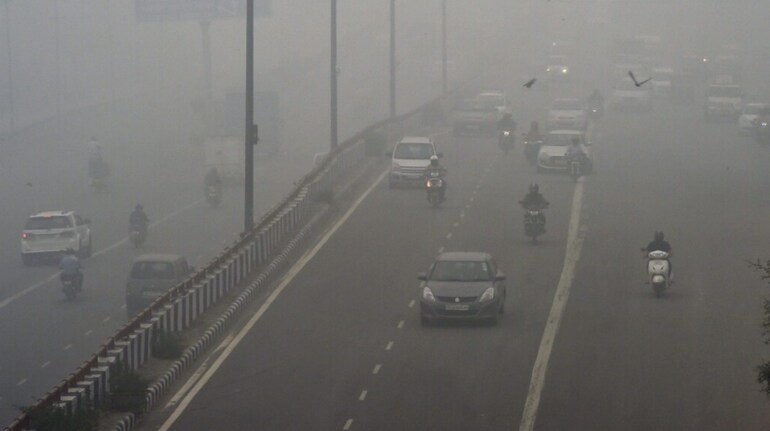

Nearly two-thirds of Delhi’s air pollution load in 2025 came from beyond the city’s boundaries, with emissions drifting in from surrounding NCR districts and neighbouring states outweighing pollution generated locally, according to a new analysis by the Centre for Research on Energy and Clean Air (CREA) reported by PTI.
Data from the Decision Support System for the winter months showed that around 65 per cent of the national capital’s PM2.5 pollution originated outside Delhi, while sources within the city accounted for about 35 per cent. The findings underline that transported pollution continued to be the dominant factor shaping Delhi’s air quality through much of the year.
“Transboundary pollution from NCR districts and neighbouring states plays a major role in Delhi's air pollution. Delhi's geographical location also makes it vulnerable, as northerly and north-westerly winds carry polluted air from surrounding regions into the city. Addressing Delhi's pollution crisis therefore requires coordinated, airshed-level action rather than city-specific measures alone,” said Manoj Kumar N, an analyst with CREA, as per PTI.
While pollution from outside the city dominated overall levels, the study found that vehicles remained the single largest contributor to locally generated PM2.5 during the winter period. Vehicular emissions made up close to half of Delhi’s local particulate pollution, exceeding the combined impact of industrial activity, construction dust and other combustion-related sources.
The analysis also pointed to a significant decline in the role of crop-residue burning during the 2025 winter season. Compared with the previous year, the contribution of stubble burning to PM2.5 levels dropped by about 10.6 per cent. During the crop-residue-burning window between October 15 and November 30, such fires contributed an average of 4.9 per cent to Delhi’s PM2.5 pollution in 2025, sharply lower than the 15.5 per cent recorded over the same period in 2024.
Daily trends showed that the highest stubble-burning influence in 2025 was observed on November 12, when it accounted for 22.47 per cent of PM2.5 levels. This was followed by 16.48 per cent on November 15 and 16.14 per cent on November 17. In contrast, the previous year saw much steeper spikes, including 37.52 per cent on November 15, 35.18 per cent on November 1, and 33.33 per cent on November 14.
Among NCR locations, Bahadurgarh emerged as the biggest external PM2.5 contributor in 2025. It recorded the highest particulate concentrations during January, October, November and December, with its annual average PM2.5 level estimated at around 173 micrograms per cubic metre.
Within Delhi, November remained the most polluted month in terms of fine particulate matter. The city’s average PM2.5 concentration for that month stood at 215 micrograms per cubic metre in 2025. Although still extremely high, this marked an improvement over November 2024, when the monthly average had touched 249 micrograms per cubic metre.
On a yearly basis, Delhi’s average PM2.5 concentration declined to about 96 micrograms per cubic metre in 2025, down from 105 micrograms per cubic metre a year earlier. This represented a year-on-year reduction of roughly 8.6 per cent.
For coarser particles, the analysis identified Dharuhera in Haryana as the largest external PM10 contributor during 2025. The town recorded an annual average PM10 concentration of nearly 278 micrograms per cubic metre, driven mainly by elevated pollution levels in October, November, and December.
November again stood out as the worst month for PM10, with average concentrations in Delhi reaching about 365 micrograms per cubic metre in 2025. In comparison, PM10 levels had been even higher in November 2024, at around 395 micrograms per cubic metre. Over the full year, Delhi’s average PM10 concentration fell to approximately 197 micrograms per cubic metre in 2025, compared with 211 micrograms per cubic metre in 2024, a decline of about 6.6 per cent.
Air Quality Index data reflected these modest gains. Delhi’s annual average AQI was 201 in 2025, with the city not recording a single ‘good’ air quality day. The year saw 79 days classified as satisfactory, 121 as moderate, 86 as poor, 71 as very poor and eight as severe.
In 2024, Delhi had logged fewer satisfactory days at 66, while the number of severe days was much higher at 17. The count of very poor days remained broadly similar at around 70. According to the analysis, the marginal improvement in 2025 was largely due to better air quality conditions during June and July, which helped pull down the annual average AQI.
(With inputs from PTI)
Discover the latest Business News, Sensex, and Nifty updates. Obtain Personal Finance insights, tax queries, and expert opinions on Moneycontrol or download the Moneycontrol App to stay updated!
Find the best of Al News in one place, specially curated for you every weekend.
Stay on top of the latest tech trends and biggest startup news.