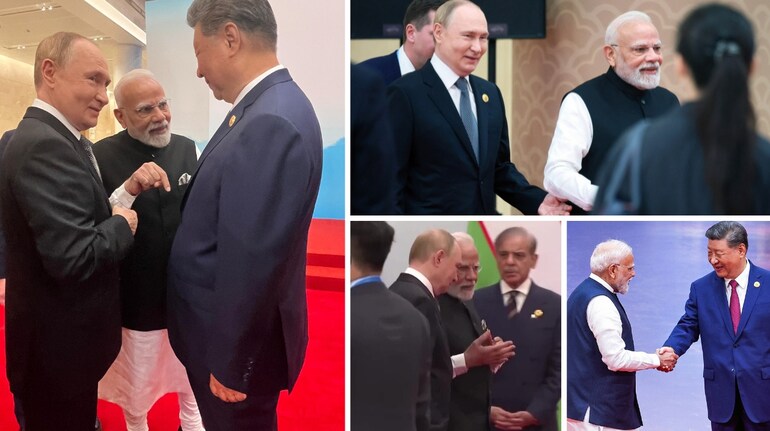
The Shanghai Cooperation Organisation (SCO) Summit in Tianjin, China has emerged as one of the most consequential global gatherings since US President Donald Trump imposed sweeping tariffs on America’s trading partners, including India. The summit brought together India, Russia, and China on a single platform, delivering powerful images and a message of solidarity as major economies explore ways to cushion themselves against the ripple effects of Washington’s trade war.
High on both optics and substance, the summit produced several highlights and positive diplomatic takeaways for India. Here are the big takeaways:
India pulls off a diplomatic coup de grâce against PakistanPrime Minister Narendra Modi seized the opportunity to call out Pakistan-sponsored terrorism before the entire world in the presence of Prime Minister Shehbaz Sharif.
Read Also: 5 pictures from SCO Summit that send big message to the worldDuring the summit, Modi articulated India’s strong stance against terrorism, condemning “some countries” for openly supporting terror and reaffirming that such “double standards” are unacceptable.
He cited the Pahalgam terror attack as an open challenge to all nations that believe in humanity, urging SCO members to unite in the fight against terrorism. “India has been bearing the brunt of terrorism for the last four decades. Recently, we saw the worst side of terrorism in Pahalgam. I express my gratitude to the friendly countries that stood with us in this hour of grief.”
Later, in the Tianjin Declaration, SCO member states strongly condemned the Pahalgam attack and echoed India’s position that “double standards” in combating terrorism are unacceptable. The declaration vindicated New Delhi’s stand and emphasized that the “perpetrators, organisers, and sponsors of such attacks must be brought to justice.”
An image of Shehbaz Sharif looking on as Modi and Putin walk past him while interacting animatedly summed up the isolation Pakistan faced at the gathering.
A message for the USThe summit took place against the backdrop of Trump’s trade war on India and his criticism of New Delhi’s purchase of Russian oil. The photo-ops underscored the bonhomie between India, China, and Russia, hinting that Trump’s trade gamble may be laying the foundations for a revised geopolitical order.
PM Modi shared one of the most striking images from the summit on X, showing him walking alongside Putin and Xi while engaging in conversation.
Michael Kugelman, Director of the South Asia Institute at the Wilson Center, observed that the summit highlighted the convening power of China and Russia while capitalizing on growing global discontent—especially in the Global South—towards the US.
Eric Olander, editor-in-chief of the China-Global South Project, told Reuters that the summit was about “really powerful optics.” He added: “Just look at how much BRICS has rattled Donald Trump, which is precisely what these groups are designed to do.”
Reuters columnist Clyde Russell argued even before the summit that “Trump’s tariffs on India risk having the opposite effect of what he intended, with the side consequence of driving a country that had been something of an ally into the arms of US opponents.”
During the summit, Xi Jinping called for safeguarding the UN-centred international system and rejecting bloc confrontation and bullying practices. “We must promote a correct historical perspective on World War II, and oppose the Cold War mentality, bloc confrontation and bullying practices,” he said—a statement widely seen as a direct message to the U.S.
The veiled references to Washington throughout the summit came in the wake of Trump’s crippling tariffs on several countries—tariffs that a US. Appeals Court has since ruled “illegal.” The US imposed a 50 percent tariff on India, including an additional 25 percent penalty for its purchase of Russian oil.
PM Modi’s straight talkThough Modi and Xi projected unity at the summit, India did not shy away from raising issues central to its territorial integrity.
During his talks with Xi, Modi flagged the issue of cross-border terrorism and sought Beijing’s support—a significant move, given China’s consistent blocking of India’s efforts to blacklist Pakistan-based terrorists.
Foreign Secretary Vikram Misri said cross-border terrorism was mentioned by PM Modi as a “priority.”
When asked whether Modi raised the Pahalgam attack and the use of Chinese equipment by the Pakistan Army during the May military conflict, Misri declined to give specifics: “All I’ll say is that, without going into the specifics, the issue was discussed. It was raised by the Prime Minister, and he outlined his understanding very, very crisply and very specifically on this issue.”
PM Modi also raised objections to China’s Belt and Road Initiative (BRI), which passes through Pakistan-occupied Kashmir. He stressed that connectivity projects must respect sovereignty and territorial integrity, citing this as a core principle of the SCO Charter. “Connectivity that bypasses sovereignty loses trust and meaning,” he said.
Repairing strained tiesThe summit also gave Modi an opportunity to repair strained bilateral relations with countries such as China and Turkey.
He said India and China had held “very fruitful discussions” after the BRICS Summit in Kazan in 2024, which had set a positive direction for bilateral ties. “After the disengagement on the border, an atmosphere of peace and stability has been created,” he noted.
Modi highlighted recent positive developments, including an agreement between the two countries’ Special Representatives on border management, the resumption of the Kailash Mansarovar Yatra and the reintroduction of direct flights. He emphasised that the interests of 2.8 billion people depend on India-China cooperation.
Separately, a video of Modi greeting Turkish President Recep Tayyip Erdogan with a firm handshake and a pat on the back on the sidelines of the summit went viral. The warm gesture stood out against the backdrop of tensions following Operation Sindoor, during which Ankara had supported Pakistan.
Discover the latest Business News, Sensex, and Nifty updates. Obtain Personal Finance insights, tax queries, and expert opinions on Moneycontrol or download the Moneycontrol App to stay updated!
Find the best of Al News in one place, specially curated for you every weekend.
Stay on top of the latest tech trends and biggest startup news.