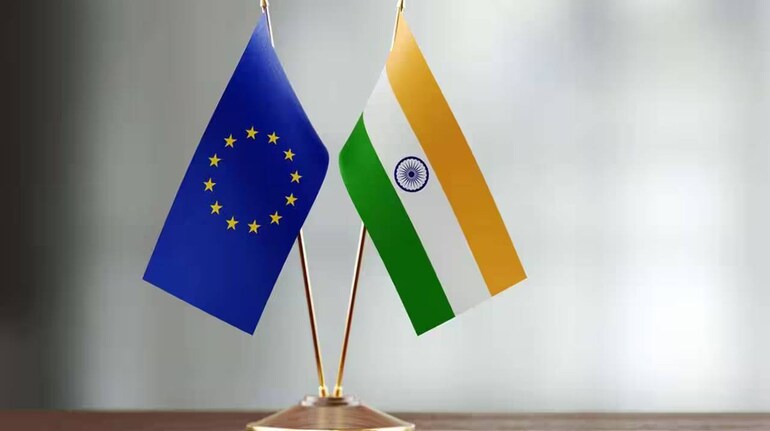

The free trade agreement (FTA) between India and the European Union will be dynamic in nature whose benefits will materialise only if the government and the private sector leverage the opportunities it creates, Ernst & Young (E&Y) chief policy advisor DK Srivastava said on January 28.
A day earlier, India and EU finalised an agreement after talks that stretched over two decades, slashing tariffs on most goods with aim to boost trade.
“I see tremendous potential in the FTA with the EU. It is going to be dynamic and evolving, which will not happen by itself,” Srivastava told Moneycontrol in an interaction. “The private sector and the government will have to take advantage of the openings that will become available.”
The agreement offers India a chance to deepen its integration with European markets. Srivastava said trade agreements by themselves do not guarantee outcomes and must be backed by coordinated policy action, investment decisions and industry preparedness to translate market access into real economic gains.
The FTA will now go through a multi-stage process before it can be implemented. The final text will undergo what is referred to as “legal scrubbing”. Legal experts on both sides will vet the final text to ensure compliance with domestic and international laws.
It will also have to be ratified by the European Parliament and individual countries. A process that typically takes a year or more.
Defence co-production
Alongside with the trade pact, India and the EU agreed to security and defence partnership and enhanced dialogue on strategic ties.
One of the areas with significant potential is defence manufacturing, particularly through joint ventures, he said.
“I see tremendous scope, as there is a strategic agreement on defence co-development and co-production. The maximum potential will be in that area,” Srivastava said.
Such partnerships can help Indian firms scale up manufacturing capabilities and integrate with global markets. “India can initiate a number of joint ventures in all of these areas so that we can access not only our large domestic market but also the EU market and the world market as a whole, and can give the benefit of economies of scale,” Srivastava said.
According to him, FTA’s success will depend on how strategically India responds to the opportunities that emerge. “It is an evolving scenario, and it depends on how we play it,” he said.
Budget 2026: Focus on AI
Srivastava said the Union Budget will play a critical role in determining how effectively India can capitalise on opportunities in sectors that require high upfront investment and are technology-intensive.
“The Union Budget should allocate higher amounts so that co-production and co-development in defence initiatives and advanced technology sectors like artificial intelligence and data centres can be encouraged,” he said.
Technological capability would be a decisive factor in these sectors. Predictable policy support and adequate budgetary allocations would be essential to crowd in private investment, he said.
16th Finance Commission
On the 16th Finance Commission, Srivastava said India needs a well-balanced system of fiscal transfers that supports both the Centre and the states over the long term without creating structural stress.
“In the longer term, we look for a system of fiscal transfers so that it leaves both Centre and states’ finances in good financial health,” he said. “Excessive transfers or deficient transfers from the Centre to states are problematic.”
While the 16th Finance Commission has completed its work and submitted its report to President Droupadi Murmu, the recommendations will be made public only after being laid before Parliament, a process that will coincide with the presentation of the Budget.
“The Finance Commission is supposed to establish that kind of balance to leave both tiers in suitable fiscal balance,” Srivastava said.
'Justice' to lower-income and mineral-rich states
On horizontal devolution, Srivastava called for stronger equalisation to address disparities among states. “On the horizontal side, inter-state distribution among states, we look at a system with the content of equalisation in overall transfers so that justice can be done to lower-income states and mineral-rich states that have suffered so far,” he said.
Such states should also gain from India’s expanding economy, Srivastava said, advocating a more equitable distribution framework that ensures neither the Centre nor the states are fiscally disadvantaged.



Discover the latest Business News, Sensex, and Nifty updates. Obtain Personal Finance insights, tax queries, and expert opinions on Moneycontrol or download the Moneycontrol App to stay updated!
Find the best of Al News in one place, specially curated for you every weekend.
Stay on top of the latest tech trends and biggest startup news.