







The India–European Union free trade agreement (FTA) includes a “lesser duty” rule, under which anti-dumping or countervailing duties should be applied only as much as is necessary to remove injury to domestic industry.
“If a Party takes a decision to impose an anti-dumping duty or a countervailing duty, the Party shall, in accordance with its law, apply a duty less than the margin of dumping or a duty less than the subsidy margin, as the case maybe, where such lesser duty would be adequate to remove the injury to the domestic industry,” the draft agreement states.
The provision appears in the chapter on Trade Remedies, which is part of the text of the full agreement released on February 27.
The FTA also includes public interest safeguards, preventing authorities from applying trade remedies if doing so clearly does not benefit the public, considering domestic industry, importers, users, and consumer groups.
It does preserve global safeguard rights under WTO rules, including Article XIX of GATT 1994 and WTO safeguard and agriculture agreements.
Under the FTA’s global safeguard provisions, any country among the five largest suppliers of a product over the past three years is considered to have a substantial interest. These suppliers must be notified and given a chance to consult before safeguard measures are applied.
The FTA also allows bilateral safeguard measures, such as suspending further tariff reductions or increasing customs duties, but strictly within duration limits.
Measures may be applied for up to two years, extendable by another two, and cannot overlap with WTO safeguard measures for the same product.
Provisional safeguards may be applied for up to 200 days, with tariffs refunded if investigations find they are not justified.
Authorities applying bilateral safeguards must also offer consultations on compensation. If parties cannot agree within 30 days, the affected party may temporarily suspend equivalent concessions, but only for the minimum period necessary.
All safeguard investigations must follow clear procedural rules: authorities must notify the public, hold hearings, allow parties to be heard, consider all relevant evidence, complete investigations within 12 months, and document the causal link between imports and injury while protecting confidential information.
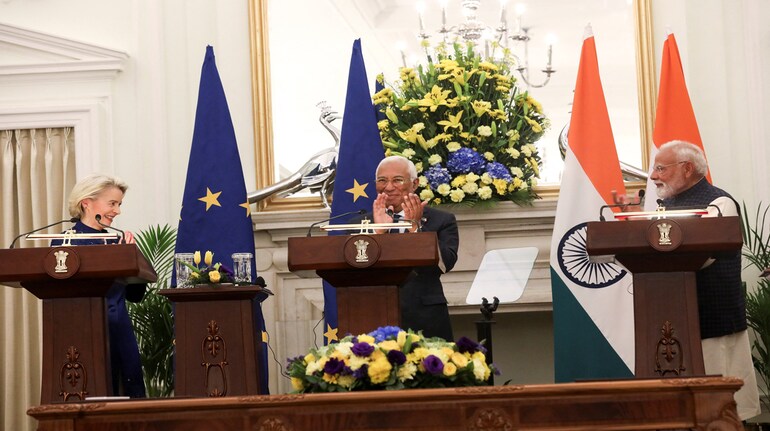
India and the EU reached the long-delayed agreement last month to reduce tariffs and increase trade between them.
Discover the latest Business News, Sensex, and Nifty updates. Obtain Personal Finance insights, tax queries, and expert opinions on Moneycontrol or download the Moneycontrol App to stay updated!
Find the best of Al News in one place, specially curated for you every weekend.
Stay on top of the latest tech trends and biggest startup news.





