The US and Israel’s attack on Iran is certain to impact India’s trade. If the war continues for longer than a few days, the agriculture and food economy will also face inflationary pressure, as imports of crude oil and fertilisers will become more expensive. India’s agricultural exports have a large market in the Middle East and North Africa (MENA), and they will also be affected. The gains from recent trade deals may also face adverse impacts.
In the last few years, India has negotiated a string of major trade pacts with Oman, New Zealand, the United Kingdom and the European Free Trade Association (EFTA) in 2025 and early 2026. Before this, the Economic Cooperation and Trade Agreement (ECTA) with Australia (2022) was a major breakthrough. In February 2026, a framework for an interim agreement on reciprocal trade was also agreed with the US, though its future is unclear due to the judgment of the US Supreme Court.
Agriculture trade
For agriculture, the critical question is not how many tariff lines have been liberalised, but whether the trade agreements actually expand India’s agricultural surplus.
India’s agricultural exports rose from USD 39.1 billion in 2014–15 to USD 51.9 billion in 2024–25, led by rice, marine products, spices, meat and sugar. However, India’s agricultural imports also grew from USD 21.2 billion to USD 38.5 billion during the same period. These imports are dominated by edible oils, pulses, dry fruits and select high-value foods.
India’s agricultural trade surplus declined from USD 17.9 billion to USD 13.4 billion over this period, as imports of edible oils, pulses and high-value food items increased.
FTAs have increased in recent years
Between 2020–21 and 2024–25, India’s merchandise trade with countries covered under FTAs grew by 92 per cent, compared with 41.5 per cent growth in India’s global trade. However, not all trade deals are of equal importance. For example, FTAs with Australia, New Zealand and the European Union are likely to be more meaningful than those with Oman and the UK.
The trade agreements with Oman and the UK fall into the category of low-risk export expansion. Both are high-income, food-importing markets with limited competition for India’s farm products. Duty-free access for marine products, boneless buffalo meat, eggs, processed foods and selected oils can improve India’s competitiveness in these markets.
In Oman, Indian buffalo meat and egg exports dominate the import basket, so tariff elimination could further increase exports.
Similarly, in the UK, the removal of duties on shrimp (previously up to 8.5 per cent), instant coffee, tea and spices could accelerate India’s exports. This could benefit fish farmers in Andhra Pradesh and Kerala.
Trade with Australia after ECTA (2022)
ECTA with Australia was considered a highly successful breakthrough. Australian agricultural, fisheries and forestry exports to India increased from USD 329.6 million in 2019 to USD 1.14 billion in 2023. India’s agricultural exports to Australia increased more slowly, from USD 310.35 million to USD 468.5 million during the same period.
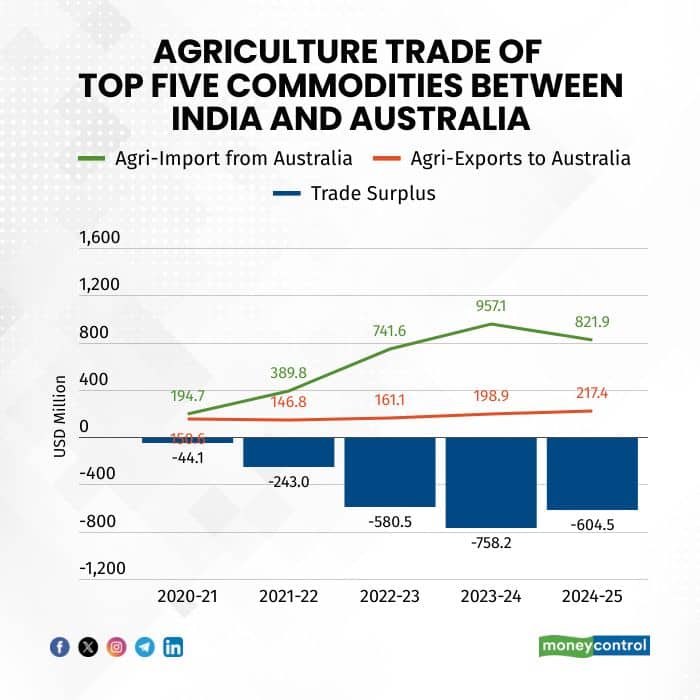
India’s agricultural imports of the top five commodities from Australia (lentils, raw cotton, greasy wool, almonds and wheat) increased from USD 194.7 million in 2020–21 to USD 821.9 million in 2024–25 (Figure 1).
During the same period, India’s agricultural exports of the top five commodities to Australia (rice, food preparations NES — not elsewhere specified — vegetable saps and extracts, coffee and bakery items) increased from USD 150.6 million to USD 217.4 million.
India and Australia also signed a Mutual Recognition Arrangement for organic products in September 2025. This reduces compliance costs and paperwork for exporters and makes it easier for Indian exporters to access the Australian market. India’s organic food exports to Australia reached USD 8.96 million in FY 2024–25. If India improves its certification process for organic produce, there is an opportunity for higher exports of organic food.
Agreement with New Zealand (December 2025)
New Zealand is among the world’s most efficient dairy exporters, with large farms, high productivity and modern supply chains. Although dairy has largely been kept off the table in India’s negotiations, even calibrated tariff-rate quotas for products such as infant milk formula may introduce structural risk. For India, the export opportunity in New Zealand’s small domestic market is relatively modest.
Agreement with the EU (January 2026)
The EU is both a large consumer market and a heavily subsidised agricultural producer through its Common Agricultural Policy. Preferential access for Indian processed foods, tea, coffee, spices, table grapes and marine products could open high-margin segments. Marine exports to the EU are already about USD 1 billion. A reduction in tariffs to zero may substantially increase India’s share in the EU’s USD 53.6 billion seafood market.
For this to happen, large investments in food processing will be required. The Ministry of Food Processing Industries needs greater budgetary support to promote an integrated modern supply chain for marine products.
The EU is also an exporter of high-value foods, including olive oil, processed dairy, confectionery and meat products. While sensitive sectors such as dairy, cereals and poultry remain excluded from the agreement, tariff reductions in processed food categories may gradually expand imports into India’s growing affluent market.
Conclusion
Agreements with Oman and the UK are likely to provide only a modest boost to agricultural exports. However, the agreement with the EU has the potential to significantly increase exports. The trade agreements with the EU and New Zealand require careful calibration to ensure that market access does not become market exposure.
Ultimately, the success of these FTAs will not be measured by the number of tariff lines eliminated, but by whether they expand India’s agricultural surplus while safeguarding the viability of its small farmers.
(Kriti Khurana is a PhD scholar of economics at BITS Pilani, Hyderabad. Siraj Hussain is a former Union Agriculture Secretary.)
Views are personal and do not represent the stand of this publication.
Discover the latest Business News, Sensex, and Nifty updates. Obtain Personal Finance insights, tax queries, and expert opinions on Moneycontrol or download the Moneycontrol App to stay updated!
Find the best of Al News in one place, specially curated for you every weekend.
Stay on top of the latest tech trends and biggest startup news.