








Finance Minister Nirmala Sitharaman has proposed several important changes to the direct tax system, announcing that the new Income Tax Act, 2025, will be implemented from April 1, 2026. The proposal was made while presenting the Union Budget 2026-27 in the Lok Sabha, marking her ninth consecutive Budget.
The new law aims to replace the long-standing Income Tax Act, 1961, with clearer language, simpler rules, and easier compliance. The government states that the reform seeks to reduce confusion, resolve disputes, and simplify tax filing for individuals and businesses.
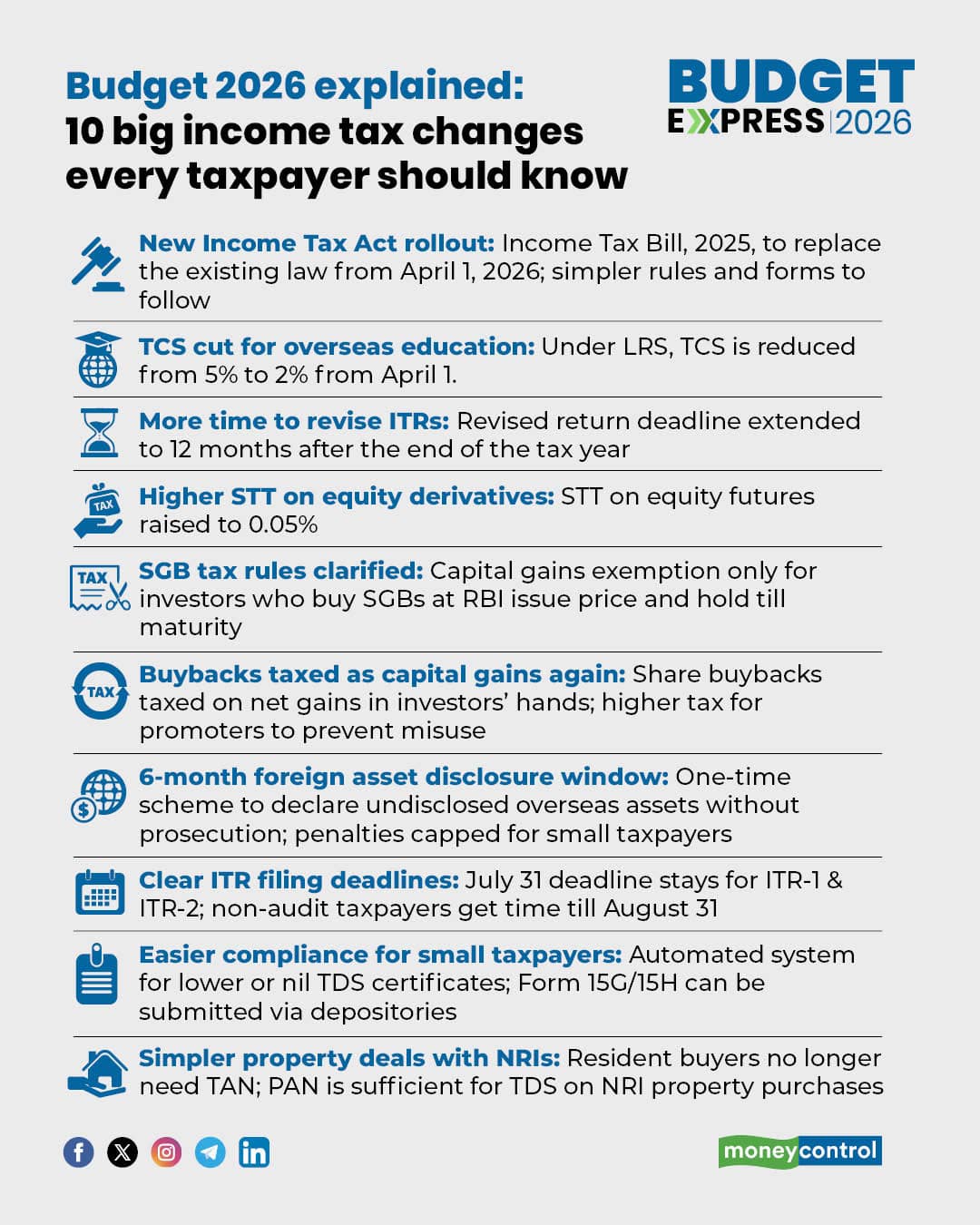
Here is the list of 10 major announcements made in Budget 2026.
1) Reduce TCS for pursuing education abroad
In her Union Budget 2026-27 speech, Finance Minister Nirmala Sitharaman announced a cut in Tax Collected at Source (TCS) on overseas remittances made under the Liberalised Remittance Scheme for education and medical treatment. The rate will be lowered from 5% to 2%, starting April 1, 2026. The move is intended to ease cash flow pressure on families sending money abroad for studies or healthcare.
2) Belated filers will get time to revise returns
The proposal seeks to extend the filing deadline for a revised return from nine months to 12 months after the end of the relevant tax year. At present, both belated returns and revised returns share the same deadline of nine months. This means taxpayers who file a belated return near the cut-off date get no real chance to make corrections later. The change aims to fix this issue by giving extra time only for revised returns, while the deadline for belated returns will remain unchanged.
3) STT increase on equity futures
Equity derivatives traders will face a new cost increase due to the announcement of an increase in the Security Transaction Taxin the Union Budget. The proposal states that STT on equity futures will rise from 0.02 per cent to 0.05 per cent, and the levy on options trades will go up from 0.1 per cent to 0.15 per cent, making futures and options trading more costly.
4) Income tax rules for SGB to change
At present, investors who hold Sovereign Gold Bondsuntil maturity do not pay capital gains tax on redemption. To remove ambiguity, the government plans to clearly define eligibility for this benefit. Under the proposal, the tax exemption will apply only to investors who purchase SGBs at the original RBI issue price and hold them until maturity. Those purchasing SGBs later in the secondary market may lose this tax advantage and be subject to capital gains tax.
5) Budget 2026 brings back capital gains tax on buybacks
Budget 2026 has restored taxation of share buybacks as capital gains, allowing investors to pay tax only on net profits instead of the full proceeds. This corrects a costly anomaly under the current dividend tax system and eases the burden on long-term investors and HNIs. The change also makes buybacks more attractive than dividends. However, a higher capital gains tax has been introduced for promoters to prevent misuse.
6) Introduction of 6 month foreign asset disclosure scheme for taxpayers
FM has announced a one-time six-month foreign asset disclosure scheme to encourage voluntary compliance. The move allows taxpayers to declare undisclosed overseas income or assets without facing prosecution. Small taxpayers, students, salaried employees and NRIs are the main focus. Fully non-compliant taxpayers with assets up to Rs 1 crore must pay tax and a penalty substitute, while partially compliant taxpayers with assets up to Rs 5 crore can regularise by paying a Rs 1 lakh fee.
7) ITR deadline clarity explained
FM said the July 31deadline for filing ITR-1 and ITR-2 will stay unchanged under Budget 2026. Non-audit taxpayers, like small businesses and trusts, can file by August 31. Revised returns will be allowed until March 31 with a small fee. The Budget also eases TDS rules for non-resident property transactions and offers a one-time window for foreign asset disclosure.
8) Ease for taxpayers
A scheme for small taxpayers is proposed, under which a rule-based automated process will enable small taxpayers to obtain a lower or nil deduction certificate instead of filing an application with the assessing officer. To ease taxpayers holding securities across multiple companies, the budget proposes enabling depositories to accept Form 15G or Form 15H from the investor and forward it directly to the relevant companies.
9) Penalties introduced for crypto non-reporting
Budget 2026 proposes strict penalties for crypto exchanges that fail to report crypto-asset transactions under Section 509 of the Income Tax Act, 2025. Non-compliance will attract a penalty of Rs 200 per day, while inaccurate reporting can lead to a fine of Rs 50,000. The rules take effect from April 1, 2026, amid concerns flagged by the Central Board of Direct Taxes over undisclosed crypto income.
10) Property purchases from NRIs become simpler for resident buyers
The Union Budget 2026 has eased property purchases for NRIsby removing the requirement for resident buyers to obtain a Tax Deduction and Collection Account Number (TAN). Buyers can now deduct tax using their PAN instead. Tax experts say the previous rule caused delays and confusion, especially for one-time buyers. The change is expected to simplify compliance and speed up property registration and transactions.

Discover the latest Business News, Sensex, and Nifty updates. Obtain Personal Finance insights, tax queries, and expert opinions on Moneycontrol or download the Moneycontrol App to stay updated!
Find the best of Al News in one place, specially curated for you every weekend.
Stay on top of the latest tech trends and biggest startup news.





