

Finance Minister Nirmala Sitharaman, while presenting the Budget 2026 on February 1, chose to keep the capital gains tax structure unchanged. The move offers continuity for investors and businesses at a time of global uncertainty, signalling the government’s intent to avoid fresh tax shocks. Market participants had been watching closely for any tweaks, but the status quo prevailed.
Capital gains tax in India is levied on profits from the sale of capital assets, such as property, shares, or mutual fund investments. This profit is taxed in the financial year in which the capital asset is sold.
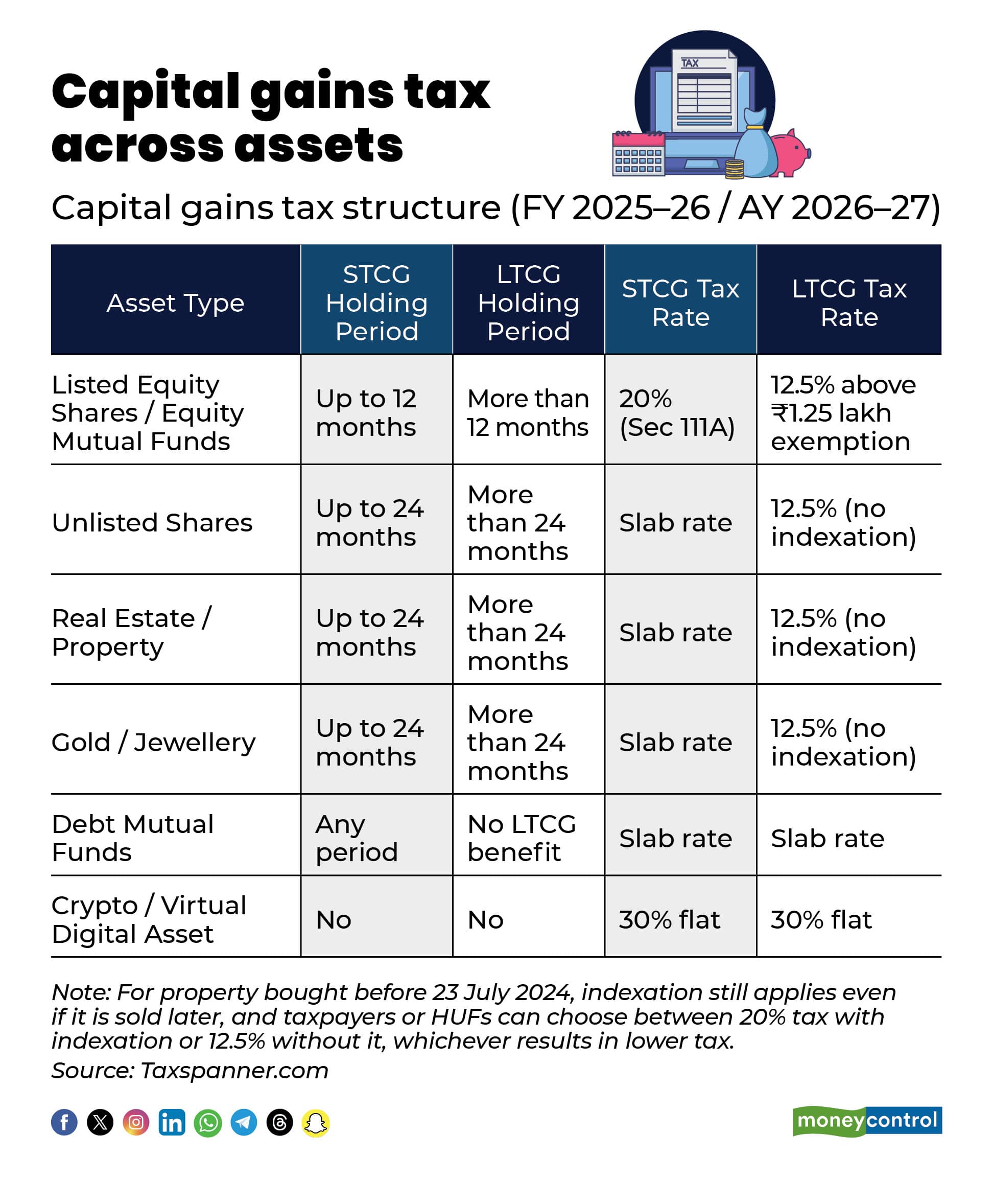
Capital gains are classified as short-term or long-term, depending on the period the asset is held before sale. Gain from the sale of an asset is considered Short-term if it is owned for up to 24 months before sale. If an asset is sold after 24 months of ownership, then it is considered long-term.
For assets such as listed equity shares, equity-oriented mutual funds, etc., if held for up to 12 months before sale, the income from their sale is treated as long-term.
For FY 2025–26, India’s capital gains tax regime has been simplified and rationalised with new tax rates and holding-period norms applying from July 23, 2024. Long-Term Capital Gains (LTCG) on most assets—including listed shares, equity-oriented mutual funds, real estate and other capital assets—are taxed at a flat 12.5% without indexation, replacing the earlier varied rates.
Under Section 112A, the annual exemption for LTCG on listed equity and equity-linked units has increased to ₹1.25 lakh; gains above that are taxed at 12.5%. Tax on LTCG from the sale of any asset is 12.5%.
"If LTCG are from the sale of listed equity shares, equity-oriented mutual funds, etc, then an exemption of ₹1.25 lakh is provided. These taxes are increased by Surcharge, if applicable and Education Cess of 4%," said Mihir Tanna, Associate Director of Direct Tax at SK Patodia & Associate LLP.
Tax on Short-Term Capital Gains (STCG)is 20% in case of sale of assets like listed equity shares, equity-oriented mutual funds, etc. Tax on Short-term capital gains from the sale of any other asset is levied at the regular rate of income tax.
Sudhir Kaushik, Co-founder & CEO, Taxspanner (a Zaggle company) said, "STCG on listed equity and equity funds (with STT paid) are now taxed at 20% under Section 111A, while STCG on other assets is added to your total income and taxed at your normal slab rate."
"Indexation benefits have been largely removed for most assets, further simplifying calculations and bringing greater uniformity across capital gains taxation for the year," said Kaushik.
Points to note

Discover the latest Business News, Sensex, and Nifty updates. Obtain Personal Finance insights, tax queries, and expert opinions on Moneycontrol or download the Moneycontrol App to stay updated!
Find the best of Al News in one place, specially curated for you every weekend.
Stay on top of the latest tech trends and biggest startup news.