






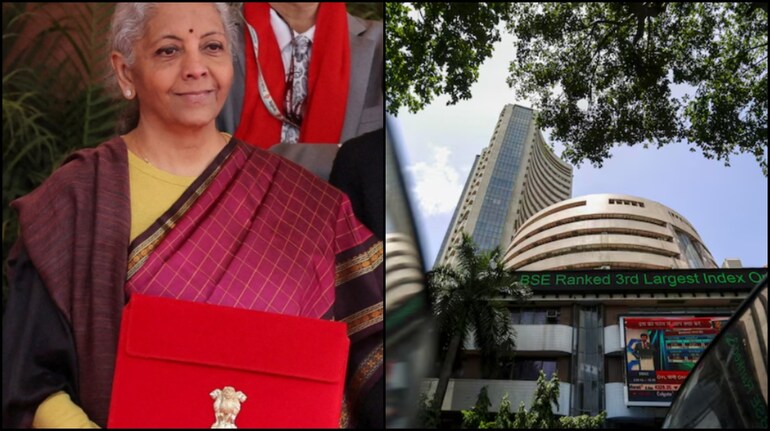

Indian stock markets saw significant decline on February 1 after Finance Minister Nirmala Sitharaman presented Union Budget 2026 in the Lok Sabha. Analysts have pointed out what bothered the markets, while what triggered pockets of buying during the trading session.
Sensex fell nearly 1,547 points (around 1.9 percent) to end the session at 80,722.94. Nifty 50 meanwhile plunged over 495 points (nearly 2 percent) to close at 24,825.45.
Despite the sharp selloff, markets did see some recovery in between. This was driven by several positive announcements in the Budget.
Finance Minister Nirmala Sitharaman on February 1 proposed to tax buyback for all shareholders as capital gains. She however added that promoters will pay an additional buyback tax.
Amit Gupta, Partner at Saraf and Partners, said buyback taxation was again tweaked back to being characterized as capital gain. "The buyback taxation regime was revamped in past budgets wherein entire amount received through buy-back was to be taxed as dividend for preventing promoter profit extraction and abuse. This recalcitration as capital gains is a welcome change and would pacify the concerns of taxpayers around buy-back route taxation," the expert said.
As a result, the shares of IT companies, who are known to have declared most of the major buybacks, gained in trade. Wipro and Tata Consultancy Services (TCS) shares rose around 2 percent each. LTIMindtree, Persistent Systems and Infosys shares also ended the session in the green.
Easy Trip, and other tourism stocks jumped after the Finance Minister announced several measures to boost the sector. She proposed to develop 15 archaeological sites, including Sarnath and Hastinapur, into vibrant cultural destinations as part of a broader push to boost heritage tourism.
She also proposed to reduce TCS rate on the sale of overseas tour programme package. While presenting the Union Budget 2026, Sitharaman said the Budget aims to reduce TCS rate on these packages from the current 5 percent and 20 percent to 2 percent without any stipulation of amount.
The shares of several jewelers surged after Finance Minister Nirmala Sitharaman kept rates on customs duty unchanged for import of gold and silver. EMS stocks also rose after she announced a Rs 40,000-crore outlay for the sector.
Along with these measures, Finance Minister proposed to build 5 medical tourism hubs in India, pushing hospital stocks higher up. Meanwhile, textile stocks rose after she announced several measures to expand and modernise India’s textile sector, with plans to set up mega textile parks through a challenge mode framework.
Fisheries and semiconductor stocks also gained in trade.
While presenting Budget 2026, Finance Minister Nirmala Sitharaman raised STT on futures to 0.05 percent from 0.02 percent. This was seen as a significant reason for the market crash today, as investors on the contrary had expected significant relief on this front.
For every Rs 1 lakh worth of futures sold, traders will now pay Rs 20 in STT instead of the previous Rs 12.50, explained Ashish Singhal, Co-founder of Lemonn. For a Rs 10,000 option contract sale, STT increased to Rs 10 from Rs 6.25, he added.
“As the current STT framework does not differentiate between various categories of users or the purpose of derivative usage, genuine hedging activity is subject to the same higher costs as speculative trading. This uniform treatment could discourage some investors from employing prudent hedging strategies, effectively increasing their exposure to market risk and making portfolio protection more expensive,” the analyst said.
"The steep increase in STT on futures and options, coming on top of last year’s hike, is likely to raise impact costs for traders, hedgers, and arbitrageurs. This could cool derivative activity and lead to a reduction in volumes. The intent appears to be volume moderation rather than revenue maximisation, as any potential revenue gain could be offset by lower derivative volumes," said Shripal Shah, MD & CEO, Kotak Securities.
As a result of the STT hike, capital markets stocks plunged. MCX shares dropped 12 percent, while Angel One and BSE shares fell more than 8 percent each.
PSU Bank stocks declined sharply, pushing the Nifty Bank index down amid concerns over potential mergers and elevated government borrowing. “Govt has set up a high-level committee to review the banking sector, and this committee could potentially be mandated to look for mergers among public sector banks. Historically, bank mergers tend to create near-term drag on performance," said Anand Dama, head, BFSI Research, Emkay Global.
The absence of significant incentives for foreign investors, who have withdrawn $23 billion from local equities since the start of 2025, also hurt sentiment. "At a time when India needs to deepen market liquidity and attract global flows, raising frictional trading costs sends the opposite signal," said Jimeet Modi, founder and chief executive at SAMCO Group.
The shares of defence companies also tumbled in trade as Finance Minister Nirmala Sitharaman’s capex plans for the sector failed to meet analysts and industry’s expectations. While presenting Budget 2026, Finance Minister Nirmala Sitharaman pegged FY27 defence expenditure at Rs 5.94 lakh crore, up from Rs 5.68 lakh crore in FY26.
Defence capital expenditure has increased 21 percent year-on-year, with the allocation for defence modernisation seeing a sharper 24 percent rise over last year.
Follow all LIVE updates on Budget here.
Disclaimer: The views and investment tips expressed by experts on Moneycontrol are their own and not those of the website or its management. Moneycontrol advises users to check with certified experts before taking any investment decisions.Discover the latest Business News, Sensex, and Nifty updates. Obtain Personal Finance insights, tax queries, and expert opinions on Moneycontrol or download the Moneycontrol App to stay updated!
Find the best of Al News in one place, specially curated for you every weekend.
Stay on top of the latest tech trends and biggest startup news.





