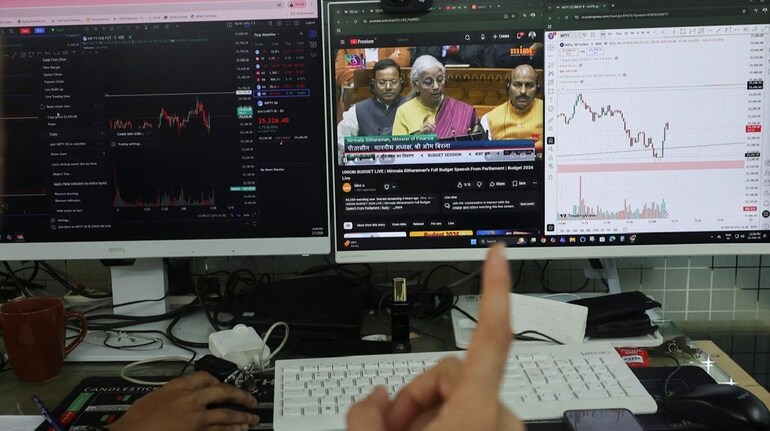

The benchmark equity indices Sensex and Nifty declined sharply in special trading session on February 1 as investors booked profits after Finance Minister Nirmala Sitharaman proposed an increase in the Securities Transaction Tax (STT) on derivatives. The government said move is aimed at curbing excessive speculation in the futures and options (F&O) segment.
Reversing the early gains, the Sensex crashed sharply by 2,370.36 points or 2.88 percent to slide below the 80,000-mark at 79,899.42. The barometer settled at 80,722.94, down 1,546.84 points or 1.88 percent.
The Nifty tanked 495.20 points or 1.96 percent to settle at 24,825.45. During the day, it tumbled 748.9 points or 2.95 percent to 24,571.75.
The BSE-listed firms erased about Rs 11-lakh crore in capitalisation amid sharp sell-off.
State Bank of India tanked 5.61 percent, while Adani Ports lost 5.53 percent. Bharat Electronics, ITC, Tata Steel, UltraTech Cement and Reliance Industries were also among the laggards. Tata Consultancy Services, Infosys, Sun Pharma and Titan were the gainers. Market breadth was negative as about 1673 shares advanced, 2296 shares declined and 158 shares unchanged.
Bank Nifty was down 2 perent. MCX was amongst top Midcap loser, falls more than 11 percent. The broader market also felt the heat, as the Nifty Midcap 100 slipped by 2.23 percent and Nifty Smallcap 100 fell by 2.73 percent.
Sudeep Shah, Head - Technical and Derivatives Research at SBI Securities, said "Market breadth remained weak, with the advance–decline ratio skewed heavily towards decliners; in the Nifty 500 universe, 330 stocks ended the session in negative territory, highlighting the widespread impact of the sell-off."
1) Increase in STT: Finance Minister Nirmala Sitharaman said the STT on futures contracts would be raised to 0.05 percent from 0.02 percent. "STT on options premium and exercise of options are both proposed to be raised to 0.15 percent from the present rate of 0.1 percent and 0.125 percent respectively," she said.
"The increase in STT, particularly in futures and options, is likely to act as a marginal negative for FPI flows, especially for high-frequency and derivative-focused global funds," said Aakash Shah, Technical Research Analyst at Choice Equity Broking.
FPIs have already remained cautious, with equity outflows of over Rs 41,000 crore in January 2026, amid global risk-off sentiment, elevated US bond yields, and currency pressures. In this environment, higher STT further compresses post-tax returns, making India relatively less attractive for short-term and derivative-oriented foreign investors, Shah added.
"The Finance Minister’s proposal to raise STT on futures to 0.05% is structurally negative for the capital market ecosystem, particularly F&O-driven businesses. Higher transaction costs are likely to reduce trading volumes, dampen short-term momentum, and lower profitability for active market participants. FII participation in derivatives may also moderate as post-tax trading efficiency declines, impacting overall liquidity.
"This can create a cascading effect on revenue streams of broking companies, exchanges, AMCs, and depositories, which are closely linked to market turnover. With derivatives volumes already shrinking in recent months, the hike may further pressure near-term earnings visibility. While fiscally supportive, the measure poses headwinds for capital-market-linked stocks," Raj Gaikar, Research Analyst, SAMCO Securities, said.
2) India VIX rises: The India VIX, a measure of market volatility and investor uncertainty, rose over 12 percent to 15.10. A rise in the volatility index typically indicates higher nervousness among investors, often leading to cautious trading and increased short-term fluctuations in equity markets.
3) Selling in PSU bank shares: The PSU bank index fell over 4 percent amid sharp selling by investors, emerging as the worst-performing sectoral index. The Nifty Public Sector Bank index recorded the biggest decline among major sectoral indices.
Shares of Bank of India and Bank of Baroda led the losses, falling 7 percent and 6 percent, respectively. UCO Bank and Punjab & Sind Bank declined the least, shedding 2 percent and 2.7 percent, respectively. All the 12 constituents of the index ended in the red.
Shrikant Chouhan, Head Equity Research at Kotak Securities, said "Today, the benchmark indices witnessed a volatile trading session. After a roller coaster activity, the Nifty ended 495 points lower, while the Sensex was down by 1546 points. Among sectors, almost all the major sectoral indices were traded in to the red but Capital Market, Defence, and PSU Banks indices lost the most, shed over 5 percent."
"Technically, after a sharp intraday dip in the second half of the day, the market trimmed some losses. From the day's lows, the market bounced back sharply. On daily charts, it has formed a long bearish candle, and it is currently trading below the 200-day SMA (Simple Moving Average), which is largely negative. We are of the view that the short-term market texture is volatile, and volatility is likely to continue in the near future. Hence, level-based trading would be the ideal strategy for day traders. On the higher side, 25,000/81300 would act as a crucial resistance zone. As long as the market is trading below this level, weak sentiment is likely to prevail. On the downside, the correction wave is likely to continue till 24650-24600/80100-79900. Further down side may also continue which could drag the index till 24500-24300/79600-79000. On the flip side, above 25,000/81300, the market could move up to 25,200/81900 or 200day SMA ."
Sudeep Shah, added "The banking benchmark Bank Nifty also came under significant pressure on Budget Day, witnessing a sharp decline in line with the broader market sentiment. The index slipped below both its 20-day and 50-day EMA, signalling a weakening short term trend. Intraday selling dragged the index to a low of 57783, from where it managed to stage a mild pullback. On the daily chart, Bank Nifty has formed a bearish candle with a lower shadow, highlighting heavy intraday volatility followed by marginal recovery attempts. Going forward, the zone of 57800–57700 is expected to offer immediate support. A sustained move below 57700 may intensify the downside and pave the way for further correction toward 57200, followed by 56500 in the short term. On the upside, the 50 day EMA zone of 59000–59100 will act as a crucial resistance area."
Disclaimer: The views and investment tips expressed by investment experts on Moneycontrol.com are their own and not those of the website or its management. Moneycontrol.com advises users to check with certified experts before taking any investment decisions.

Discover the latest Business News, Sensex, and Nifty updates. Obtain Personal Finance insights, tax queries, and expert opinions on Moneycontrol or download the Moneycontrol App to stay updated!
Find the best of Al News in one place, specially curated for you every weekend.
Stay on top of the latest tech trends and biggest startup news.