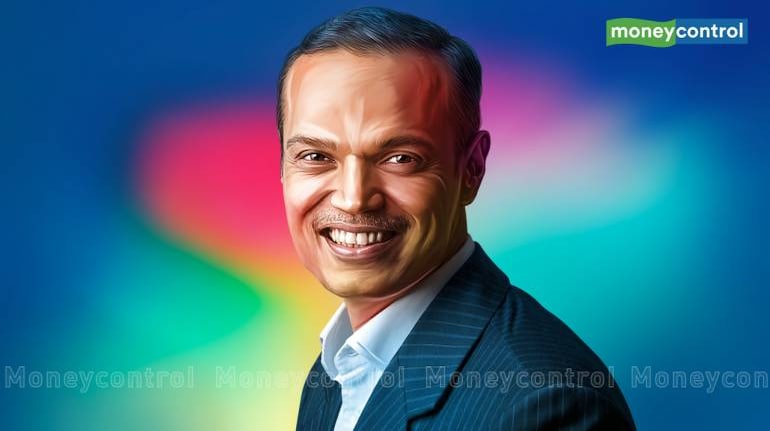
In a conversation with Moneycontrol, Ridham Desai, managing director, Morgan Stanley India, spoke about how investors can navigate the bull market, on how India’s dependency on global growth and capital has reduced and what to look out for in the days ahead. Edited excerpts:
How do long-term equity investors handle the fact that we are going to witness a long structural bull run and the fact that you have to navigate these corrections and downturns whenever they arise?
Indian markets have actually done quite well over time. On a 25-year trading basis, the MSCI India index compounded in US dollar terms at 10 percent. The US stock market, which is supposed to be the mecca of investing, has done 6.2 percent. That's how well India has done and I think there are reasons to believe we will continue on this path. If you take a 15- to 20-year view, there will be volatility along the way. I do detect rising volatility in the coming 12 months, if not for anything, just for the fact that the starting point of volatility is so low that it is bound to undergo some reversion. And, of course, we have a large number of events with binary outcomes lined up. And when there are binary outcomes, the market will invariably produce more volatility. If you don't come with a long-term mindset, then I think there's going to be a lot of difficulty, but if you do, then you will be okay in the long run, even amidst this volatility. I wouldn't worry too much about it, but you have to structure your portfolio in order to overcome any risk of major downdrafts that could come along the way.
Also watch: Morgan Stanley's Ridham Desai lists 6 most important things to watch out for in 2024
Where are we in terms of the economic and market cycles?
To understand these, we will need to use two proxies. GDP growth defines the economic cycle while earnings growth and share prices/trailing returns define the market cycle.
The notion that in the long run earnings equal to GDP is correct. But that's really long-term, like 50-100 years. In the middle of that, you could get 10-15 years of earnings cycles that deviate materially from GDP. So, if you do a logarithmic plot of India's nominal GDP and earnings, we have deviated to the downside on earnings for almost 10 years between 2010 and 2021, which is where earnings were well below GDP trend. Now, over the last two years, there has been a catching up, but we are still actually below (the GDP trend). It is safe to say that this will now go above trend GDP and will then actually stay there and then mean revert back to trend GDP.
On top of this, share prices do even wilder swings. In the long run again, returns on shares do not deviate materially from nominal GDP, because earnings do not deviate from nominal GDP. The fact is that ultimately share prices reflect real earnings, not necessarily accounting earnings but cash flows. So, ultimately share prices will come back to GDP trend and if India's nominal growth over the next 10-20 years is less than what it has been for the last 30-40 years, then it goes without saying that India’s return on share prices will also be less than what they have been for the last 30-40 years. I am of the view that the earnings cycle is on its way up and here to stay for a fairly lengthy period. And it's probably going to go above trend GDP and therefore, share prices will follow suit or will lead the earnings cycle. The market have not accounted for that (earnings overshooting) fully.
Why is that happening?
There are three things that have happened which are noteworthy. First is that we've had macro stability (includes stability in inflation and growth) like never before. As a country we’ve changed our approach to inflation. So we've as a country changed our approach to inflation. Prior to 2015, before the law was etched, that the RBI's sole mandate is inflation, we've oscillated between growth and inflation as an objective for the central bank depending on the mood of the day. Now this macro stability has been earned from hawkishness on inflation.
The other aspect of macro stability is our dependence on the world to grow. That dependence comes from two things, the trade that we do with the world and the capital that we get.
Since the last eight or nine years, we are no longer dependent on global capital markets to fund our growth. And we are trading in a very different way from the rest of the world in terms of how our terms of trade have evolved. And we are now less susceptible to adverse movements around the world, especially in oil. The oil intensity of this economy has gone down because of two reasons—GST (goods and services tax) and the ubiquitous availability of electricity. A lot of long-term market participants will know that 15-20 years ago, diesel genset companies used to be toast of the town because every home in India needed to have a diesel genset or an inverter since the supply of electricity was not reliable. That has changed. Every single one of India’s 600,000 villages has electricity now. So our consumption of diesel as a primary source to generate electricity has declined and, therefore, consumption of oil.
GST has eradicated interstate borders. Prior to 2017, trucks would line up for hours outside state borders to pay the toll tax, to pay the interstate tax, to pay all the taxes. Corruption aside, it involved a lot of fuel consumption. Trucks used to move a lot more slowly on our roads. Even cars that pass through toll nakas (booths) had to line up for hours because we did not have electronic toll nakas. That's changed. So the amount of time that we're spending on the road has reduced, therefore the amount of fuel that we're consuming has reduced. If you look at the oil intensity of India's economy, it has declined sharply in the last 15 years. Fifteen years ago, when we were a $1 trillion economy, we were consuming 100 million barrels of oil (a year). Today we're doing 150-160 million barrels. We're nearing up to $4 trillion (economy). We've quadrupled as an economy, our net oil consumption is up 60 percent.
If you see our terms of trade, we are now exporting a lot more services to the world. In the last three years, our services exports on a net basis have doubled. Our market share in physical goods exports has improved. And the most critical thing is that we are no longer dependent on global capital markets to fund that saving deficit that we have. Now, since a large part of our deficit is funded by FDI (foreign direct investment), which is less sensitive, at the stock market level, our correlation with oil, with Fed funds rate and with US growth has crashed.
The second piece is the focus on profits. I think this administration announced that in 2019, when they cut corporate tax rates and essentially said that we are in this economic model where we're trying to boost corporate profits, because that will lead to higher investments and more jobs and a virtuous economic cycle. It's a more reliable way to generate growth than to undertake social spending and consumption.
And the third thing is this shift that happened in 2015, when we allowed retirement funds to invest in stocks. It is very similar to what (US) President (Ronald) Reagan had done in 1980 when he allowed 401K plans in America to invest in stocks and what you got then was a subsequent 20-year bull market, which only ended with the NASDAQ bubble when the index traded at 100 times earnings. We're nowhere close to that. And because our demographics are different, I think this is not a 20-year story for India, this could be a 40-year story. So the bull market is underpinned.
In consumption we've just arrived at the sweet spot of $2,500, where a lot of staple consumption peaks out and discretionary consumption takes off. We have unmatched digital infrastructure, which is allowing the government to undertake social transfers, which has made it possible for banks to open accounts to the hitherto unbanked who were not commercially viable. So suddenly, financial penetration is way above our per capita income. At the current per capita income we have, the amount of financial penetration we have achieved is unparalleled in world history. So a lot of these things have happened and that underpins the economic cycle, which looks very good.
What about the risks to this?
There are risks. The risk is global, because the world is not as good as it used to be. It's heavily indebted. It's slowing down. And it's also ageing. So this is no longer 5 percent global growth environment. It is more like 3 percent. We do have that headwind, because as we try to trade more with the slowing world, we will rely on acquiring market share to ensure that our terms of trade remain intact. I think we will acquire market share. We will more likely double our market share in the next few years across the board.
The other headwind is our own political cycles, they keep coming and going and any change in administration brings with it some uncertainty, volatility, some setback in investments. So we have to keep an eye on that. Geopolitics continues to feed its pushes and pulls. I think our farm sector requires reforms. That's another headwind that we run into.
But I think generally speaking, our economic cycle should be okay. Our earnings cycle, I think, is on its way up, when companies will gain share in profits. We peaked at 7 percent in 2010, went all the way down to 2 percent just after COVID broke out, we're now back to 5 percent. I reckon in this cycle we'll go past our previous peak.
The US at its peak 12 months ago was at 13 percent. Share profits in GDP is 13 percent. This determines how profits are linked to GDP. How do we gain share in profits? Profits gain share when the investment cycle happens. Because the main anchor to earnings is investments. And we're starting at a low point on investments, low point on corporate leverage. This is a good setup for earnings to gain share in GDP. Earnings, I think, will trend better than GDP and, therefore, share prices will actually do a whole lot better. And then of course, the question arises on the headline multiples. I think they are okay, they're not exuberant. Of course, they're not cheap. But I tell investors that if India gets cheap, you're not going to buy it.
Why is that?
Because it will only get cheap in a crisis and everybody will run away. The problem about this desire that stock multiples got a little lower is getting a little too cute. If they fall 5-15-20 percent, of course they can. Are they going to fall 50 percent? Well, they can, but that will be a crisis, you will not buy stocks then. Because then fear will grip the world and people will say no, this is not a place I'm coming to. So I think the market keeps giving 10 percent corrections and everybody bids into those corrections. You could even get a longer correction. You could get a deeper correction. And some of these events may go against us, say, for example, in 2024, the corrections could get deeper, but I don't think it upsets the overall dynamics of a long-term cycle that we are in. And what underpins this ultimately is demographics. We have a young population that is highly aspirational, that wants to win. And it's a force that's very difficult to counter. I think people should not even for a moment underappreciate how much the rising lower middle-income group wants to succeed and that's our driving force and that is not an advantage almost any other country in the world can take.
Are we saying that the market are catching up still?
Earnings are playing that catch-up. In a large part, that catch-up is done now. There's still a little bit of a gap left. I think it will be covered in the subsequent 12 months and then earnings will start its ride to go above trend, because that's what it usually does. Of course, I have reasons to believe that, because investments drive that, terms of trade drive it and those are factors that favour earnings right now so that it will go above trend. Prices anticipate that. The market is not oblivious to this, that we are in a new earnings cycle which is taking earnings a whole lot higher. It's not stupid. The market collectively is very smart, but it is unlikely that it is fully priced in. So there is still room for this to surprise us on the upside.
Disclaimer: The views and investment tips expressed by investment experts on Moneycontrol.com are their own and not those of the website or its management. Moneycontrol.com advises users to check with certified experts before taking any investment decisions.
Discover the latest Business News, Sensex, and Nifty updates. Obtain Personal Finance insights, tax queries, and expert opinions on Moneycontrol or download the Moneycontrol App to stay updated!
Find the best of Al News in one place, specially curated for you every weekend.
Stay on top of the latest tech trends and biggest startup news.