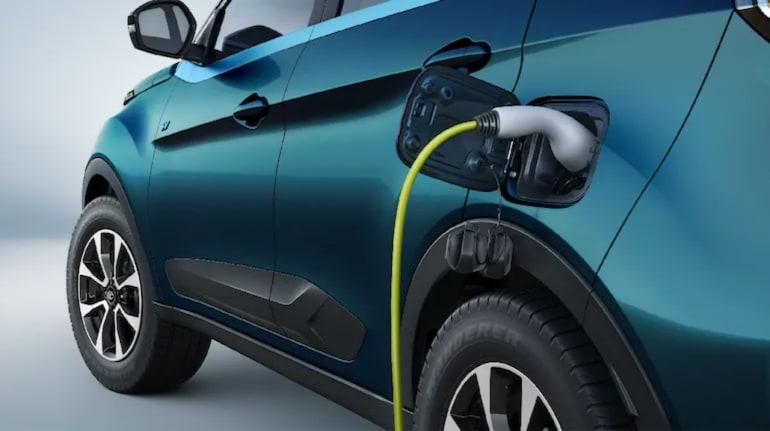
India’s startup ecosystem has proven to be a hotbed of technological innovation, particularly for the burgeoning EV space. With many of the EV startups showcasing their creations and technologies at the Auto Expo 2023, the established order will soon be firmly shaken-up this year. Here are the most disruptive brands to look out for and the individuals driving change.
Narayan Subramaniam and Niraj Rajmohan - Co-Founders, Ultraviolette Automotive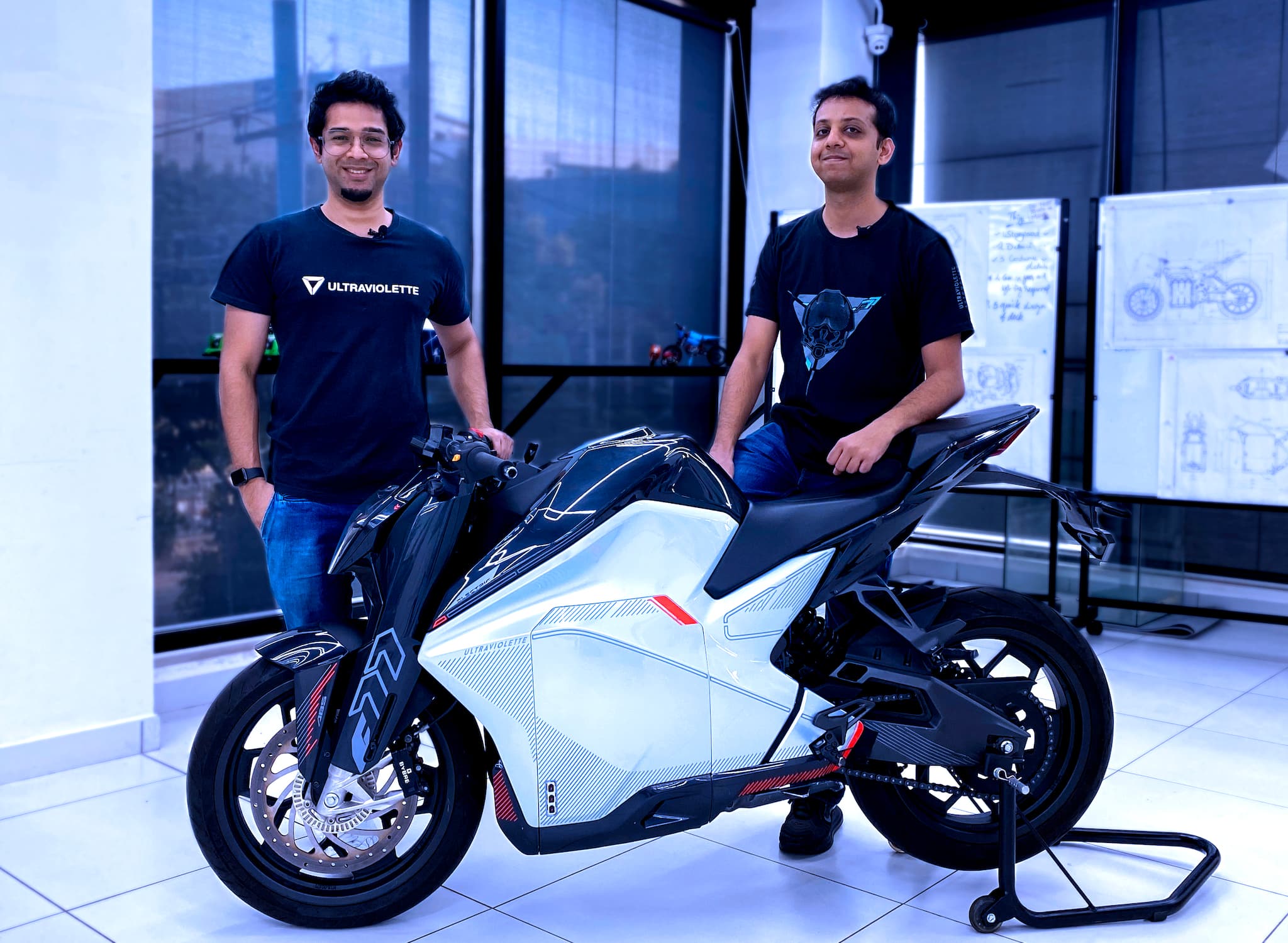
Ultraviolette is hard to define as a brand, since, according to Chief Executive Officer (CEO) Narayan Subramaniam himself, it is a “technology-focussed company in the mobility space.” As the only brand entering the challenging middle-weight performance e-motorcycle segment, it’s clear that neither Narayan nor the brand’s Chief Technology Officer (CTO) Niraj Rajmohan are into the cookie-cutter scheme of things.
The brand’s first offering – the Ultraviolette F77 – is the first of its kind to tackle the middle-weight performance e-motorcycle space. But despite having the term “Automotive” in its name, the co-founders claim that their influences come from the automotive, aerospace and consumer electronics space, having hired personnel from Boeing, Lockheed Martin, Airbus and Honeywell Aircraft electronics.
The Objective“Our core strength is innovation. We deliberately avoided the mass (E2W) segment because once there is competition in it, it’s always about fighting for the lowest price point and so innovation takes a backseat,” says Narayan. “When we looked at motorcycles, the whole 300-500cc segment represented a great opportunity not just in India but also globally. We view this as a tech opportunity to build a lot of IP (Intellectual Property) in-house, create systems from the ground-up not only on the electric side but also on the powertrain and connected systems side which will keep us considerably ahead of the market when they get into motorcycles,” he adds.
The Competition
While legacy players like Royal Enfield, Yamaha and Ducati will soon offer electric alternatives to their Internal Combustion Engine (ICE) motorcycle, the space remains sparsely populated due to the inability of electric motorcycles to offer the right balance of power, weight and range in the same way as an ICE motorcycle can.
As such, players like Ultraviolette are pioneers in the space, since the Electric Two Wheeler or E2W market has primarily catered to the urban commuting space. With the more premium F77 Recon providing a claimed range of 307km and a torque figure of 95 Nm, the e-bike aims to be a viable alternative to the middle-wieght performance bike segment and has no direct rival.
“For legacy brands, there are barriers to entry,” says Rajmohan. Barriers which don’t necessarily impede start-ups with an early-mover advantage.
“Legacy players are entering a new territory where multiple aspects have to be optimised simultaneously. For the longest time, their major spending has been on the engine technology front” says Rajmohan.
Narayan adds : “If you’re the first, a category-defining product, then you’re effectively creating a market for other products like them.”.
The ChallengeAlthough legacy motorcycle manufacturers have attempted to make e-motorcycles, none have been a sales success including the Harley-Davidson Livewire. The reason? Motorcycles cannot immediately opt for the “bigger battery for more power” option like electric cars. Ultraviolette intends to change that by arriving early.
The Future“For us, the limitations will be on the supply-chain side. We want to iron out these issues and keep it scalable so we’re not looking at more than 15,000 units a year, for the moment. Demand is quite significant” says Narayan, when asked about what this year holds for the brand.
“What is going to happen in the next couple of months is that the demand will far outstrip the supply for the next 24 months” he adds. “Lots of Southeast Asian countries are looking to move to high-powered electric two-wheelers, so we will have a good first-mover advantage.”
Siddharth Bagri, CEO, Pravaig Dynamics
With a claimed range of 500 km, 402bhp on tap and 620 Nm of torque, the Pravaig Defy – Praviag Dynamic’s maiden offering -- is said to be the only EV of its kind to offer such a potent package at an introductory price of Rs 39.50 lakh.
Sure, the prototype may be a little rough around the edges, but according to CEO Siddhartha Bagri, there’s more to the vehicle than meets the eye.
“Cars are increasingly being driven away from ownership. The EV space has so many microtransactions now, including heated seats and performance software patches” says Bagri.
Pravaig offers the ability to physically disconnect from the Internet of Things (IOT), cloud systems and data monitoring systems through what Bagri refers to as air gaps. “There are hard cut-off switches everywhere in the car,” says Bagri, reiterating that the Defy, whose battery pack, Battery Management System and suspension has been designed in-house.
The Objective“Privacy. Ownership. Repairability” says Bagri, before elaborating on what appears to be a confusing slogan. “We will be at least five times cheaper than a luxury EV is to repair” he says, adding that Pravaig Dynamics service points are already operational in 400 Pin Codes.
He also aims to bring a level of transparency to the EV servicing space, by providing all
servicing-related data on the brand’s website, so that the consumer has a reference point when surveying the servicing costs.
According to Bagri, the objective also appears to be bringing top-shelf luxury features at a more affordable price point.
“What we offer is pretty much unparalleled at the cost you’re getting, in terms of range, power, headroom, leg room, size and suspension. Suspension is a speciality of ours,” says Bagri, whose prototype was recently unveiled to a mixed response. “We certainly know how not to launch a product in white, under the sun,” he says before adding: “We will be bringing out a minor design update mid-2023”.
The CompetitionGiven Pravaig’s price point, the brand will be going toe-to-toe with other luxury EVs. The entry-level luxury EV space is likely to get more crowded with the likes of the Hyundai Ioniq 5 EV also entering the fray, at which point Pravaig had better bring its A-game with a more well-rounded production model.
For the moment, however, no EV offers a sub-500 km range, although that figure remains unverified until the product is tested. Bagri goes so far as to claim that “you don’t get anything better at this price point globally.”
The ChallengeHaving received “a good number” of pre-bookings (an exact figure wasn’t revealed), Pravaig Dynamics claims to be off to a good start, but will need to prove itself in a highly competitive market filled with cash-rich legacy players bringing more sophistication in terms of software and battery management. In the longer run, Pravaig’s analog approach to data privacy may pay off should the EV-environment prove rife with privacy blindspots.
For now however, it’s a battle for who offers greater safety, range, performance and, at this price point, aspirational value.
The FutureBagri harbours dreams of international conquest. “By 2028, we want to do a million units a year,” says Bagri, adding that 70-80 percent of the total units will be exported. “We will also offer more products without compromising on the features”
Kapil Shelke, Founder/CEO Tork Motors
Pune-based e-mobility startup Tork Motors aims to bring a level of performance and efficiency to the commuter segment that’s currently unavailable, particularly for the select few for whom an electric scooter just won’t do.
“Scooters took over the commuter motorcycle in a big way in cities. But there will always be people who want motorcycles. I’m not a scooter guy, “ says Tork’s founder and CEO Kapil Shelke. “There will be a million people in a country of a billion who will want a motorcycle and for them an electric is the way forward.”
“Everything is made in-house. We will also have a lot more control on the data side when we have more vehicles on the road. When we have a million vehicles on the road we will have a lot more data” says Shelke, whose maiden offerings – the Kratos and the Kratos R – were launched at the beginning of last year, with deliveries commencing mid-2022.
The ObjectiveWith a 180km claimed range derived from the 4kWh battery powering its flagship offering – the Kratos R – Shelke aims to jazz-up the daily commute for the 100 to 150cc commuter, while also luring-in the 350cc performance bike-rider and introducing them to the joys and convenience of electric bikes.
Shelke believes that there’s plenty of desirability and performance to be eked out of the commuter segment, and only an electric powertrain can deliver that. “ICE cycle is about 29% efficient. The rest is converted to heat. The electric motor is 95 per cent efficient.” he says. “The generation that was tuning their 100cc bike to go faster, now can do it via their mobile phone. If 100 cc can migrate to Kratos, a 350cc can migrate to a Kratos as well. My focus is on getting the best quality daily commute.”
The CompetitionWhile Shelke claims that the moribund e-motorcycle space means Tork has no direct competitor, the brand does face competition from the premium end of the e-scooter spectrum, the likes of which offer similar range and acceleration at a similar price point.
“E-scooters are being sold at a premium. We are selling electric motorcycles at a lower price point. And we can go higher from here. We’ve created a bridge between the existing commuter and entry-level performance machine and brought it to a more reasonable price point.”
“We don’t have a direct competitor. We are the only brand existing in this space. Competition is good, because then the value of the Kratos will be clearer. Currently we are the only brand operating in this segment at this price,” says Shelke, admitting that premium e-scooter brands do offer a lot of features.
The ChallengeAt present Shelke isn’t interested in making high-powered electric motorcycles, saying the challenge lies in adding more appeal to the 100-200cc segment. “It’s easy to build an expensive machine. The bell curve lies at 100-200cc. That’s the harder problem to solve.”
Having recently commenced operations, opting for the dealership route instead of the direct-to-customer model has its challenges too.
“Our challenge lies in getting dealers to follow a certain standard operating procedure. How they deliver the vehicles, how they showcase them, how they charge them. When you opt for the dealership route, you want a lot more standardisation.”
The futureTork intends to produce 40,000 units per year, with the plan of meeting 50-80 percent of that capacity by mid-june 2023. In 2022, the brand produced 500 motorcycles, out of which it delivered 250.
“This year is the scale-up zone. At present we have three dealers, but officially we’re only in Pune and will soon open up a dealership in Hyderabad.” says Shelke.
“The next 12-18 months will be crucial in terms of expansion. The idea is to move to 100 cities as fast as possible.”
Sanjay Behl, CEO Greaves Electric Mobility
Having acquired e-scooter maker Ampere Electric, back in 2019, Greaves Electric Mobility – the e-mobility wing of Greaves Cotton – is slowly emerging as a juggernaut in the Electric Vehicle space.
In the October-December 2021 quarter, the company acquired a 100 percent stake in e-3-wheeler company ELE, specialising in e-rickshaws, and acquired a 26 percent stake in MLR Auto. According to its CEO Sanjay Behl, “Greaves Electric Mobility is a full-spectrum EV ecosystem with in-house battery development, and a range of electric two and three-wheelers, for last-mile passenger and cargo mobility. No other company offers EVs in both 2 and 3-wheeler category”
“We are among the EV manufacturers that offer a high level of indigenised sourcing. Our EVs are designed and engineered in India, with a high component of local sourcing and supply chain” he claims, adding that Greaves Electric Mobility has been the recipient of one of the largest single tranche growth capital investments in the Indian e2W/e3W sector. “It’s a show of confidence from our investors, in our capabilities.”
The ObjectiveIn the short run, it will offer powertrains which are built in-house, including the battery pack, as far as Ampere’s electric two-wheelers are concerned. “We will be unveiling a new powertrain design and Battery Management System at the Auto Expo 2023. The BMS has been developed in-house, via a partnership of course, but it is a completely new electric powertrain.”
The CompetitionAccording to Behl, the ICE segment still holds a major legacy advantage. “There are some well established brands. Electric scooters have only 5 percent market penetration, 95 percent of the market is still ICE scooters and two-wheelers. Going forward, that’ll be a major source of our growth,” he says, e sounding buoyant about the future. “Within the EV-fold, there are strong brands, but the market is getting consolidated. If you look at the registration data, the top 3 players, of which Ampere Vehicles is one, we have 50% of the market share,” he says.
The ChallengeIn the electric three-wheeler space, according to Behl, range continues to be a concern since the average three-wheeler in both Tier 1 and II cities in India, covers over 100km a day. In addition to that and the load bearing limitations of the e3W (a higher load further compromising range) the higher purchasing costs continue to prove a barrier to entering the space, keeping the overall market share occupied by e3W to 10 per cent.
However, according to Behl, the benefits outweigh the drawbacks.
“Driver fatigue is considerably lower. Ownership costs are lowered by 70-80 per cent, spares and servicing costs are dramatically reduced, so I expect there to be greater market penetration by e3W.”
The Future“Our manufacturing capacity at Ranipet is at 250,000 units in a single shift, which can be increased to 500,000 units,” says Behl, adding that Greaves Electric Mobility was able to do three-times the volumes in the Q2 of the current fiscal yea, in e3W.
The brand has also shared that it will be unveiling five new electric vehicles at the Auto Expo 2023, across Ampere Electric and GEMPL three-wheelers range. This includes a next-generation three-wheeler cargo carrier concept and an all-new electric scooter debuting a new brand identity.
Discover the latest Business News, Sensex, and Nifty updates. Obtain Personal Finance insights, tax queries, and expert opinions on Moneycontrol or download the Moneycontrol App to stay updated!
Find the best of Al News in one place, specially curated for you every weekend.
Stay on top of the latest tech trends and biggest startup news.