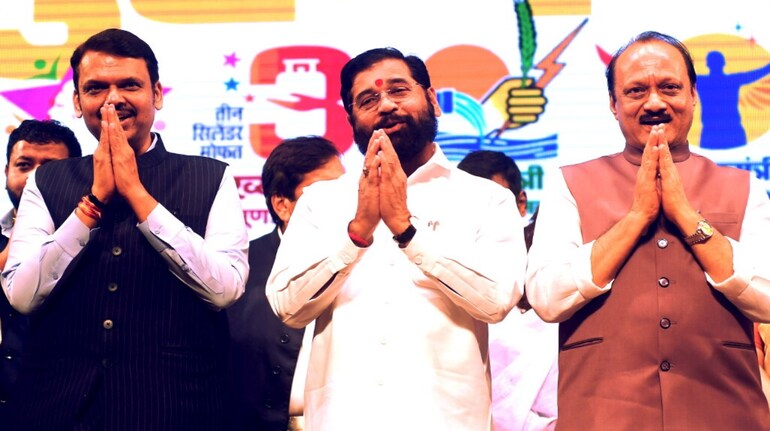
The ruling Mahayuti alliance delivered a comprehensive victory across the state, consolidating its organisational strength and political momentum even as internal differences and sporadic "friendly fights" surfaced in the run-up to the Maharashtra local body elections 2025, the results to which were declared Sunday.
The BJP-led camp secured 207 out of 288 municipal councils and nagar panchayat president posts, leaving the opposition Maha Vikas Aghadi (MVA) with just 44, underlining the NDA's dominance at the grassroots level after its comprehensive victory in the Assembly elections held a year ago.
At the heart of the Mahayuti win is the BJP's emergence as the single-largest party within the coalition. The State Election Commission data show the BJP clinched 117 president posts, followed by the Eknath Shinde-led Shiv Sena with 53 and the Ajit Pawar faction of the NCP with 37.
On the other hand, the MVA’s victories were spread thinly with the Congress winning 28, the Sharad Pawar faction of the NCP seven, and the Uddhav Thackeray-led Shiv Sena (UBT) nine posts.
Mahayuti prevails despite tensions
The biggest takeaway from these election results is how the Mahayuti proved resilient despite occasional friction and the Opposition leading a united fight. Earlier in the campaign, there were reports of internal discord, including cases where alliance partners fielded candidates against each other in select constituencies, a phenomenon often termed "friendly fights" in local elections.
One indication of the alliance's strategic coordination was the seat allocation agreement ahead of the polls. For example, in Mumbai (where the Brihanmumbai Municipal Corporation elections are now scheduled for January 15, 2026), Mahayuti partners reached consensus on 150 of the 227 seats, with remaining allocations to be settled by senior leaders.
On the other hand, the Mahayuti's tactical flexibility also played a decisive role in unsettling the Opposition Maha Vikas Aghadi (MVA). In several civic bodies, MVA constituents were seen backing either the Eknath Shinde-led Shiv Sena or the Ajit Pawar-led NCP, depending on local equations, exposing the lack of cohesion within the Opposition bloc.
This selective support worked to Mahayuti's advantage, as it blurred traditional alliance lines and forced MVA partners into contradictory positions. Instead of a unified Opposition front, the Mahayuti's manoeuvres pushed the MVA into a web of conflicting choices, weakening its campaign narrative and eroding coordination at the grassroots.
In effect, the ruling alliance succeeded not through overt unity alone, but by exploiting the Opposition’s internal contradictions and turning them into electoral liabilities.
Opposition in retreat
After the decimation it faced in the Assembly elections last year, the MVA's performance in the recent polls has reinforced the gulf between it and the ruling camp at the local level. Its component parties struggled to gain traction in the grassroots contests that require strong organisational networks and voter outreach.
In contrast, Mahayuti's institutional strengths, particularly the BJP’s cadre base and the combined pull of its allies, translated into tangible wins across a wide swath of urban and semi-urban bodies.
The defeat was especially stark for smaller allies of the Opposition. For instance, the Maharashtra Navnirman Sena (MNS), led by Raj Thackeray, failed to secure a single president post across the 288 local body contests.
Local dynamics
Political analysts point to the performance of individual Mahayuti partners as another factor in the sweep. The BJP's organisational campaign and development messaging, emphasised by central and state leaders alike, resonated with voters in many councils.
Meanwhile, the Shinde-NCP alliance strengthened the saffron bloc's appeal among diverse voter constituencies in regions where they have local influence.
Despite isolated setbacks, such as losses in pockets like Nanded where rival local leaders of the Nationalist Congress Party recorded wins, the overall narrative from the results is one of a cohesive alliance that outperformed the Opposition.
The Mahayuti's victory in these elections is significant not just for its scale but for its timing, coming ahead of high-stakes contests, including the Brihanmumbai Municipal Corporation (BMC) polls in January 2026.
But more than that, the alliance's capacity to mobilise support and maintain unity even when tested is what poses a strategic challenge for the Opposition as it prepares for future electoral battles in Maharashtra.
Discover the latest Business News, Sensex, and Nifty updates. Obtain Personal Finance insights, tax queries, and expert opinions on Moneycontrol or download the Moneycontrol App to stay updated!
Find the best of Al News in one place, specially curated for you every weekend.
Stay on top of the latest tech trends and biggest startup news.