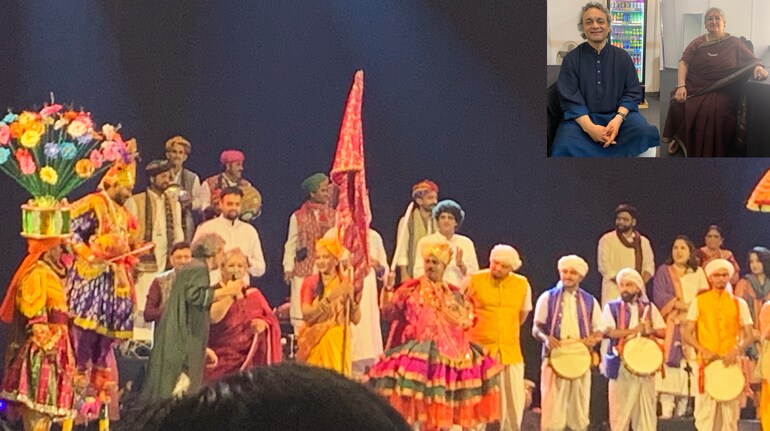
Shubha Mudgal is easily one of the more prominent Indian musicians to straddle the worlds of classical and popular music. She and her husband, tabla player and music researcher Dr Aneesh Pradhan, have also been promoting musical traditions—both folk and classical—from around the country through their label Underscore Records as well as their curatorial practice for more than 20 years. At the recently concluded 2025 Serendipity Arts Festival (December 12-21), the husband-and-wife duo extended this programme by curating a show with performances by musicians belonging to different traditions, from all over the country.
Indeed, the multidisciplinary festival in Goa opened on December 12 with a performance curated by Shubha Mudgal and Dr Aneesh Pradhan. Called 'Clay Play', the 2-hour performance brought together musicians from traditions that seldom talk to each other, leave alone sharing a stage. 'Clay Play' put another filter on the selection: bringing together musicians who work primarily with clay-based instruments. So, there was ghatam from the south led by Sukanya Ramgopal. From west India, there was the Ghumat festive song-and-dance from Goa led by Kanta Gaude, and Raitila Rajasthan with musicians like Govind Ram and Saddik Khan. And from the north Indian musical traditions, there were vocalists as well as tabla and harmonium players.
(Though the energy of the performance dipped in-between and it was not quite as polished a performance as any one of the groups might have delivered on their own, it had its moments of brilliance. For one, seeing the musicians passing the proverbial baton back and forth was arresting. And Ramgopal's hands striking the ghatam were a sight to behold, as she struck the claypot in different places to extract different sounds, and threw the pot up in the air to produce the periodic 'thump, thump, thump'.)
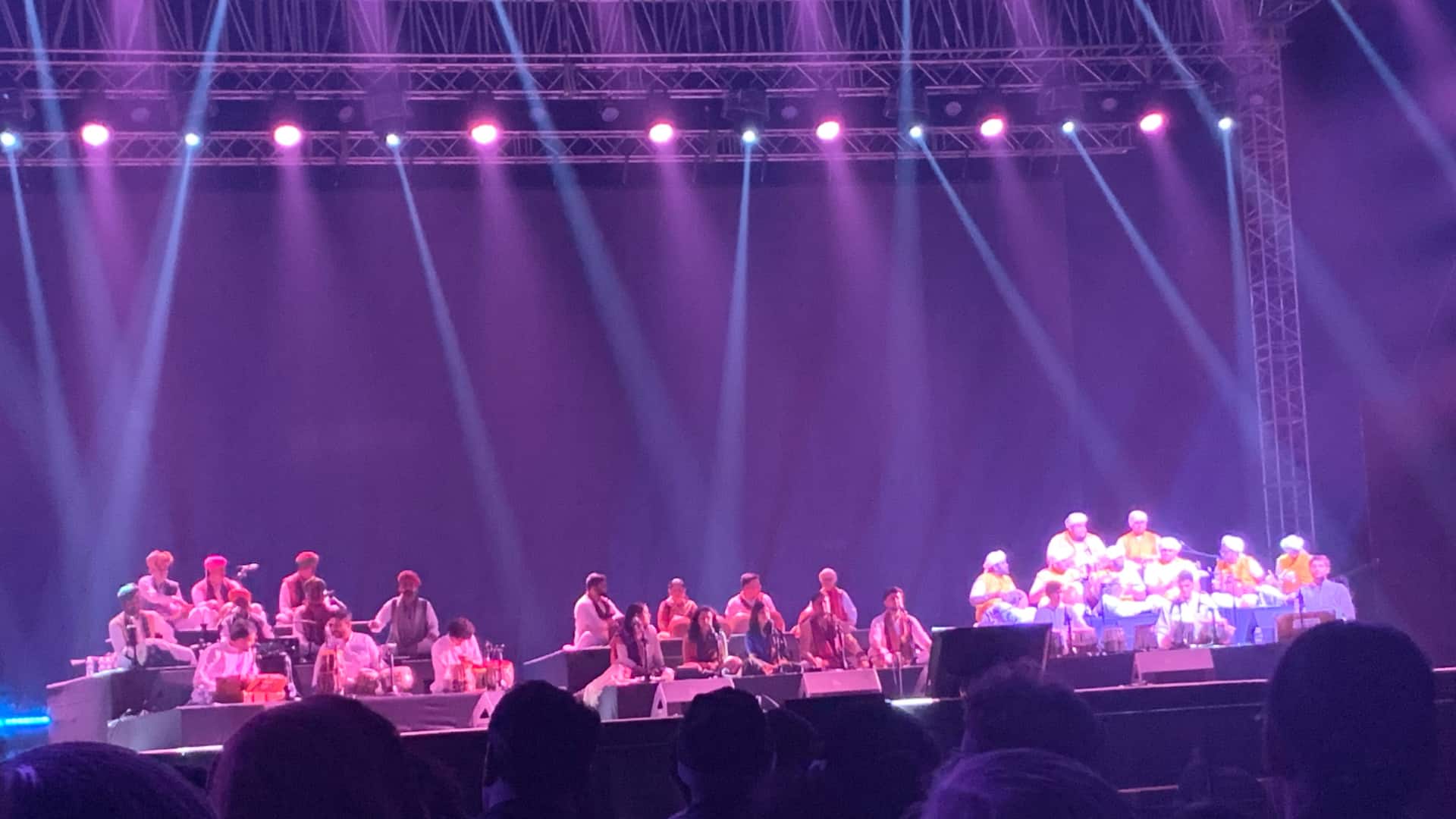 'Clay Play', curated by Shubha Mudgal and Dr Aneesh Pradhan. (Image: Moneycontrol)
In exclusive backstage interviews with Moneycontrol in the makeshift green room of The Arena in Nagalli Hills, one of 12 venues of the 10th Serendipity Arts Festival in Panjim, Goa, Shubha Mudgal and Dr Aneesh Pradhan responded to questions about what constitutes an intelligent performance, how they curate segments with dozens of musicians across the folk and classical divide and why video conferencing is a terrible way for musicians to jam and practice—even today. Edited excerpts:
Shubha Mudgal
What to your mind constitutes an intelligent performance? Perhaps you could respond both as someone who's given thousands of concerts and heard even more as an audience member?
For me as a student of music, it's very important that I am really comfortable doing what I'm doing on stage. You have to know what space you're performing in and what repertoire you're known for, what repertoire you're comfortable with. There are forms which I haven't learned, which I'm not familiar with. Today it's very popular to do these jugalbandi kind of things. But if I don't know the artist, however wonderfully brilliant they may be, if I don't know the music, how on earth am I going to be able to do anything? So, I think an intelligent performance would be where you're comfortable with what you're presenting, in the space that you're presenting, or at least can make yourself comfortable and don't feel really pressured to do anything that you don't want to do.
And as an audience member, what you're looking for in a music performance?
I go with an open mind, particularly if it's a form of music that I haven't been very familiar with. I go and sit down there and say, let me experience the music. It's a very experiential thing for me to begin with. And depending on my response at that particular moment—I mean, I may have come through 2 hours of traffic in Delhi and I may already be, 'Oh my God, why am I this is the city?' Maybe that day I don't make a connect. But if I do, I try and find more ways of finding out more about the artists. But at that moment, I like it to be an experiential thing and just respond to it as a student of music.
You embody the idea of interdisciplinarity, in that you came to music through kathak which you learnt for over a decade. We are talking at the Serendipity Arts Festival which in its 10th edition has 40-plus curators across music, theatre, photography and other visual arts, performance and culinary arts... How important is this idea of multidisciplinarity and chance encounters with other creative people in your own practice? Does it also filter into your practice as a music curator?
You know, we've spent a large part of our lives as performers. As curators, our experience is far less. So when Serendipity asked me to be a curator in the very first year that they started, it was a very exciting and very challenging prospect for me. I did not want to be on stage because that I have a fair amount of experience with now, but to imagine what will happen when I bring together different artists or artists in the same system but in a different format—that for me was very big, very exciting, very challenging. And it was a way of trying to see if there are ways of presenting traditional music, which I've been studying for so long, in any other way than what we've been doing. I love the way it's presented. I'm very happy to sing in the music circles for 3 hours or in a festival for Malhar, etc. But I also feel that there is so much more to the music, so many more stories to be told, so many more little things to be dug out and shared with people. And also for us to learn from the people who work with us, it's a very enriching experience -- that really is what makes us very excited as curators.
So, where do you share these stories?
We've tried different ways over the years. Many years ago, we had been reading in various languages—we read in Hindi, English, Marathi, Aneesh can read Gujarati, and I understand but I don't read Bangla. But there's a lot of material which is basically study material and which we've been trying to encourage our students to also read. But reading is not a habit which you can inculcate very easily—that's been our experience—among students of the music world who want to learn the music and be on stage.
But there were such amazing stories that we read... So we approached a theater director in Mumbai, Sunil Shanbag, and we said: 'Look, we have these different pieces of information from different sources. Do you think we can put it together?' And we did. It's called 'Stories in a Song', which did more than 100 shows. It was music theater, but we were able talk about forms like qawwali, kajri, about music and particularly musicians being aligned with social and political movements, all kinds of stories. Otherwise, you have this idea of (the musician as) some sage living even now in an urban forest somewhere doing classical music, whereas the story is actually quite different, you know, people really engaging with life in general. So, we managed to do that and that really also encouraged us to look at other ways of sharing information without making it a lecture demonstration.
Your book also came out some six years ago.
Yes, quite some time. 'Looking for Miss Sargam: Stories of Music and Misadventure'.
That was also a way of sharing stories or was that centred more around your thoughts on the world of classical music training and performance?
That was me being a fly on the wall in green rooms and backstage and seeing so much which you get to see as a performer, but you never really get to talk about it. The stories are not always happy ones. It's over 40 years now that I've been performing, and I go to so many places and the experiences from all of these places; my reading while other people are on stage... I see a different set of activities happening, I see different situations, organic, dynamic stuff happening, rivalries, competition, sulks, trauma, tantrums. And I was thinking, I don't think people really know. I don't really get to ever speak about these. And I can't also, because I don't have permission from everybody to declare that this is what I saw. So I thought why not fictionalize it? Because this isn't something that is just happening to me. It's happening to so many artists that I know of. So I thought, let me try and write fiction, which I had never done before; it was one of those impulsive decisions to start writing these stories.
Your parents were professors. Did you ever consider taking up a more conventional or more stable job?
Actually, it's very likely that I would have taken that path. It's not just my parents, but my entire family.
All of them are educationists?
Everyone. But my mother was a quite a firebrand. She was really somebody who thought out-of-the-box. I remember when we were growing up, we were always involved in music, theatre, etcetera. And my mother would not let us skip (dance) classes during exams. Today parents might say, 'Right, you need to stop your dance classes because you're appearing for an exam.' She would say, 'No, you're doing everything else: You're having a bath every day, you're brushing your teeth, you're eating every day. You're not rejecting what should be part of your everyday life.' That in itself was a very big thing, when almost every parent was saying, look, this is serious stuff now, Class 10, please stop all the leisure activities. My mom was saying just the opposite. And apart from that, when I graduated (from school), she gave me this offer and she said, 'Look, I've been observing you're crazy about the music and I think you should just take a year off and decide what is right for you.'
Which year was this? 1990s or earlier?
No, no, much earlier. Should be 1980. I had just graduated, so I would have been 18.
I was very thrilled... The moment I said this is what I want to do, she said, 'Listen, there's a lot you haven't learned... there are many things that five- and six-year-olds learn which you have not learned.' Because I was learning kathak, I was not learning vocal music. So, she said: 'There's a lot to learn apart from what you should be learning at this age. You need to enroll for an MA (master of arts) in music. You need to learn individually in the guru-shishya parampara and you need to please pull up your socks and start working on things you haven't learned.' My day was spent entirely with music.
She was not the doting mom at all. But I can see what she opened up for me. And this was not like doing something because mom and dad have said so. She saw that I was keen about it and she gave me the opportunity to do that kind of music. But she wanted and she insisted I make a full-time commitment to it and not just sing the occasional song with a bunch of friends saying 'Oh, you're wonderful.' She pushed me further. In the early '80s, she said, 'You've grown up in this town (Allahabad). This is a small university town. Everybody knows you as our daughter. Half the people you call masi, half the people you call chachi. Your masi and chachi are not going to tell you: "Listen, you don't have much merit." You need to go out and check in the world where you stand.' And that in itself, you know, sending away your young daughter at that time and saying, no, learn to stand on your feet, find your own place in this world, I think that was pretty unorthodox and quite courageous. And her unconditional support and my father's, though he was a bit reluctant at first, but their unconditional support through my life, that's been one of the big blessings.
You came to music through kathak. From the outside, it looks like there is a hierarchy of performers in classical dance—where the dancer is the main act and the musicians are often credited as accompanists...
The hierarchies exist in many ways. This is not the only example.
For example, in theory, very often we are told that classical art is the highest. Having said that, everyone believes it's archaic and talks of contemporary. But if we are making classical music today, then it's contemporary classical music. What makes it antique or archaic?
Is it because this tradition draws prestige from its past, even if new performances are naturally contemporary?
I mean there's quality to attach to it, but in terms of the commerce and the business and music, we are outsiders in the music industry today. It is the mainstream YouTube big-time artist that is the celebrated artist.
You've broken the barrier, but yes, I take your meaning.
I may have broken one barrier. But the barriers keep coming up again and again. I'm somebody who likes diversity, really, I enjoy it. I'm an avid listener. And I don't reject anything unfamiliar easily, because I feel, maybe I'm not understanding what they're doing. So I need to know a little more before I reject something completely. There may be a song or a kind of music which I just cannot relate to, and I will not listen to it, but I will still not reject it saying this is bad or this is low art. I am unable to say that.
New barriers keep coming up, and we all try... artists are very adaptable... we all try and negotiate those spaces, but there are some spaces that we have never come to be comfortable with. Each of us has to find the spaces that we are able to be comfortable in and not feel pressured ki bhai aaj toh yeh chal raha hai (that this is what's trending now). Art in itself is very liberating, and why would we be bound (by set notions)? If I'm a person who doesn't take two bottles and play with them, and make music, I neither need to reject the people who do that and nor do I have to make music like that if I don't want to do it. That's not me. That's not my aesthetic. So why should I do it? But I'm happy enough to listen to other people doing it and not feel pressured.
What are you looking forward to in 2026?
2026 I have a lot of travel and performances over Boss coming up, but I'm now also a mentor to many students who come to me. I'm watching them go through their challenges. I feel the butterflies in my stomach when they go on stage and I feel very proud when they do well. I'm also there... because each person reacts differently, you can't have the same antidote for everyone.
In terms of teaching?
In terms of teaching and I like to be accessible to students, but I also like them to be independent. I don't like them to be just following me around.
Could you give an example of how the antidote can be different for different students?
You can go to a concert or you can watch a performance by one of your students which isn't the best, and they also know it. But you don't need to rub it in. The amount you need to be candid, what you can say to which person and not bruise them or scar them for life can vary. You need to help them get up and be back on stage.
You had teachers like that as well, right?
My teachers really helped me, but they didn't mince words—at all. It was a different generation, and I don't feel that I need to... I mean they were very generous teachers in terms of what they gave me. I lived in some of their homes as well. So that's a big thing. I cannot do that because I live in a little apartment. These kids come to me from different cities to learn. Their parents are anxious about what they will do. They want to be full-time musicians, but it is not easy to be a full-time musician. And I should be there to help them but not be in conflict. I'm not there to start a revolt in the family. I understand the anxiety of the parents as well. I also understand the kind of support (required) and just in general be there for them.
Dr Aneesh Pradhan
For 'Clay Play', was it challenging to bring musicians from different traditions, different geographies together? Even though they were all percussion instruments, they come from different systems and contexts, so how did you gel it all together?
One thing is that we've always believed in preserving and projecting the plurality and diversity of our culture as is reflected in music. That's why in every project that we do, we try to have a certain kind of representation of that. Obviously, one can't be very comprehensive because of the financial resources that are available and the duration that is available, etc.
Are finances and resources the key hurdle, though?
They are major hurdles. Because you can dream as much as you want, and you can find collaborators also in those regions as much as you want, but the production element is so huge. And we're just musicians, right? We can't handle those things. So it's great when a festival like Serendipity Arts Festivals allows you, encourages curators to do all of this. Of course there's always a pull and push with the budget as well. Having said that, it's been a great experience for the past 10 years.
When we started 10 years ago, I had done a project called Dhamal, which again brought a whole series of percussion instruments together. The idea was to break down hierarchies between classical and folk, while not diluting either—that was very important. Because there's sometimes degree of condescension when you talk about folk instruments... that 'Oh, you know they don't have a language... Oh, they're just grooving to the song,' etc. But if you heard ghumat (during the performance of 'Clay Play' on December 12), each of those pieces has a name to it, has a performance context to it, and there are sub-themes also in that. This is what I learned, for instance, in my 10 years' experience with Goa. And I'm deeply indebted to Goa and particularly to the culture expert here, Kanta Gaudeji, whose team always collaborates with us. Because without him, we wouldn't have known so much about it. Of course, there's much more to learn... In the span of time, this is what we get to experience from Goan culture. Which is why we wanted to also have Shigmo (harvest festival when there are lots of cultural performances) and Jagor (a type of Goan folk theatre) to be represented through those processions... It was our tribute, and thank you, to Goa for having taught us so much as curators.
You mentioned the cost barrier to bringing performers together. During COVID, a lot of us were on video conferencing apps. Even artists who were collaborating across national borders. Is that not a workable solution for more musical collaborations—provided there's dependable Internet access, etc., of course? It's much cheaper than actually flying everybody down if you want a performance with, say, the mridangam and ghatam from the south and the khartal, khol, pakhawaj as we move up the country?
That was a problem with the software. When you want to play in tandem or in unison, you can't have a three-second gap. Even when we were teaching (during the pandemic lockdowns), it was so frustrating. You know, sometimes you want things to be done just by observation and not by actually articulating each and every little thing. So you want the student to sing with you, follow immediately. But here there was a lag. Then, the tanpura, for instance, which is so integral to our music, the drone... the tanpura was regarded as noise (by the conferencing apps), so it automatically reduced the "noise". It was so crazy. And then if you had the tabla alongside, on the far side, you were hearing a different tempo. It was coming a little delayed, so you couldn't sing over it.
Otherwise, there is no problem getting artists from the north to collaborate with musicians from the south?
We have been exchanging files day in day out. For instance, in 2019, Shubha and I did an entire album called 'Bridge of Dreams' with Australian musicians. It was a collaboration with Sandy Evans, who's a fantastic saxophonist from there and a composer, arranger and an all-women band, and even transgender, called Sirens Big Band. It was focusing on jazz and our interpretation, or what we could contribute to that.
Of course, we workshopped in person as well. But we exchanged a lot of files and part of the recording took place in India for our stuff. They did theirs there and then we put it together and the audio engineers did magic. So, it's possible. Of course, I wouldn't say that it's an absolute substitute for in-person dialogue because otherwise then you're taking out the human element, right? One really craves for that—and that's what we craved for through COVID.
But back to your question about bringing the musicians together; yes, we really believe that these are spaces where you can actually experiment with that... The Rajasthani songs were related to the clay pot. All the Hindi songs related to gaagar, matka, etc. And it was very metaphorical also; the shape of the claypot representing the human body and what comes after existence, all of that. We tried to bring all of that together.
What do you think constitutes an intelligent performance; whether you're performing yourself or listening as an audience member, what are you looking for?
What is the idea behind all art? I think, for me, art is about a representation of your innermost feelings, your innermost emotions, and using any form of art as a medium to express that. When it's a performance, then you're trying to communicate that to the audience.
Till then, you're still making art. Like I'm making art at home, perhaps. When a painter is painting at home, in his or her studio, they're not doing it as a performance art but they're still creating art.
But then when it's a public performance, it's a different thing. You want to reach it out there at that moment, and when in that moment, everybody comes together and latches on to those original emotions and forgets about the medium—yes, the medium is there and you can critique the grammar, the repertoire and all of that—but behind that is this set of emotions which has actually surcharged this medium at that point. So if those emotions can reach from me to you, that's the biggest takeaway for me as performer, as audience or anything.
Could you unpack that? You've got your compositions which you've learned. Because you've practiced for so many years, you know that you have a particular style, there are some things that you favour over others. But what at the end of the day, when you sort of given a performance, you think this was something that I haven't done before or this was something that I hope I can do again.
I think you have hit the nail on the head with that last statement: that you haven't done before. Which is not the entirety of the performance, but there is a risk element. That's what life is about. There's a gamble. Some things succeed, some things don't. You're not really demonstrating your vulnerability, but you're showing that you're human, and that's why you have all these emotions. And I'm just placing, I'm sharing my emotions with you... When you're crying, you don't need to look around: Is anybody looking at me? That's just an example. Or when you're laughing, you don't want to look at everybody (and think): 'Oh, am I, you know...' So that's the way I think a performance also should take place. Ideally, I'm not saying that I do that every time, but ideally, I would like to have it like that. Take risks, be vulnerable, be in the moment.

Discover the latest Business News, Sensex, and Nifty updates. Obtain Personal Finance insights, tax queries, and expert opinions on Moneycontrol or download the Moneycontrol App to stay updated!
Find the best of Al News in one place, specially curated for you every weekend.
Stay on top of the latest tech trends and biggest startup news.