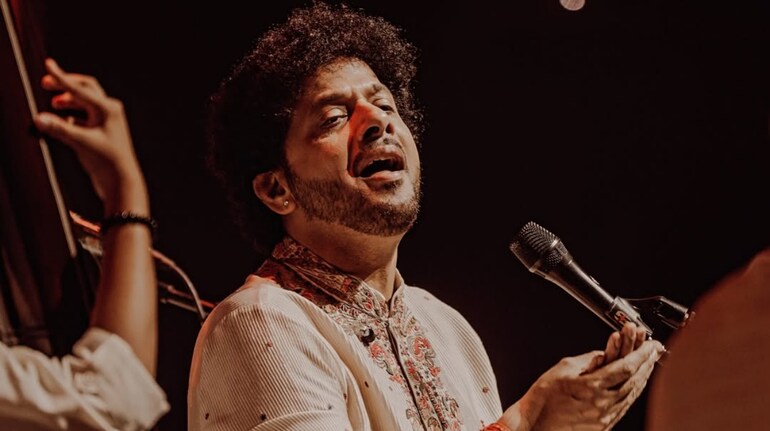

At a time when Indian classical music is finding new audiences across digital platforms and global stages, Mahesh Kale remains one of its most powerful contemporary voices. A National Award-winning vocalist known for his mastery over Hindustani classical music, abhang, natya sangeet and devotional repertoire, Kale has built a rare bridge between tradition and accessibility.
Whether in intimate baithaks or international auditoriums, his voice carries both technical depth and spiritual intensity. In this conversation with Moneycontrol ahead of the Mahindra Percussion Festival 2026 in Bengaluru, Mahesh reflects on rhythm, influence, devotion, virality and the evolving journey of an artist.
At the Mahindra Percussion Festival 2026, Mahesh Kale presents YĀTRĀ within a percussion-led format. Speaking about reimagining melody on a rhythm-centric stage, he says, “Mahindra Percussion Festival is a wonderful initiative where rhythm has been identified as a topic to put on center stage and explore. YĀTRĀ, the concert that I'm going to present, has a unique way of showcasing the rhythm in its own way. I feel without silence, music cannot exist. And it is this silence that actually inspires both music and rhythm. The silence is broken by a sound ‘naad’, which if held, becomes a passage of melody that we call ‘alap’. When this particular ‘alap’ is mounted on a symmetric meter, then that alap or the meter itself becomes percussion. So if you really ask me, melody and percussion are two sides of the same coin. Without one, the other one cannot be. In this festival, we are flipping the coin on the side of the rhythm. And I'm happy that I am a representative of the melody in the festival to showcase and highlight the rhythm in the percussion festival.”
On where he feels most alive as a performer, Mahesh reflects, “I love nature and I want to draw an analogy to address the question. There are a few trees in the United States that also find themselves thriving in Europe, but in a different form. They become shrubs in one country and they become tall trees in another. Nevertheless, they bear the same sweet fruit that is meaningful. The life that they assume is just as meaningful in its own way. Now, since we, as Indian classical music artists, the practice itself, if you look, is a holistic experience. Very often it's called Ashtanga Gayaki, Ashtanga Pradhan Gayaki, where Indian classical looks at its presentation in eight forms, much like yoga. And you try to practice, understand and imbibe each Anga. Now, in a concert, depending on the topic and the context, some of these Angas are more predominant than others. And that is what keeps the dynamic of the spirit of both - music and the artist - alive. So, I would say I feel alive as an artist because Indian Classical Music affords me the freedom to choose and explore all these different facets.”
Discussing influences, Mahesh is expansive in his gratitude: “Naming only a few will be unjust, but without a doubt my Guruji comes the very first, singularly to my mind and also my mother who laid the foundation. But I have drawn many influences as far as classical music goes. Obviously, the greats like Pandit Bhimsen Joshi, Kishori Amonkar, Amir Khan Sahib, Pandit Kumar Gandharva and the list goes endless. But also from popular or non-classical music, Andrea Bocelli, the way his sound texture, his sound quality, the way he uses it is immaculate. I also like the compositional beauty of Shajarian, I enjoy Umm Kulthum, I enjoy folk artists, and who can forget Lata Didi. If you want to witness music in its most pristine form, you have to observe and be in the presence of her music. So I don't think it is fair for any artist or any genre to limit themselves to that particular genre as far as influences is concerned, because as I mentioned Indian classical is a holistic activity, just like life, even if you have a profession that is built on a certain discipline, if you have to lead a balanced life, you need to draw from different facets of life itself.”
On practice and evolution over the years, he explains, “The core prep of a classical musician never changes. It's like yoga. You probably repeat an exercise within the routine a little more depending on what needs attention. But the routine stays largely the same. The yoga poses have not evolved in number, but they continue to evolve in the first the technique and then the second in ease and third in the peace that you find in the postures or the breath or all those eight things that are. Similarly, my routine has not changed, but I have to pivot and align, identify to try and relate and contextualize the percussion festival angle of it. In that, I'm trying to think and align with the whole idea of rhythm in a philosophical way, which is a little outside of the norms, but also find a motive.”
On carrying Marathi cultural memory through abhang and devotional music, Mahesh says, “You know, when I sing, I don't think I sing because I have a certain responsibility. I don't sing a certain way because I have a certain responsibility. Music is not about responsibility, it's just being about mindfulness and consciousness and largely celebrating life itself. Now, because I was born and raised in Maharashtra, I have a certain way of upbringing which strongly roots in the local traditions. The classical training affords me to look at a broader global picture. But when I sit, I close my eyes and I surrender to the deity, to the God that I am singing. Honest to that surrender, I just follow a path of celebration. In that celebration, if God blesses, that celebration permeates the crowd. And I must admit, Vitthala, Rama and all the Gods that I sing for have been extremely kind and generous to me.”
On the virality of Kaanada Raja Pandharicha, he concludes, “I feel extremely grateful that a song in a local tradition finds a global appeal. But I would be lying if I were to answer why it did. All I can think of is the purity of intent, the honesty of rendition and the grace that it found from the God himself can perhaps be the only reason. Virality has no formula to itself, especially in classical forms. The norms of virality as we observe them now is not something that naturally lends to classical music. But yes, something about this song and a few others that I can think of mine, have struck a chord and it is so heartening to see people that don't even understand the language, or for that matter do not even belong to the same faith, have no problem embracing the emotion they feel inside themselves that the song elicits. And I want to keep on drawing from this and keep doing more such traditional heritage music pieces with as much passion and surrender as I can.”
Discover the latest Business News, Sensex, and Nifty updates. Obtain Personal Finance insights, tax queries, and expert opinions on Moneycontrol or download the Moneycontrol App to stay updated!
Find the best of Al News in one place, specially curated for you every weekend.
Stay on top of the latest tech trends and biggest startup news.