






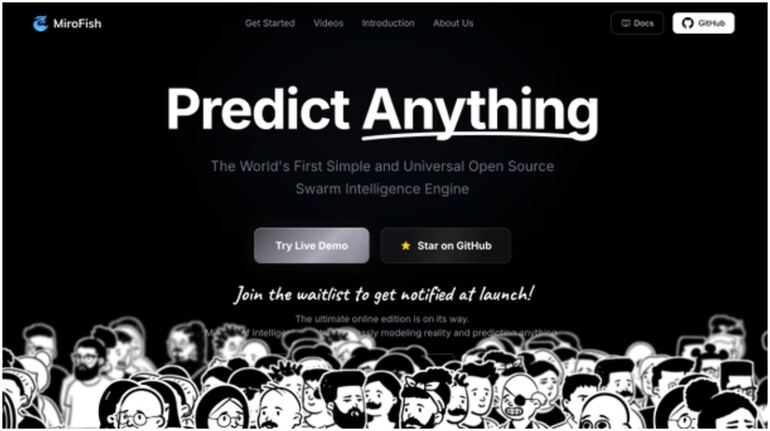
A newly released open-source artificial intelligence project called MiroFish is drawing attention among developers and technology observers after appearing on trending charts on GitHub, where it has rapidly accumulated thousands of stars from the developer community.
The project is described by its creators as a universal swarm-intelligence engine designed to run large-scale simulations in order to explore possible future scenarios. Instead of relying on a single predictive model, the system creates a simulated digital environment populated by thousands of independent AI agents that interact with each other in parallel.
According to project documentation, the system builds its simulations using information drawn from real-world sources such as news reports, financial data, policy documents or social media discussions. This input data is converted into a structured knowledge graph, allowing the system to identify relationships between people, institutions and events before generating a simulated environment in which digital agents operate.
The developers describe the project as “a simple and universal swarm intelligence engine, predicting anything.”
Within this simulated environment, each AI agent is assigned its own behavioural profile, memory and decision-making logic. As the simulation progresses, the agents communicate, react to information and influence each other’s decisions, producing patterns that resemble collective social behaviour.
Supporters of the project say this approach attempts to model how groups of people respond to events rather than relying purely on statistical forecasts.
One explanation shared in the project materials describes the system as a way of “rehearsing the future in a digital sandbox”, allowing analysts to explore possible outcomes before real-world decisions are made.
The platform operates through a multi-agent architecture built with a Python-based backend that coordinates the simulation and a visual interface developed using Vue.js, enabling users to observe interactions between the simulated agents.
The system also incorporates GraphRAG, a retrieval method that structures information into interconnected entities and relationships instead of treating documents as isolated text fragments. This allows the simulated agents to reason about complex networks such as influence patterns, economic connections and social groups.
pic.twitter.com/I7JTYJkWlq— Muhammad Ayan (@socialwithaayan) March 12, 2026
Long-term memory within the system is maintained using the Zep platform, which enables agents to store and retrieve experiences across different rounds of simulation, allowing behaviours to evolve over time.
According to technical documentation, the engine can be deployed locally or through container systems such as Docker, and it supports integration with multiple large language models that are compatible with the OpenAI API framework.
The system can also generate interactive analytical reports based on the behaviour of the agents inside the simulation, allowing users to explore different scenarios by adjusting variables and observing how the virtual environment changes.
Developers say the technology could potentially be used for a range of purposes, including analysing market sentiment, modelling public opinion, testing policy responses or exploring narrative outcomes in creative contexts.
However, researchers associated with the project emphasise that the system should be used for scenario exploration rather than precise forecasting. Documentation notes that the platform provides insight into possible dynamics but “is not a substitute for statistically validated probability forecasting.”
The project has gained visibility partly due to its rapid rise in popularity within the open-source community. Repository statistics indicate that the project has accumulated more than 17,000 stars and over 1,800 forks on GitHub since its public release, with thousands of new stars appearing within short periods as interest spread among developers.
Reports in Chinese technology media also suggest that the project was developed by a young Chinese programmer and has received financial backing from entrepreneur Chen Tianqiao, founder of the technology group Shanda Group, which has reportedly invested tens of millions of yuan to support further development of the platform.
Discover the latest Business News, Sensex, and Nifty updates. Obtain Personal Finance insights, tax queries, and expert opinions on Moneycontrol or download the Moneycontrol App to stay updated!
Find the best of Al News in one place, specially curated for you every weekend.
Stay on top of the latest tech trends and biggest startup news.









