







Five minutes after the headline hit, the first email from a tight-knit club of guitar-pedal companies came through: “just won the tariff case!”
“Seriously?!?!?!” was the first response. “Apparently so!” was the next. More followed: “IEEPA GONE huge news.” “WOW!!!!” “SO GOOD,” read one, with a rainbow of colors behind each letter. “Woo-hoo!!” “Amazing!!” “OMG! I hope they actually stop it today!”
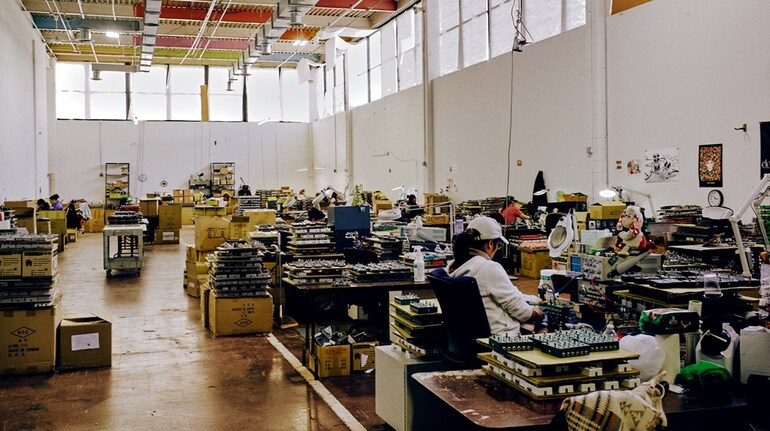
Those celebrating the US Supreme Court’s decision Friday to strike down President Donald Trump’s sweeping global tariffs are all part of a group of builders of the small stomp boxes that musicians use for their rock ’n’ roll sound. The manufacturers, who are spread across the US and typically compete against each other, formed a support group last year to share advice for surviving the tariffs, swapping tips on Zoom calls and over email.
While Trump responded by imposing a 10% global levy, then said a day later he’d increase it to 15%, the guitar-pedal group was celebrating for now.
“I’m having a great day so far,” said Julie Robbins, who started the group and was at a post-Pilates massage when the Supreme Court’s 6-3 ruling hit Friday. “I got out of the massage to see all the news. I’m elated.”
Robbins, chief executive officer of EarthQuaker Devices in Akron, Ohio, has been an outspoken critic of the tariffs. Last May, she testified before the US Senate Committee on Small Business and Entrepreneurship, telling lawmakers that the soaring prices she was paying for printed circuit boards and other components subject to the tariffs — parts unavailable or too costly to source domestically — were pushing her 35-employee company to the brink.
The Supreme Court said that Trump exceeded his authority by invoking the federal International Emergency Economic Powers Act, or IEEPA, to impose his “reciprocal” tariffs around the world as well as targeted import taxes his administration says address fentanyl trafficking. Trump told reporters Friday that the justices in the majority are “very unpatriotic and disloyal to our Constitution.”
EarthQuaker — which makes distortion, delay and other effects pedals used by Radiohead, LCD Soundsystem and far-less-famous bedroom guitarists — raised prices on 10 of its 42 stomp boxes on Jan. 1 to soften the blow from the tariffs after holding out on lifting prices for months. Robbins had been planning another hike, on other pedals, for sometime before the end of May.
“I don’t think we’re going to need to increase prices again this year, which is great,” Robbins, 46, said. EarthQuaker might also be able to bring a part-time marketing employee on full-time, she said — a move that the tariffs had prevented her from making.
The tariffs have been especially painful for manufacturers with fewer than 100 employees, which account for 93% of the roughly 240,000 US industrial firms. Unlike giant conglomerates, small factories tend to lack the cash reserves, lobbying influence or supply-chain flexibility to absorb steep tariff hikes or pivot production quickly. The niche guitar-pedal industry offers a window into the economic toll on such firms.
One member of the Pedal Builders Support Group — the one who emailed the initial “just won the tariff case!” — was indeed a literal winner in the lawsuit. David Levi, owner of MicroKits in Charlottesville, Virginia, worked with the Liberty Justice Center to become a plaintiff in the initial complaint filed in the US Court of International Trade in April.
“We somehow ended up all the way to the Supreme Court — and won,” Levi, 32, said in a phone interview shortly after the decision was announced.
MicroKits, which Levi started in 2020, makes do-it-yourself kits that allow children to build their own theremins and pocket-size synthesizers, offering a way to get musically inclined kids interested in engineering as well. Much like EarthQuaker, the company assembles its products in the US, but relies on components from overseas.
“I try to do as much as I can in-house,” said Levi, who employs three people including himself. “Some people think tariffs might help in that situation, but tariffs don’t help — even though I do more production in the US than some people do. Because there are some parts you just can’t get domestically.”
The tariffs have hurt MicroKits, which was expanding quickly before the levies were imposed. The company slowed its purchase of components as the tariffs boosted prices and cut one worker’s hours, resulting in fewer kits being produced. MicroKits had been growing 30% a year, but last year it shipped just 12,000 units, down from 16,000 in 2024 — a direct result of the tariffs, Levi said.
“I’ve had to figure out how to survive,” he said. “At the end of the day, there are thousands of fewer people getting my product.”
The full impact of the Supreme Court ruling remains unclear. Left unresolved by the decision was how tariffs already collected would be refunded, kicking off what could be a prolonged battle to recoup as much as $170 billion paid to the US government. Justice Brett Kavanaugh, writing in dissent, wrote that the process is “likely to be a ‘mess.’”
“It still leaves me with a lot of questions — logistical questions — on how things are going to play out,” Robbins said. The tariffs EarthQuaker has paid were included in bills from component suppliers, meaning those firms, and not EarthQuaker, covered the costs before passing them on. Robbins also had to pay brokerage and processing fees that accompanied the tariffs. “Will those be refunded as well?”
In a group email, a member of the Pedal Builders Support Group put the question a bit more succinctly after the initial jubilation died down: “Where’s my Check?!?!?!?”
Discover the latest Business News, Sensex, and Nifty updates. Obtain Personal Finance insights, tax queries, and expert opinions on Moneycontrol or download the Moneycontrol App to stay updated!
Find the best of Al News in one place, specially curated for you every weekend.
Stay on top of the latest tech trends and biggest startup news.





