








While French President Emmanuel Macron was in India from February 17-19 for the India AI Impact Summit and to launch the 2026 India-France Year of Innovation, he also visited India Design ID in the Capital. In its 14th edition, the design expo-cum-symposium India Design ID is organized around the theme of “The Age of Design Syncretism”, with France as the country of honour. But what is design syncretism, and what does it look like in the 21st century? What does it entail in a post-colonial world? And in a world on the brink of faster and bigger technologies and breakthroughs in materials and methods?
To be sure, as with most other fields in 2026, design is at an inflection point. Not just because the world is finally breaking out of a Eurocentric and West-centric view of itself. Not just because buyers in India and China are now exerting a larger influence over what gets made and how. Not just because the Global South is asserting itself more — and not just as a market for goods made here and elsewhere. And not just because artificial intelligence or AI is changing the way we look at materials and opening up possibilities for how to build more sustainably.
On the sidelines of 2026 India Design ID, Moneycontrol asked Mateo Kries — director of the Vitra Design Museum in Germany which is still the custodian of some iconic designs by Ray and Charles Eames, Alexander Gerard and George Nelson who designed the now-ubiquitous L-shaped desk for executive offices — about design syncretism, its past, how it looks different in 2026 and what takeaways design archives like the one at Vitra Design Museum hold for the future. Edited excerpts:
You’ve written a book on American designer and architect Alexander Girard, who drew on the Global South for inspiration. Ray and Charles Eames, who had a long business engagement with Vitra, found the design of the Indian lota fascinating. Some of the biggest collectors for art by Jangarh Singh Shyam during his lifetime were in France. Obviously, art and design influences have crossed borders and oceans before. Is design syncretism today a logical progression of these cross-cultural interactions, or is there an inflection point / break / massive change in how it translates in 2026? In short: is design syncretism a new idea or is it taking new forms in 2026? In what way?
The blending of cultures and styles has always been part of the design world. In the 19th and 20th century, syncretism in design has been less controversial and was dominated by Western perspectives. Today, we are more sensitive to cultural appropriation and we’re asking more critical questions: Whose culture is this? Which power structures are reflected? On the other hand, cross-cultural references have become very common and we take them for granted. It can be rewarding to look at the many layers of meanings and cultures that an object includes.
How important are market forces in this kind of syncretism? For example, does this syncretism relate to a broader move away from Eurocentric and West-centric approaches; given that, for much of the 19th and 20th centuries, those were the primary markets that products were being designed for?
Certainly. With the sheer market power of countries like India and China, the design vocabulary is changing. This can refer to specific materials, ornaments or forms, but also to entire practices like crafts that are being revisited in these countries from a contemporary perspective. But we have to differentiate between the market’s perspective — which is mainly driven by commercial success — and the cultural perspective of curators or museums. The latter is often more critical towards consumerism and market forces, it favours sustainability, diversity and something I would call purity of form and function.
Scientific discovery and technical innovation have historically had a massive impact on design. An example that comes to mind is how the invention of plastic in the early 1900s changed product design forever. Or how high-pressure injection molding enabled the creation of the all-plastic monobloc chair that is made from a single material and therefore easier to recycle. Is there a scientific discovery or area of invention that you are currently watching as potentially having a similar impact on the world of design?
We are just about to start developing industries built around recycling and circularity that will hopefully lead to a more sustainable use of materials. Also 3D printing will become an integral part of production — not as a tool for gimmicks, but as a technology that informs an object’s aesthetic and can lead to more diversified industries that combine digital and manual labour.
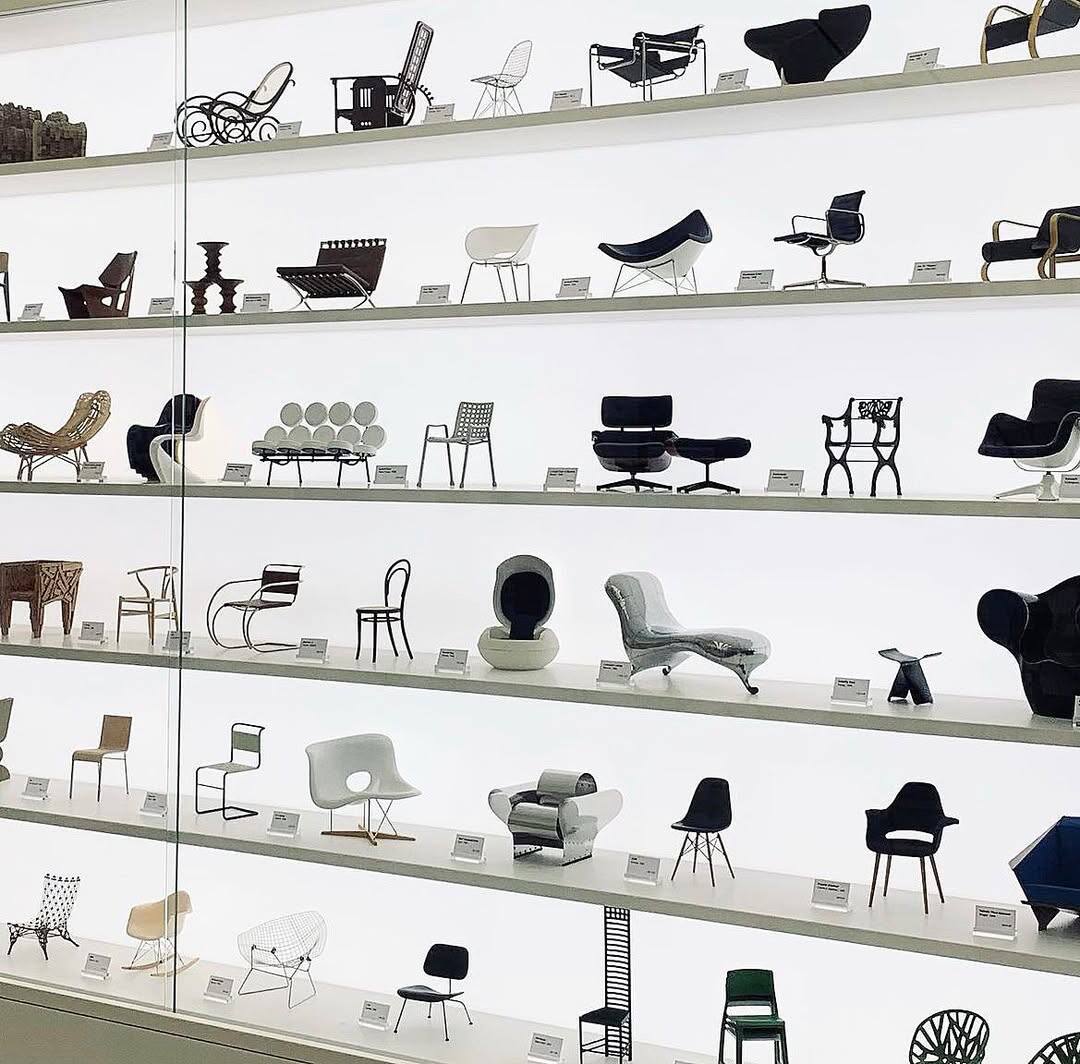 Miniature furniture at the Vitra Design Museum in Germany. (image via Instagram)
Is artificial intelligence (AI) something you are keeping an eye on with respect to what it is doing or could do for design? What excites or worries you most?
In certain areas, AI can lead to real improvements, for example in medicine and research. It can simplify cost-intensive processes of selection or putting together a simple podcast, for example. But real design cannot be generated by AI — it would always lack the edge and the human factor that only humans can produce. Design is not only the average of all previous designs, it is a spark of imagination, of magic that suddenly appears and makes an object or an idea stand out. And I am not even talking about the challenges that AI poses for designer's intellectual property, which is their main capital.
The Doshi Retreat at Vitra Campus opened some five months ago. Tell us a bit about how you see Indian architect B.V. Doshi’s contribution to design.
Balkrishna Doshi has bridged cultures and epochs. As someone having still worked with Le Corbusier in Chandigarh, he had gone through the classical phase of Modernism, but deliberately left it for something new that only he could imagine: a blend of the modern aesthetic with vernacular and traditional architecture, which led to a deeply humanistic design approach. He taught us that to find your artistic path, you need to find your personality while putting your ego in the background. He brought architecture into the age of mindfulness and self-awareness.
Looking back at the designers associated with Vitra in the 20th century — from George Nelson and his focus on office storage, including the now-ubiquitous L-shaped executive desk; to Jasper Morrison’s pared-back, essentialist approach — what stands out is that they were solving real challenges in the world, not just creating beautiful objects. What three or four ideas or approaches from this history of product design do you think we can and could carry forward into the future? Why look back at all at this archive today?
To name just a few of the approaches that had an impact beyond just furniture design:
- The Eames’es hands-on methods of experimentation and prototyping, which — besides leading to some of the most outstanding furniture designs of the 20th century — anticipated the strategies of the Californian start-up culture that was to emerge one–two decades later.
- Alexander Girard’s and Hella Jongerius’ re-introduction of colour and ornament into contemporary design
- Jasper Morrison’s no-nonsense design approach that re-introduced honesty and simplicity into design in the late 1980s
- More recently, the Brouroullec brothers who combined a highly artistic sensitivity with engineering skills and organic forms
We live in an epoch where real innovation has become rare. Do we really need another chair? Looking back at how great designers of the past have identified the problems of their time and came up with solutions can help us do the same today and produce relevant design — not just another variation of something that has been done before. We are facing a lot of challenges in today's world, and design and designers need to tackle them with great commitment and seriousness.
Have you been to India before? What you are especially looking forward to seeing or doing on this visit, beyond India Design ID?
I have been to Ahmedabad when preparing the Balkrishna Doshi exhibition. We sat in Doshis’ garden and talked about many things, and equally rewarding was the exchange with his grand-daughter Khushnu Hoof and her German husband Sönke, both equally great architects. This time, I am visiting design studios, museums, schools and will try to take in as much as possible. I will also go to Chandigarh, which has been on my list for a long time.
2026 India Design ID is on from February 19 – 22 at the NSIC Grounds in Okhla, south Delhi. This is a ticketed event; prices vary by package and number of days of access.

Discover the latest Business News, Sensex, and Nifty updates. Obtain Personal Finance insights, tax queries, and expert opinions on Moneycontrol or download the Moneycontrol App to stay updated!
Find the best of Al News in one place, specially curated for you every weekend.
Stay on top of the latest tech trends and biggest startup news.





