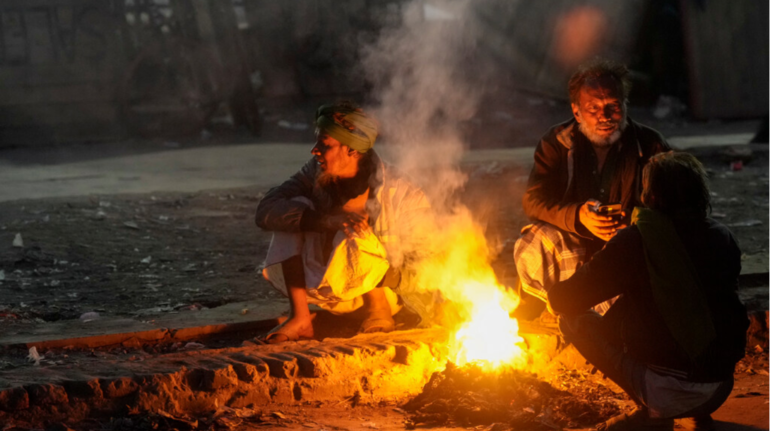

A stark and unusual meteorological divide gripped northern India on Monday, with the plains of the northwest recording significantly lower minimum temperatures than the hills - a phenomenon that has left the region in the grip of a severe cold wave and dense morning fog.
According to minimum temperature data from the India Meteorological Department (IMD), the plains witnessed a deep freeze. Amritsar plunged to 1.1 degrees Celsius, Churu to 1.3 degrees Celsius, Hisar to 2.6 degrees Celsius and Delhi’s Safdarjung observatory recorded 3.2 degrees Celsius, marking the capital’s coldest morning of the season. In stark contrast, popular hill stations like Mussoorie (7.7 degrees Celsius) and Shimla (8.8 degrees Celsius) remained notably warmer.
IMD Director General M Mohapatra attributed this inversion directly to prevailing weather systems. “A western disturbance is impacting the upper reaches so the night was cloudy. This is mainly why minimum temperatures are higher over the hills,” he stated, explaining that the cloud cover acted as an insulating blanket, trapping daytime warmth.
Persistent cold wave and dense fog
The IMD forecast offers little immediate respite, predicting that cold wave to severe cold wave conditions will continue over Rajasthan, Punjab, Haryana, Delhi, Himachal Pradesh and Uttarakhand for the next two to three days before abating. Dense fog is also very likely to persist during morning hours over northwest India and Bihar for the next five days.
Residents in Delhi faced a harsh start to the day on January 13 too, with an orange alert in effect for cold wave conditions and reports of dense fog disrupting travel.
While the maximum temperature is expected to reach 20-21 degrees Celsius under clear skies, strong northwesterly winds of 5-10 kmph will exacerbate the wind chill.
A region parched for moisture
This cold snap occurs against the backdrop of an alarmingly dry winter for northwest India. The region is experiencing one of its driest winters on record, with an 84.8% rainfall deficiency in December and an 84% shortfall in the first ten days of January.
The unprecedented dry spell, caused by western disturbances — storm systems that bring winter precipitation — bypassing the region, has created near-drought conditions across the Western Himalayas. Higher reaches of Uttarakhand have recorded no snowfall in January, a rare occurrence. Officials have indicated that the current western disturbance affecting the hills may begin to break this dry spell.
Technical weather systems in play
The IMD’s technical bulletin notes several active systems: an upper air cyclonic circulation over the Comorin area, a powerful subtropical westerly jet stream with core winds of 185 kmph over northeast India and the western disturbance over the Western Himalayan Region. A fresh western disturbance is likely to affect the same area from January 15.
No significant change in minimum temperature is expected over northwest India for the next three days, with a gradual rise of 2-4 degrees Celsius anticipated over the subsequent four days. However, isolated pockets over Uttarakhand, Punjab, Haryana, Chandigarh and Rajasthan are very likely to experience ground frost conditions in the interim.
Discover the latest Business News, Sensex, and Nifty updates. Obtain Personal Finance insights, tax queries, and expert opinions on Moneycontrol or download the Moneycontrol App to stay updated!
Find the best of Al News in one place, specially curated for you every weekend.
Stay on top of the latest tech trends and biggest startup news.